Healing Handcrafting


Leave a comment

Interview With An Artist~ Susanne Ryan of The Felted Gnome Knows

When I got into crochet and opened my Etsy shop, I was not part of a fiber community. I was inspired, energized and over-the-moon in love with making little funny creatures that made kids smile (and grown-ups). I would look at Etsy and marvel at the creativity and artistry of people all over the world, and often times, barely knew what I was looking at~ I had no idea what needle felting, wet felting or even fulling knitted items were! I was super green.

Until: Susi.

One day, I got an email through Etsy from someone who had an Etsy shop too, called The Felted Gnome Knows. The artist behind this great shop is Susanne Ryan, aka Susi; she introduced herself and I immediately realized that I had already been admiring her work. Her pieces are whimsical, gentle, and inspire creativity. And she lived just a couple of towns away from me! I had no idea what needle felting was at that time, but would see pictures of needle felted creations and ache to understand how they were made. I cannot remember the first time Susi and I met face-to face! Isn’t that funny? In no time at all, though, we became friends. And then we took our first trek up to Mountain Fiber Folk together, which changed my life in so many ways.

I recently sat down with Susi and asked her questions about her art, her craft, her opinions on fiber, her history, and I wanted to share our conversation with you.

The Interview:

HH: I feel like the process of working with wool inherently is soothing and centering. Obviously I’ll want to get to that, but first, can you tell the story of how you came into fiber art?

SR: Several years ago, my husband was transitioning into a new phase of his work life and consequently money was tight. We have a very large family, and that, for some reason, was the year that folks decided that we were going to get a little something for everybody. At that time, I was taking wool sweaters and fulling them down and making them into things. I was knitting and I had gotten a needle felting kit with my daughter at Kaleidoscope Yarn. It was to make little Santas. We made them, and there was something about needle felting where I thought, I could do so much with that.

Interestingly, I wasn’t interested in spinning wool at all. I started with needle felting and then went into wet felting. Initially, I found that there were not a lot of stores in the area that carried felting supplies. The area store that did had classes that were at times I couldn’t go. Also, there are some who are very ready and willing to help people learn things and some who are not, so I ended up learning a lot on my own.

Around that time, I ran into Leslie Lewis (Ewe Who Farm), an old friend from my school days, and we reconnected. Over time, she made a quilt for Maggie and told me about her sheep. So, after seeing that options were limited in terms of local stores helping with my fiber questions, or simply not having the supplies, I contacted Leslie again and asked her if she sold her fiber, and she said “Yes!” I had already been going to farmer’s markets and buying wool from farmers, but getting in touch with Leslie is really what started my seeking out of local farmers to buy fiber from.

When I was at Kaleidoscope yarn, I remember them handing me a brochure for Mountain Fiber Folk, so when I met you I said, you know, I’m going to go up there. I had gotten to the point where I wanted to buy local. I’ve always been interested in and shopped at farmer’s markets, and was involved in getting a farmer’s market in my town. I’ve always felt strongly about that. If you support a local business, they support local and your money goes back into the community.

Going up to Mountain Fiber Folk and seeing what they were doing and how they were doing it was very encouraging in terms of what I wanted to do.

I’m all self taught. I’ve only recently started taking classes this year for things that interest me like the masks and the clothes.

HH: And those classes are very specialized, right? This is a commitment to taking your craft to a whole new level.

SR: Yes, they are advanced classes. It’s interesting to meet all of these women who are so big in the fiber world. I thought Gladys Paulus and Anita Larkin, being in the upper echelons of the felting world, might not be approachable, but they were very down to earth and accessible. This is a passion for them.

HH: Oh yeah, it’s totally a passion! It grabs you and doesn’t let go! It is so inspiring to see what artists do with fiber. It seems infinite, the possibilities.

SR: It’s not going to support you… part of that is that people have no idea how much work goes into making needle felted sculpture, or hats and slippers. They take hours and hours, and sometimes many days. Especially when you take into consideration that often times, I’m getting these fleeces processed by Michael (of Hampton Fiber Mill), or processing them myself. I tend to be a very particular when it comes to skirting and cleaning a fleece, so that takes a lot of time! But you know, it’s frustrating when you pay for roving or batts and you’re picking out veggie matter!

And also, people are really getting a full-on, Vermont-made piece. Needle felting has become popular, so overseas companies are mass producing felted figures and selling them cheaply which makes it difficult for the consumer to understand why local pieces like mine are higher than other felted products. 

HH: I was thinking about the social and political aspects of fiber art yesterday when I was dyeing wool with kids at school. There is so much to think about and make choices about when it comes to where we buy our supplies, how we process our fiber, and where we spend our own money. It’s a whole mind-set.

SR: I also think too, in Vermont, we are so focused on the maple producers, and the organic food movement, people forget that there are a lot of sheep and goat people out there that are struggling. They have a wonderful renewable resource that is not being tapped into or marketed appropriately. Not only can we make clothing with it, but it can be used for insulation, you can compost it…. There’s so much you can do with this product. These people are living from hand to mouth, all for the love of their sheep!

HH: What do you think it is about working with fiber that makes people so passionate? Or, what grabbed you about working with wool?

SR: There’s something very earth-bound about it. It’s very grounding. There’s something about wool that’s very… I think it’s the same as gardening… it puts you back in touch with the natural side of the world. You are woking with a natural product that is renewable. It’s warm and it evokes a sense of homeyness and tradition. There’s something magical about it. You know, you can twist it and it becomes yarn! It magically transforms! There’s a whole magic to it… like alchemy.

I also really dig the fiber community. They’re really very down to earth people. Most of them, I have to say, especially those who raise their own animals, are very warm and open and generous about their knowledge.

HH: Isn’t that what was so wonderful about Mountain Fiber Folk? I walked in there that first time knowing nothing about handspun yarn, and walked out completely moved. Next time we went, I left with a drop-spindle that Ruth so generously helped me to figure out.

SR: It sucks you in! If you talk to Michael (Hampton Fiber Mill), he’ll talk about how he learned to knit from his grandmother, and then from there, he learned to spin, and then the next thing you know, he wanted to process fiber!

For me, I can tell you all about breeds and good wools for different projects! For some reason, I can retain this information. Who knew? I make the comparison to my father; he’s really into physics and he starts talking about it and everyone glazes over, but he’s so passionate about it. My sister says I’m like our dad….”you and the sheep, man!” I get so excited about it and want to talk about it, but nobody cares! That’s why it’s so great to get together with other fiber people who get it!

HH: I have to ask this… I know for me, I get around handspun yarn, and I must smell it. I can’t help myself. It’s an automatic thing I do. Do you do that?

SR: No, I don’t smell the wool, but I love to touch it and see the luster and sheen. I want to feel the coarseness of it. I don’t mind the smell of lanolin or raw wool at all. I do have to say, I don’t like skirting at all. There’s a big thing about not using chemicals to get the veggie matter out of fleeces. Well, you don’t have to use chemicals. You just have to be really detail oriented and pick the stuff out! The fiber you and I put out, it’s clean! But you’ve seen the fiber that has a ton of vegetable matter in it!

HH: You have to front load time and effort into preparing the wool. That’s the invisible work. There’s so much dirty work. And you can’t use “chemical free” as an excuse for not being careful with your product.

SR: It was the experience of paying for roving that was filled with veggie matter that really pushed me into preparing my own wool. Now I’m selling kits and supplies and it’s kind of exploded!

HH: What’s your favorite thing to do now? If you’re looking to spend the day however you want, what would you do?

SR: Making a hat. Making whatever kind of hat I want and not worrying about it if it turns out.

HH: What’s your favorite hat you’ve made?

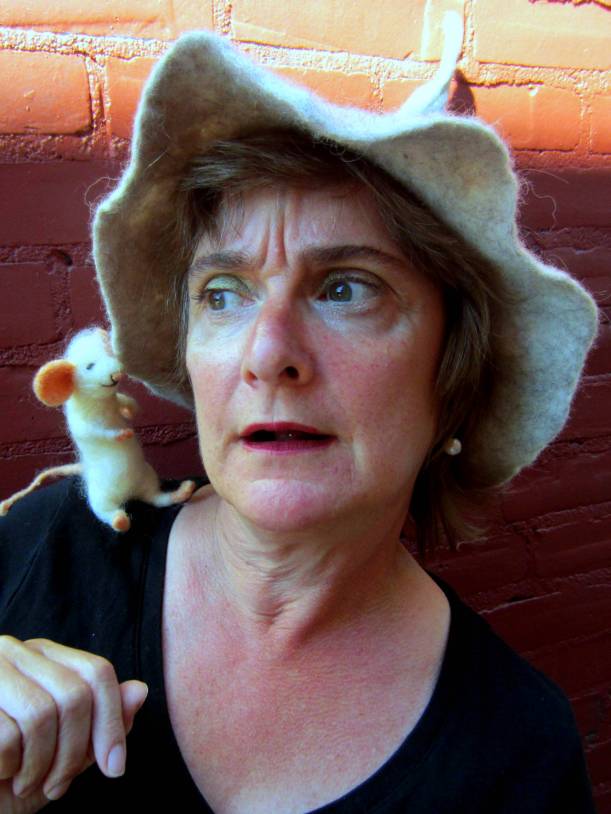
SR: I have two: the felted Gnome Noggin hats, and the Ratagast hats. I love those two. Those are original designs. I make my hats with wool that some would not use for that purpose, but I line them with fleece. You know, I think I’m different than a lot of felters because I think merino is overrated.

HH: What fibers do you like to work with right now?

SR: Border Leicester, Gotland, Romney and Icelandic. With Icelandic- if you take the time to separate out the outer and inner fibers, the under coat is just as soft.

HH: Did you do handwork when you were young?

SR: No. My entire family is like, who knew?! I think what it was is I was never interested in the packaged craft kits available for children when I was young. I was always into the arts, but not in a very public way. I did win a poetry slam when I lived in the Carolinas and I was always around artists and musicians. I did do a lot of theater, too. But it wasn’t until I found felting that I found my medium. I did teach myself how to sew and knit, and I had the ability to put things together, but this really was the first medium where I knew what to do with it without having any prior introduction.

HH: What’s on the horizon for you? Anything you are looking forward to tackling?

SR: I want to fool around with very freeform clothing. I took with Linda Veilleux that was incredible; she’s an amazing artist. I am not as meticulous as she is, and I am learning why it is important to take careful measurements, but I want to play around with shapes and turn them into wearable, freeform clothes. I’m not really interested in making vases. It needs to be wearable or functional. If I’m going to do a sculpture, I’m going to needle felt it. I do like the idea of marrying wet felting and needle felting. Anita Larkin is a wonderful artist~ she stitches pieces together and wet felts them. Those types of ideas are interesting, but I’m also figuring out how to support my habit.

HH: So, you’re done with the holiday fairs…

SR: Yes, but I’ll be at the Stowe Renaissance Fair in the spring. I’m going to make hats for that.

HH: I know where I’ll be seeing you in the spring! I love a good Renaissance Fair and seeing your hats, and you!

Check out Susi’s links to her Etsy shop, her Facebook page, and her website. She keeps them up to date on where she’ll be and what classes she’ll be teaching.

Thank you, Susi, for taking the time to talk with me!
IMG_6767


Leave a comment

Busy, Busy, Breathe

It’s been busy. But not the same kind of frantic busy I was experiencing leading up to the holidays. That got bonkers. I seriously need to work on chilling the hell out in the months leading up to the holidays; has it always been like that? I don’t remember my parents seeming frantic when I was a kid pre-Christmas. Maybe they were and just hid it, or my siblings and I were comfortably and age-appropriately self-centered enough to not realize all that was going on for our folks. I don’t know. 

I am now fully committed to getting real peaceful with what I can do and what I can’t,  and what I want to do and what I don’t. I’ve definitely been reckoning with the fact that I could have done many different things in my little life, and that I’m a person with a bunch of interests. I’m often grabbed by something- an image, a topic, an idea, that with infinite time and energy I’d maybe be able to do something with. But I don’t have infinite time or energy, and I have certain commitments and have made certain love-filled promises that remain firmly at the top of the what I am doing list. 
Anyway, I’m noticing that busy-ness is not feeling freakish of late. I think maybe after paring down and getting realistic, the responsibilities and endeavors that keep me busy feel much more grounded in the truth of my skills and my limits. Melancholy and peacefulness can live together, surprisingly. Letting go of desired but untenable pursuits is sad, but the process of doing so opens up energy and time to do what’s right in front of me, what is fueled by inspiration and honesty. 

I guess those are my thoughts on this chilly Wednesday. 


Leave a comment

Hopes For A New Year

This Year:

I Wish For The Calm to Remember to Breathe and Look Around 

IMG_6474

I Hope to Listen to the Stirrings of My Soul and Respond Accordingly, With Courage, Not Urgency

IMG_6242

I Long to Expand Into and Learn More About Fiber Art, Spinning Wool and Doing Tricky Stuff with Crochet Hooks and Knitting Needles

I Look Forward to Learning From and Talking To Fiber Artists Who I Admire, Who I Love, Who I Barely Know and Who I Have Not Met Yet

I Will Remember Every Single Day to Honor the Blessings In My Life and To Really See My Children As They Grow and Change

IMG_6457

I Plan To Make More Handmade Gifts That Are Filled With Love and Intention, For People I Know and People I Don’t

FullSizeRender-47

And, This Year, I Promise to Trust Myself More and Make More Time to Imagine, Make and Create

Happy New Year to You!


Leave a comment

Knowing One’s Landscape

This summer, I contracted Lyme Disease. Mid-July, when I was feeling better than I ever have in my adult life, but for the achy joints and stiff neck, a big ole rash showed up on my back. I figured it was just a horsefly bite, but by the next day, it took on the tell-tale bulls-eye shape, and my symptoms went from mildly annoying and easy to pass-off as over-exertion from running and exercising to being really, fully and wholly awful. Before this, I was out in our field, our woods and our yard very often, looking for flowers and other things that I could throw into a dye pot. I have ridiculous amounts of wool to dye, and I made it my job to experiment with as much as I could.

IMG_4825

I don’t know where I picked the tick up. I didn’t know I had the bite and only recall asking my husband to see if there was something on my back a few weeks prior. He didn’t see anything.

Since then, I’ve been gun-shy about field flower-picking and woods walking. I look at my back woods and wish I felt comfortable heading into that beautiful place, to look for fallen branches with bark I can use, or mushrooms I can harvest and experiment with. Just yesterday, after cleaning my shed and periodically picking up hickory nuts to dye with, I picked a minuscule tick off of my ear. It’s so small, I can’t tell if it’s engorged or not, but I think it is, which means I likely got it somewhere else and not from my yard.

IMG_4826

Why share this whole story here? Well, because I’m aware of the possibility of fear getting between me and something I deeply long to do. I can tell you with all of my being that I don’t want to get Lyme Disease again, and I wouldn’t wish it on any other living thing. Ticks are this crazy, mind-boggling paranoia inducing creature. If I lived near leeches, I’d have the same issue with them. Remember that scene from Stand By Me? Oh no. I’d perish on the spot. Spontaneous combustion style.

Anyway, I want to forage, pick and search for beautiful things to use to dye beautiful wool and I’m realizing that a very important mandate is demanding to be respected. Know the Landscape in Which I Work. I learned how to think this way while training at the Assisi Institute under the tutelage of Michael Conforti, Ph.D. He lectured frequently about how, when working with people, with dreams, with story and with symbol, that one must understand and be acquainted with the qualities and specifics to the given place, person, animal, landscape, etc. Know the landscape. This applies to all things. To teaching, to business, to swimming… Take swimming: the rules that apply to swimming in a pool are inherently specific to swimming in pools and different than rules that apply to swimming in rivers. And oceans. There are different mandates that apply to these different settings and one must honor them in order to navigate the waters safely and with success. Swimming in an ocean demands having an understanding of riptides, the sea-life specific to that area, tides and weather. One need not know these same specifics in a pool, but one must know about depth of water before diving, as well as whether it is salt water or chlorinated (some people are allergic to chlorine). These are not exhaustive lists, but you get the idea.

The same is true for gathering flowers and plants. One must know where one is in the world, what animals rely upon the plants one is gathering, how much of a plant can be taken without threatening future growth and what plants might have irritants (ever pick stinging nettle? That’ll ruin a couple of hours in a day if you don’t handle it properly). And, of course, when walking in nature, one must know of any possible dangers. I don’t live out west, but if I did, and if I were walking in very remote areas, I’d want to know about bear, cougar and snakes. Here, in Vermont, I want to know how to identify signs of bobcat and coyote. I know they aren’t likely to harm me, but they could do some damage to my cat who follows me everywhere on our property, and frankly, I’m not interested in running into larger predators with my kids. And ticks. I have to understand ticks and how to prevent tick bites, even when I’m not doing the typical things that one thinks of as being “risky” in terms of ticky situations.

I’m seeing clearly how much I need to respect my environment, and understand it, to fully enjoy its beauty and offerings. Maybe a full and comprehensive understanding will help me gently nudge my fear into caution.

IMG_2092


5 Comments

Let Me Introduce Myself

Hello to you, and thank you for taking the time to read this blog. I have been hovering over the idea of writing about the healing effects of working with fibers for a long time, and often dissuaded myself from taking the leap into blog-land by telling myself things like:  there are so many blogs, why add another? or, can anything new be said about the soothing and healing nature of handwork?, and of course the ultimate killer of ideas and new projects, am I “expert” enough to write about fiber art, fiber craft handwork and psychology? Well, let me make my admissions and explanations here so I can get on with it!

I am a psychologist and have been working in the field in a variety of ways since 1999, although I took a few years off to be home with my children. I love the work, and I love thinking about being a person and all that goes with it, in the mind anyway. I have a particular interest in Jungian psychology, dreams, developmental stages and all of the archetypal power that is alive and working through us as we navigate the tumultuous waters of growth. Being a psychologist and therapist has become part of who I am. It is creative, dynamic and can lead a life and profession in myriad directions. I know that I will be studying for as long as I can.

I am also passionate about, and grateful for, my love of working with wool and other fibers. I crochet, knit, spin wool and other fibers into yarn, dye wool using natural and synthetic dyes, and dabble in macrame, weaving and needle felting. I am not an expert in these crafts and I am learning new things all of the time. When my two children were 3 years old and 6-months, I began taking them to a lovely Waldorf  style playgroup. It was there that I began knitting again, after many years of forgetting about my knitting needles in the back of my closet. I was delighted to learn that I could knit balls for my children to play with, and then stuffed animals from patterns. As I learned more, I decided to pick up crochet, which opened up a whole new world for me. For some reason, I felt more confident with crochet and found that I could easily improvise and make up my own patterns. Friends liked them and started buying them! One friend in particular encouraged me to open an Etsy shop, which I did. It is called Jabo and Belles: Handmade. Well, that was really fun! 

After a short time, I serendipitously met who has become a dear friend, Susi, who is The Felted Gnome Knows. I owe a lot to her, as she introduced me to a group of wonderful women who run Mountain Fiber Folk, a fiber and yarn cooperative in Montgomery, Vermont. I did not know about handspun yarn before walking into MFF. Not really. I didn’t know how incredibly textured yarn could be: curly locks, thick and thin, chunky and smooth, vibrant, filled with personality, scent and the essence of the very animal from whence it came! I really did not know until that day how earthy and grounding yarn could be. Some of the women who make up the cooperative have their own animals from whom they collect their fibers. Sheep, alpaca, llama, rabbit, goat… it’s all there and it thrilled me to the core. The women there also affected me deeply. They are creative and fun and extremely generous with what they know. After my third time visiting, I asked about how I might learn to spin wool and received a lesson right then and there on how to use a drop spindle. I worked with that for a while but knew a spinning wheel was in my future. My friend Susi (thank you, Susi!) told me about another friend of hers, Leslie, who has a farm, sheep, and spins their wool into beautiful yarn. She suggested I contact her to see if she would be willing to give me some lessons. Leslie was kind enough to do so, and again, I had the great blessing of meeting a woman who shared her knowledge, was patient and deeply passionate about her sheep, her yarn and her fiber art. She is a freaky-good knitter! And quilter. Whoa. 

For my 40th birthday, my mother gave me my spinning wheel, an Ashford Traveller. When it arrived in the mail, I could hardly contain my excitement.  I did not take the time to look at all of the paperwork it came with because I was so impatient to start (that is relevant for reasons you will see later). When I tried spinning the first many times, I could not believe how much I could not do it! This reality was maddening and frightening because I wanted to spin wool so much and had worked up a whole bunch of expectations around “getting it”. Finally, after many deep breaths and a lot of swearing, I got it. It wasn’t beautiful, but I got it. And I got it some more, and then some more. And soon, I was spinning wool every night and at times during the day when my children were napping or otherwise happily occupied (spinning wool with an unhappily occupied young person around is really very impossible). I soon realized that spinning wool in the evening was one of the most relaxing and meditative practices I had done in years. I felt noticeably more calm and at peace with whatever was transpiring in my life. I started learning more about various animal fibers and different spinning techniques. I also started seriously thinking about how much my life had changed since I began knitting again, and how therapeutic I was finding all of these crafts. The psychologist hat came on, and I began to wonder, “if these practices are helpful for me, is it possible that there are some inherent qualities in them that lead to healing? Is it possible to use these crafts when working with other people in therapy?”

Sometime after those thoughts began percolating, I was cleaning up some papers and periodicals on my desk. I started to thumb through one that came with my spinning wheel. I suddenly read the words, “Weave Away the Blues”, by Dr. Ann Futterman Collier. WHAT?! The first sentence of her piece reads, “About 10 years ago, I noticed something interesting in my textile-making: as I made handcrafts, I was transformed into a better “mental” place.” You can find her article in “the Wheel: Ashford’s Fibrecraft Magazine”; Issue 23, 2011. Well, I was transfixed! I laughed out loud, and I may have cried a little as I read her article. There it was, right in front of me and I knew then that I could learn so much more about this whole phenomenon. My two worlds met in the middle and did a high-five. Since then, I’ve read and re-read Dr. Collier’s wonderful book entitled, Using Textile Arts and Handcrafts in Therapy with Women: Weaving Lives Back Together. I’ve also started to move more into understanding what this is all about, why handwork and fiber art is such a powerful medium for healing and transformation, and how it can be used in working with others.

I hope this serves as a good-enough introduction to me and to the purpose of writing on this blog. Healing Handcrafting is not only for psychologists or therapists, or for fiber artists and handcrafters. I believe there is a powerful message and meaning in the fact that fiber arts and handcrafts are so popular right in the United States and around the world. I believe that in this culture of infinite busy-ness, many multiple ways of being contacted and contacting others through short sentences, “likes”, texts, emails, landlines, cell phones, etc, we are actually completely overstimulated and remarkably unconnected. I think that many people are longing for ways to calm down their lives, reconnect with themselves again, or for the first time, and engage with other people in real-time, with eye-contact and in ways that tend to the spirit and the soul. Working with fibers in all the ways one can grounds us, opens doors to our distant ancestors as well as possibly to our mothers, our grandmothers and great-grandmothers. There is something about fiberwork that is honest and eternal. It is from this vantage point that I hope to offer my thoughts. I’ll also share my own work and process and things I learn along the way.

 ~ Bradie