I wanted to share this incredible article about the healing power of joining, in a circle, with other women and crocheting, for asylum seekers who have been traumatized on their road to safety. I will truly never, ever understand the horrible unfairness in the world. I gaze upon my children, my husband and myself and marvel at the difference between a bad day for us versus a bad day for people who are literally fleeing their homes to save their families and themselves. It borders on absurd and is, inherently, excruciatingly upsetting.
Nothing can capture the title of my blog better than this article can.
We are in between seasons right now, here in Vermont. When I first moved here from Florida, I heard the term “mud season” and didn’t understand what people were talking about. Living in Burlington at that time, and not venturing much out of the city, I had little occasion to experience Mud Season head on. Now, after almost twenty years here, I get it.
The ground thaws (not too hard this year, after such a mild winter), the red wing blackbirds, robins, cardinals and cedar waxwings make an appearance in our yard. Large flocks of geese sail overhead, their calls to one another feeling like a call to my spirit, encouraging and light and commemorative of a winter gone by. The air smells clean and wet. Sugaring begins. The mud, it adds inches to my height, and a wobble to my walk when I muck around in the yard, this year imagining my cleaned up garden beds, a hoped for herb spiral, and a dyer’s patch. The need to vacuum much more frequently to prevent the brought-in-the-house mud, dirt, pebbles and sludge from making its way to the carpets is a fact. Why is taking one’s boots off in the garage so difficult?!
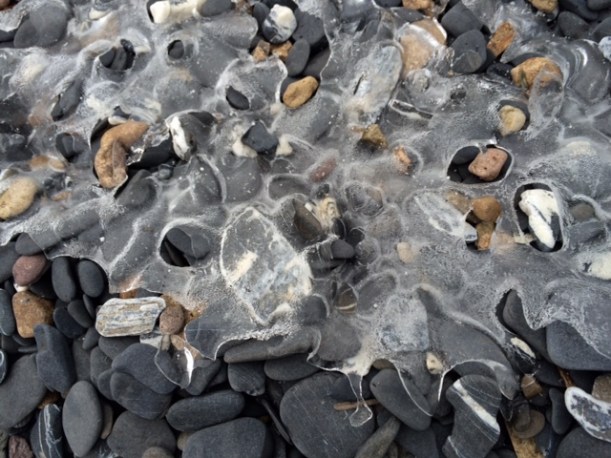
On a walk the other day down by Lake Champlain, the weather was the epitome of the “in like a lion” description of March. It was windy, rainy, snowy, icy… it was epic, really, and since I was dressed appropriately for such riotous weather, it was absolutely exhilarating. I laughed out loud in reaction to some especially strong bursts of wind, feeling not one ounce of embarrassment because I was alone. Down on the water, I could see Winter releasing her grip from the stoney shore.
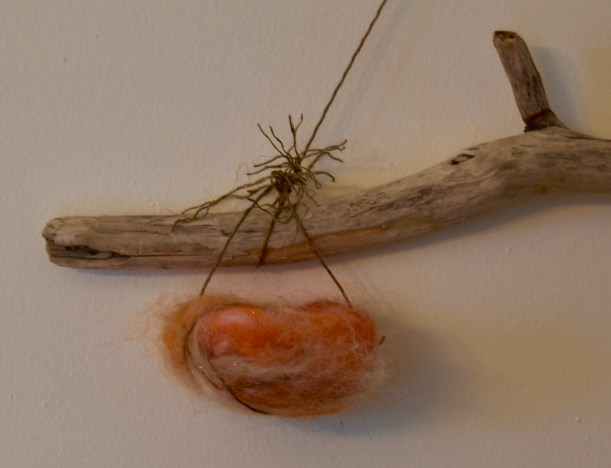
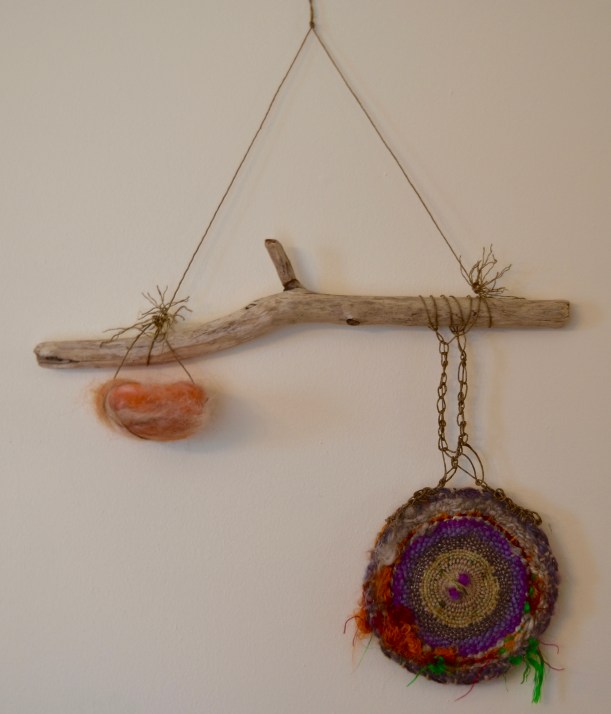
I found large pieces of driftwood that I harvested~ a project will happen with them, I am sure. Walking all the way back to my car with these water-logged, slippery gifts, against the wind, at a speedy clip (I was due to volunteer in my son’s class in just a little bit of time) proved to be the workout I needed. Sore and tired, wind-kissed and grateful, I was able to finish a project later that day that had been waiting patiently, in all of its scattered parts, for some attention.
I love working with my Majacraft cirucular weaving loom. I’ve been making completely random things with little bits of all kinds of materials~ sari silk, banana silk threads, handspun, conventional, thick, thin, chunky, wild yarns, twine and wire. I am fully appreciative of the process of beginning a circular weaving project, releasing into the hard job of finding clarity in the first few messy rounds. I can hardly tell the order of warp threads at first. Now I can predict how much time it takes for me to begin to worry that I’ll never get it straight, and then, voila, the foundation is set for my piece and I can relax with the ups and downs of weaving. Then, adding a new element creates its own new chaos, anticipated but surprising, nonetheless. Sometimes it takes another few rounds to straighten things out again, to hit that rhythm where predictability and order are available if desired.
These projects conjure similar feelings of excitement, tension and hope as Spring does, in all of her wild glory. They promise beauty out of chaos, like spring’s pungent dirt promises baby birds, more light, new growth, froggy smells and strong storms. Order from chaos, gifts from turbulence, beauty reborn. Laughing out loud at all this natural noise is such a relief.
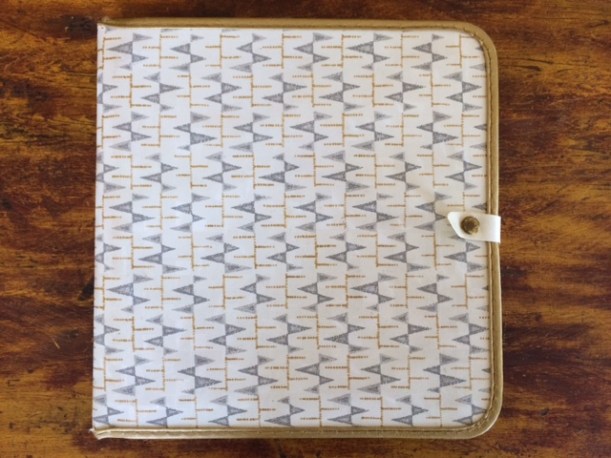
Last week, I received a box from my mom and grandmother. I call my grandmother Mema. Others in my family call her Meme, or is it Meemee? I don’t know. I have to call her Mema, because it’s what I have called her my whole life. Anyway, this box that they sent me contained some yarn that Mema is no longer needing, and some sweet treasures meant for my kids’ dollhouse. There was also a book, or binder, or container of some sort. I had no idea what it was when I first saw it, but when I opened it, I lost my breath.
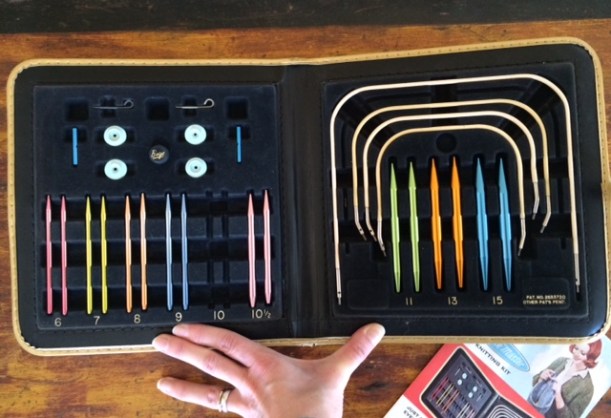
It was a vintage Boye Needlemaster Knitting Kit. I’d never seen anything like this before! The place holders, the circular needles that you could change out for different sizing. All kinds of cool stuff! I was truly overwhelmed when I saw it. Ironically, that very day I was struggling with knitting. I really want to up my skills and was having a hard time figuring out a pattern, or really, the stitches that were called for in the pattern. I had to put it down for a while and was lamenting my weak frustration tolerance. And then this came. Way to raise the bar, Mema!
Mema is a master knitter. She has some serious skills. It’s funny because I cannot recall a time actually seeing her knit when I was little, but I have seen the things she has made, and I remember hearing my grandfather speak with pride about how she worked on certain sweaters. Now that I’m older, I think I understand that he wanted to make sure we kids understood how much work and love went into the things she made, and that she was really talented.
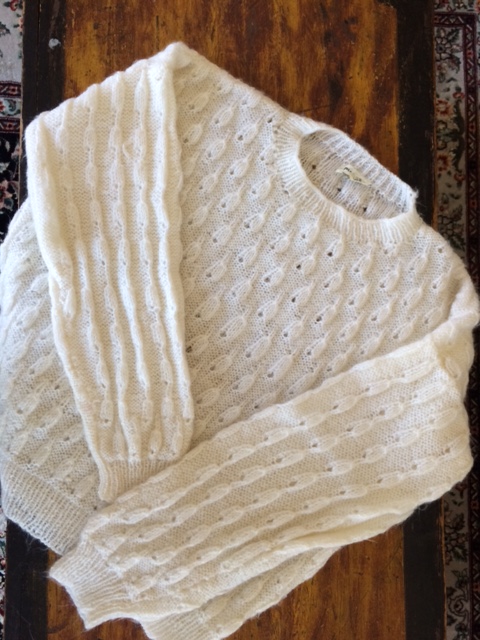
When I was in high school, Mema gave me this sweater.
I loved it then, but I definitely did not have a good appreciation for how complicated it was to make this. If you’ve read others of my posts, you may have read about my growing edge with reading patterns and understanding measurements and all of the technical stuff. This sweater is technical, and I can remember Mema telling me that she had to really concentrate when knitting it, counting and marking, and doing over… I love this sweater more now than I can even describe. To me, it means love, and commitment, and patience. It is soft and delicate, and very beautiful. And, now I have the knitting needles that were part of her arsenal of tools used to make such beautiful things. I feel so lucky.
I love how Mema made her own tag and wrote, “Made By Mee Ma”.
Mema in 1975
Mema with Pop Pop. They were so proud of each other.
Recently, I was having a conversation with someone I consider a mentor and a guide in my life. He said, “you can’t carry history with you.” We were talking about the kind of history that hurts, that isn’t yours to carry. Then I told him about the knitting needle kit Mema sent me. That is the kind of history I want to carry with me. Things that my grandmother touched and took such good care of, and used to make things with love, while sitting at night with my grandfather. Thank you so much, Mema.
I’ve gotten a bit behind in documenting the wonderful work my daughter’s class did in their woolen adventures. A few weeks ago, the “job” for the day was to card their beautiful, dyed wool. I wanted to share a bit about how we did it and how these young five and six-year olds fared.
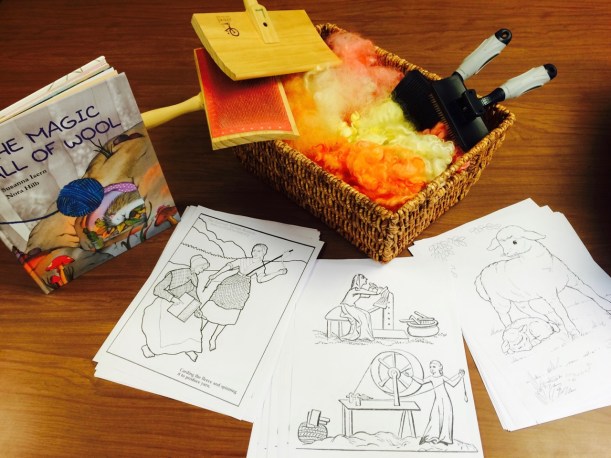
For the activity that day, I brought in my Fancy Kitty Drum Carder, which I love and adore. I was careful with it, and I had some rules: no touching it without me being right there, don’t crank it as fast as you can, no fingers on the carding cloth, and have fun! I also brought in some mini-hand carders (for this project I actually used small dog brushes (these are not the exact ones I used, but they are similar). I KNOW! CHEESY! But listen, they worked fine for this project, and they were affordable given the quantity I needed.) I brought in my regular sized Ashford Hand Carders as well.
The way we organized the class that day was to show a brief slide show talking about carding and what it actually means. Then, I met with about five children at a time. Around a table, they all had locks to start fluffing out. Once enough fiber was fluffed, I taught them how to load the hand-carders. While three students used the hand carders, one fluffed more wool, and the other started the process of carding on the drum carder. They all rotated through all of the jobs. I provided coloring pages for the kids who were waiting for their turn to card.
I have to say, the drum carder stole the show. Not one of the students was unimpressed with that tool, and all wanted to use it more. I wished I could have given them more time on it! The children were in agreement that adding different colors to the drum carder batt was the way to go, so by the time we got to the very last student, we had a gorgeous tutti-fruity looking batt that I wanted to spin so bad! Oh, the self-control!
Beautiful Batt!
Rolags Galore
I think that the kids really got to appreciate the time, patience and purpose behind carding wool. They all seemed to feel like they had put in a good day’s work, including my daughter, who’s seen this all a bunch. I was so proud of them.
I was out the other day with my kids and another family for a great lunch in an old-timey malt shop. This was on the table right in front of me:
It says: “We cannot live for ourselves alone. Our lives are connected by a thousand invisible threads, and along these sympathetic fibers, our actions run as causes and return to us as results.” ~ Herman Melville
I find myself thinking about this quote a lot right now, turning it around, wondering what Melville had in mind when he wrote it. I’m inspired by it, and I do find that my relationship with fiber is changing as I think about my connections with known and unknown people, how I interact with the world and what I expect from her, and how I long to participate in life. I’m feeling my focus changing and becoming more intentional. I feel like priorities are becoming more clear, although at times they pull in opposite directions, causing a strain for me, and a need for discernment. I’m becoming less upset about the reality that there just is not enough time to do all the things I want to. That is painful. So, the things I let go of… I have to be okay with them going… grieve them a bit… and allow the regained energy to fuel what is right in front of me.
All this from time well-spent at a malt shop, eating my most favorite ice cream flavor ever: peppermint stick.
If you told my 18-year old self that one day I would be more than delighted to treat myself and family to a brand new dish towel for Valentine’s Day, I would have probably swam to a different land in an attempt to start over, reboot, reset my course to avoid such a fate.
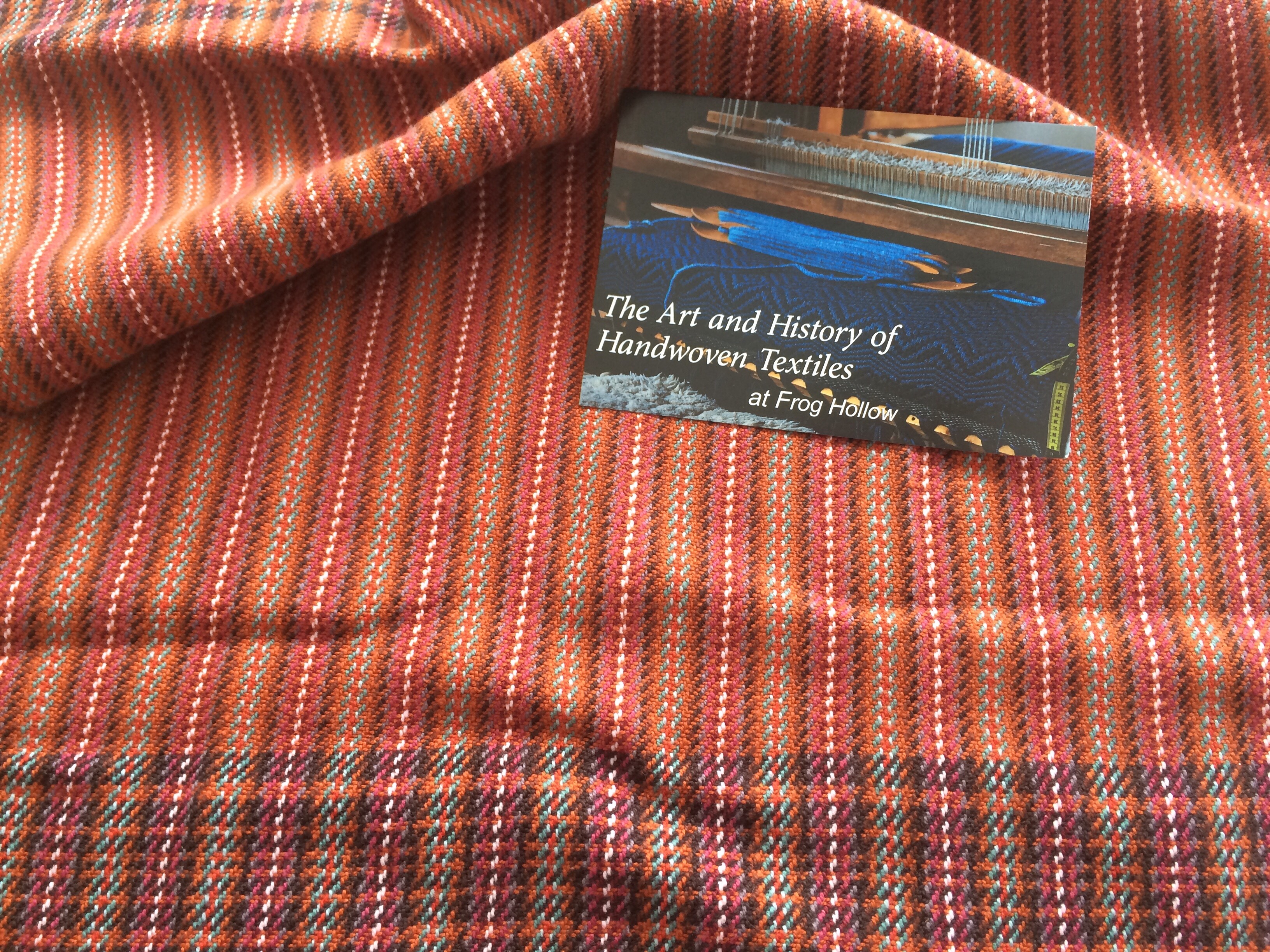
I’m so relieved no one meddled with my future in such a reckless way, because now I am the proud owner of hopefully the first of several hand woven towels made at the Marshfield School of Weaving. It is gorgeous, sturdy, soft and functional. It took time, great skill and a dedication to an “old” way of making. It felt like a decadent, yet moral and tame purchase. We will have this towel for decades, I’m sure. And every time I dry my hands, wipe up water or dry a pot with it, I will think about where it was made. I love this more than champagne and chocolate.
Go to Frog Hollow in Burlington, VT to see a lovely exhibit from the Marshfield School of Weaving. It runs through the end of February and won’t disappoint.
When I got into crochet and opened my Etsy shop, I was not part of a fiber community. I was inspired, energized and over-the-moon in love with making little funny creatures that made kids smile (and grown-ups). I would look at Etsy and marvel at the creativity and artistry of people all over the world, and often times, barely knew what I was looking at~ I had no idea what needle felting, wet felting or even fulling knitted items were! I was super green.
Until: Susi.
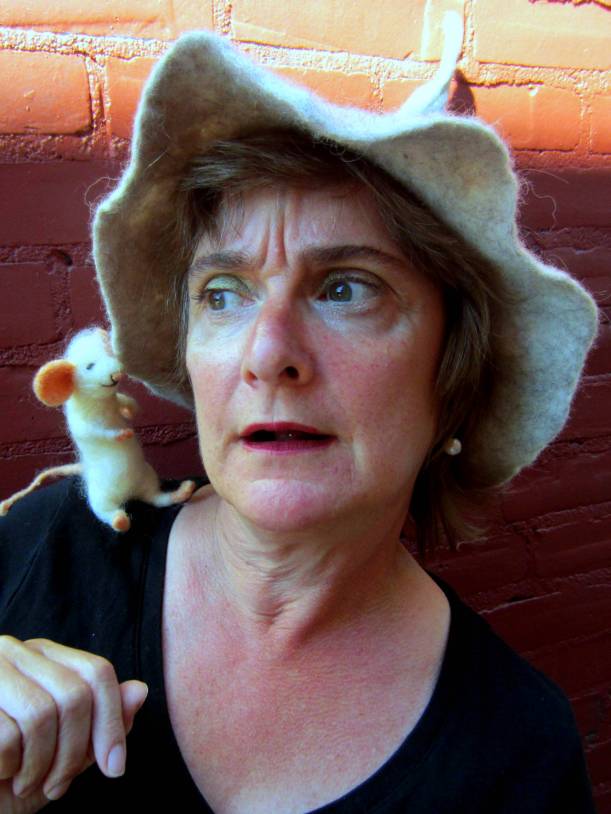
One day, I got an email through Etsy from someone who had an Etsy shop too, called The Felted Gnome Knows. The artist behind this great shop is Susanne Ryan, aka Susi; she introduced herself and I immediately realized that I had already been admiring her work. Her pieces are whimsical, gentle, and inspire creativity. And she lived just a couple of towns away from me! I had no idea what needle felting was at that time, but would see pictures of needle felted creations and ache to understand how they were made. I cannot remember the first time Susi and I met face-to face! Isn’t that funny? In no time at all, though, we became friends. And then we took our first trek up to Mountain Fiber Folk together, which changed my life in so many ways.
I recently sat down with Susi and asked her questions about her art, her craft, her opinions on fiber, her history, and I wanted to share our conversation with you.
The Interview:
HH: I feel like the process of working with wool inherently is soothing and centering. Obviously I’ll want to get to that, but first, can you tell the story of how you came into fiber art?
SR: Several years ago, my husband was transitioning into a new phase of his work life and consequently money was tight. We have a very large family, and that, for some reason, was the year that folks decided that we were going to get a little something for everybody. At that time, I was taking wool sweaters and fulling them down and making them into things. I was knitting and I had gotten a needle felting kit with my daughter at Kaleidoscope Yarn. It was to make little Santas. We made them, and there was something about needle felting where I thought, I could do so much with that.
Interestingly, I wasn’t interested in spinning wool at all. I started with needle felting and then went into wet felting. Initially, I found that there were not a lot of stores in the area that carried felting supplies. The area store that did had classes that were at times I couldn’t go. Also, there are some who are very ready and willing to help people learn things and some who are not, so I ended up learning a lot on my own.
Around that time, I ran into Leslie Lewis (Ewe Who Farm), an old friend from my school days, and we reconnected. Over time, she made a quilt for Maggie and told me about her sheep. So, after seeing that options were limited in terms of local stores helping with my fiber questions, or simply not having the supplies, I contacted Leslie again and asked her if she sold her fiber, and she said “Yes!” I had already been going to farmer’s markets and buying wool from farmers, but getting in touch with Leslie is really what started my seeking out of local farmers to buy fiber from.
When I was at Kaleidoscope yarn, I remember them handing me a brochure for Mountain Fiber Folk, so when I met you I said, you know, I’m going to go up there. I had gotten to the point where I wanted to buy local. I’ve always been interested in and shopped at farmer’s markets, and was involved in getting a farmer’s market in my town. I’ve always felt strongly about that. If you support a local business, they support local and your money goes back into the community.
Going up to Mountain Fiber Folk and seeing what they were doing and how they were doing it was very encouraging in terms of what I wanted to do.
I’m all self taught. I’ve only recently started taking classes this year for things that interest me like the masks and the clothes.
HH: And those classes are very specialized, right? This is a commitment to taking your craft to a whole new level.
SR: Yes, they are advanced classes. It’s interesting to meet all of these women who are so big in the fiber world. I thought Gladys Paulus and Anita Larkin, being in the upper echelons of the felting world, might not be approachable, but they were very down to earth and accessible. This is a passion for them.
HH: Oh yeah, it’s totally a passion! It grabs you and doesn’t let go! It is so inspiring to see what artists do with fiber. It seems infinite, the possibilities.
SR: It’s not going to support you… part of that is that people have no idea how much work goes into making needle felted sculpture, or hats and slippers. They take hours and hours, and sometimes many days. Especially when you take into consideration that often times, I’m getting these fleeces processed by Michael (of Hampton Fiber Mill), or processing them myself. I tend to be a very particular when it comes to skirting and cleaning a fleece, so that takes a lot of time! But you know, it’s frustrating when you pay for roving or batts and you’re picking out veggie matter!
And also, people are really getting a full-on, Vermont-made piece. Needle felting has become popular, so overseas companies are mass producing felted figures and selling them cheaply which makes it difficult for the consumer to understand why local pieces like mine are higher than other felted products.
HH: I was thinking about the social and political aspects of fiber art yesterday when I was dyeing wool with kids at school. There is so much to think about and make choices about when it comes to where we buy our supplies, how we process our fiber, and where we spend our own money. It’s a whole mind-set.
SR: I also think too, in Vermont, we are so focused on the maple producers, and the organic food movement, people forget that there are a lot of sheep and goat people out there that are struggling. They have a wonderful renewable resource that is not being tapped into or marketed appropriately. Not only can we make clothing with it, but it can be used for insulation, you can compost it…. There’s so much you can do with this product. These people are living from hand to mouth, all for the love of their sheep!
HH: What do you think it is about working with fiber that makes people so passionate? Or, what grabbed you about working with wool?
SR: There’s something very earth-bound about it. It’s very grounding. There’s something about wool that’s very… I think it’s the same as gardening… it puts you back in touch with the natural side of the world. You are woking with a natural product that is renewable. It’s warm and it evokes a sense of homeyness and tradition. There’s something magical about it. You know, you can twist it and it becomes yarn! It magically transforms! There’s a whole magic to it… like alchemy.
I also really dig the fiber community. They’re really very down to earth people. Most of them, I have to say, especially those who raise their own animals, are very warm and open and generous about their knowledge.
HH: Isn’t that what was so wonderful about Mountain Fiber Folk? I walked in there that first time knowing nothing about handspun yarn, and walked out completely moved. Next time we went, I left with a drop-spindle that Ruth so generously helped me to figure out.
SR: It sucks you in! If you talk to Michael (Hampton Fiber Mill), he’ll talk about how he learned to knit from his grandmother, and then from there, he learned to spin, and then the next thing you know, he wanted to process fiber!
For me, I can tell you all about breeds and good wools for different projects! For some reason, I can retain this information. Who knew? I make the comparison to my father; he’s really into physics and he starts talking about it and everyone glazes over, but he’s so passionate about it. My sister says I’m like our dad….”you and the sheep, man!” I get so excited about it and want to talk about it, but nobody cares! That’s why it’s so great to get together with other fiber people who get it!
HH: I have to ask this… I know for me, I get around handspun yarn, and I must smell it. I can’t help myself. It’s an automatic thing I do. Do you do that?
SR: No, I don’t smell the wool, but I love to touch it and see the luster and sheen. I want to feel the coarseness of it. I don’t mind the smell of lanolin or raw wool at all. I do have to say, I don’t like skirting at all. There’s a big thing about not using chemicals to get the veggie matter out of fleeces. Well, you don’t have to use chemicals. You just have to be really detail oriented and pick the stuff out! The fiber you and I put out, it’s clean! But you’ve seen the fiber that has a ton of vegetable matter in it!
HH: You have to front load time and effort into preparing the wool. That’s the invisible work. There’s so much dirty work. And you can’t use “chemical free” as an excuse for not being careful with your product.
SR: It was the experience of paying for roving that was filled with veggie matter that really pushed me into preparing my own wool. Now I’m selling kits and supplies and it’s kind of exploded!
HH: What’s your favorite thing to do now? If you’re looking to spend the day however you want, what would you do?
SR: Making a hat. Making whatever kind of hat I want and not worrying about it if it turns out.
HH: What’s your favorite hat you’ve made?
SR: I have two: the felted Gnome Noggin hats, and the Ratagast hats. I love those two. Those are original designs. I make my hats with wool that some would not use for that purpose, but I line them with fleece. You know, I think I’m different than a lot of felters because I think merino is overrated.
HH: What fibers do you like to work with right now?
SR: Border Leicester, Gotland, Romney and Icelandic. With Icelandic- if you take the time to separate out the outer and inner fibers, the under coat is just as soft.
HH: Did you do handwork when you were young?
SR: No. My entire family is like, who knew?! I think what it was is I was never interested in the packaged craft kits available for children when I was young. I was always into the arts, but not in a very public way. I did win a poetry slam when I lived in the Carolinas and I was always around artists and musicians. I did do a lot of theater, too. But it wasn’t until I found felting that I found my medium. I did teach myself how to sew and knit, and I had the ability to put things together, but this really was the first medium where I knew what to do with it without having any prior introduction.
HH: What’s on the horizon for you? Anything you are looking forward to tackling?
SR: I want to fool around with very freeform clothing. I took with Linda Veilleux that was incredible; she’s an amazing artist. I am not as meticulous as she is, and I am learning why it is important to take careful measurements, but I want to play around with shapes and turn them into wearable, freeform clothes. I’m not really interested in making vases. It needs to be wearable or functional. If I’m going to do a sculpture, I’m going to needle felt it. I do like the idea of marrying wet felting and needle felting. Anita Larkin is a wonderful artist~ she stitches pieces together and wet felts them. Those types of ideas are interesting, but I’m also figuring out how to support my habit.
HH: So, you’re done with the holiday fairs…
SR: Yes, but I’ll be at the Stowe Renaissance Fair in the spring. I’m going to make hats for that.
HH: I know where I’ll be seeing you in the spring! I love a good Renaissance Fair and seeing your hats, and you!
Check out Susi’s links to her Etsy shop, her Facebook page, and her website. She keeps them up to date on where she’ll be and what classes she’ll be teaching.
Thank you, Susi, for taking the time to talk with me!
I’ve gotten a bit behind in sharing what I’m working on. My last post was a share of a fellow blogger who was kind enough to detail her Kool-Aid yarn dyeing know-how. Well, I tried it yesterday with clean, uncarded wool. I needed to practice with the stuff before I brought it into my daughter’s kindergarten class to dye wool that they will be using in an art project in a few weeks.
Last week, the children washed raw wool. I wish I could share pictures of it, but you know… privacy and other people’s children is very important to honor! Let me just tell you it was funny, wonderful and I was so proud of all of them. It is true that there was a lot of “ewwwww!!!!” and “gross!” and “it smells like poop!”, but I can assure you that there was no poop in the wool and once they realized it was kind of like petting sheep, they got over it, and all of the kids wanted to put the wool into the warm, soapy water.
I had to do a few rinses of the wool once I got home because there just wasn’t time to get it all done at school.
This week I’ll bring some of that washed wool back to school to have them dye it. I was stumped when I was trying to figure out how to expose them to wool dyeing- I have gotten really into plant dyes and have done some dyeing with synthetic products, but those are stinky, kind of complicated and very time consuming. Somewhere along the way, I came across a mention of Kool-Aid dyeing, but when I first started researching it, I found a lot of links to directions involving heat, stoves and time. That’s why I was so excited to find this link.
I tried it myself yesterday and loved the results. This is what I did:
I separated my wool into weighted amounts: 4 2 oz piles and 1 1 oz pile. I then soaked the wool in warm water for 30 minutes. While the wool was soaking, I got my dyes set up.
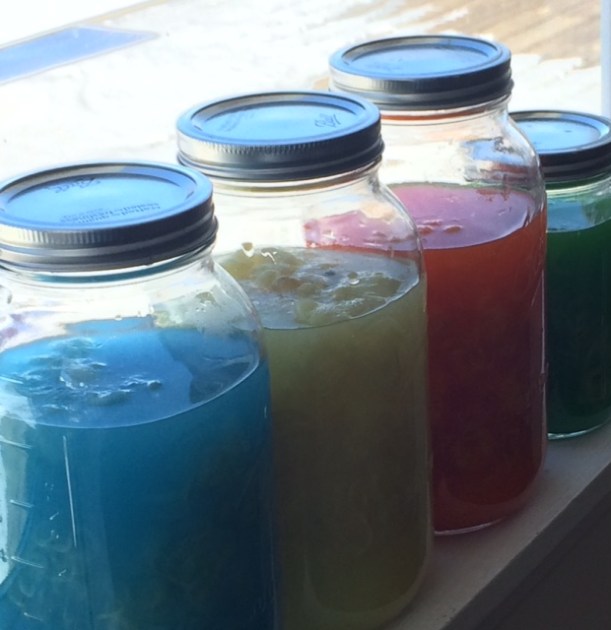
I had three half-gallon mason jars and one one-quart mason jar.
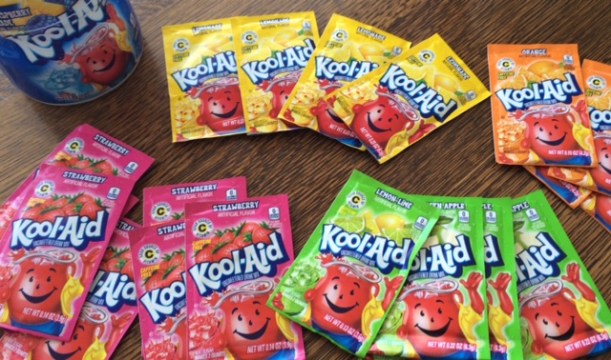
In each of the three large mason jars, I put four packets of Kool-Aid, 1/2 cup of white vinegar and filled them about half-way up with warm water. I then stirred the mixture well.
In the one-quart mason jar, I put two packets of Kool-Aid, a 1/4 cup of white vinegar, and half filled it with warm water.
I had an extra glass bowl hanging around and put three packets of raspberry Kool-Aid in that, along with 1/2 cup of white vinegar and some warm water.
Once the 30-minutes of soaking was up, I put the wool in their respective jars and bowl, added warm water until the wool was submerged, covered the jars and bowl and then put them all in a sunny spot for about 4 hours.
When I was happy with the color absorption, I pulled out the wool and rinsed. I was delighted with the results and know this will be wonderful for a classroom experiment/project. The color was not totally spent in the dye bath; I’m not sure if that’s because I used too much Kool-Aid for the fiber that was in the bath, or if I didn’t leave it in long enough.
I am so excited to do this with the kids next week. I’ll let you know how it goes.
I’m doing a little research on how to easily dye wool with Kool-Aid in my daughter’s class. This is such a great and simple explanation, and I love that the class will get to watch the process over the course of the day! So fun! Thanks for this information!
1. Wind your yarn into a very loose skein and soak in warm water for at least 30 minutes. This step makes sure all the yarn fibers are saturated and better able to accept the dye.
2. In the quart jar, mix the KoolAid powder with 1/4 c white vinegar and then fill the jar to the half way mark with warm water.
3. Put the sopping wet yarn into the jar. If you want a more even dye, make sure the yarn does not get smooshed up against itself or the jar. You may want to use…















 Healing Handcrafting