Hello to you, and thank you for taking the time to read this blog. I have been hovering over the idea of writing about the healing effects of working with fibers for a long time, and often dissuaded myself from taking the leap into blog-land by telling myself things like: there are so many blogs, why add another? or, can anything new be said about the soothing and healing nature of handwork?, and of course the ultimate killer of ideas and new projects, am I “expert” enough to write about fiber art, fiber craft handwork and psychology? Well, let me make my admissions and explanations here so I can get on with it!
I am a psychologist and have been working in the field in a variety of ways since 1999, although I took a few years off to be home with my children. I love the work, and I love thinking about being a person and all that goes with it, in the mind anyway. I have a particular interest in Jungian psychology, dreams, developmental stages and all of the archetypal power that is alive and working through us as we navigate the tumultuous waters of growth. Being a psychologist and therapist has become part of who I am. It is creative, dynamic and can lead a life and profession in myriad directions. I know that I will be studying for as long as I can.
I am also passionate about, and grateful for, my love of working with wool and other fibers. I crochet, knit, spin wool and other fibers into yarn, dye wool using natural and synthetic dyes, and dabble in macrame, weaving and needle felting. I am not an expert in these crafts and I am learning new things all of the time. When my two children were 3 years old and 6-months, I began taking them to a lovely Waldorf style playgroup. It was there that I began knitting again, after many years of forgetting about my knitting needles in the back of my closet. I was delighted to learn that I could knit balls for my children to play with, and then stuffed animals from patterns. As I learned more, I decided to pick up crochet, which opened up a whole new world for me. For some reason, I felt more confident with crochet and found that I could easily improvise and make up my own patterns. Friends liked them and started buying them! One friend in particular encouraged me to open an Etsy shop, which I did. It is called Jabo and Belles: Handmade. Well, that was really fun!
After a short time, I serendipitously met who has become a dear friend, Susi, who is The Felted Gnome Knows. I owe a lot to her, as she introduced me to a group of wonderful women who run Mountain Fiber Folk, a fiber and yarn cooperative in Montgomery, Vermont. I did not know about handspun yarn before walking into MFF. Not really. I didn’t know how incredibly textured yarn could be: curly locks, thick and thin, chunky and smooth, vibrant, filled with personality, scent and the essence of the very animal from whence it came! I really did not know until that day how earthy and grounding yarn could be. Some of the women who make up the cooperative have their own animals from whom they collect their fibers. Sheep, alpaca, llama, rabbit, goat… it’s all there and it thrilled me to the core. The women there also affected me deeply. They are creative and fun and extremely generous with what they know. After my third time visiting, I asked about how I might learn to spin wool and received a lesson right then and there on how to use a drop spindle. I worked with that for a while but knew a spinning wheel was in my future. My friend Susi (thank you, Susi!) told me about another friend of hers, Leslie, who has a farm, sheep, and spins their wool into beautiful yarn. She suggested I contact her to see if she would be willing to give me some lessons. Leslie was kind enough to do so, and again, I had the great blessing of meeting a woman who shared her knowledge, was patient and deeply passionate about her sheep, her yarn and her fiber art. She is a freaky-good knitter! And quilter. Whoa.
For my 40th birthday, my mother gave me my spinning wheel, an Ashford Traveller. When it arrived in the mail, I could hardly contain my excitement. I did not take the time to look at all of the paperwork it came with because I was so impatient to start (that is relevant for reasons you will see later). When I tried spinning the first many times, I could not believe how much I could not do it! This reality was maddening and frightening because I wanted to spin wool so much and had worked up a whole bunch of expectations around “getting it”. Finally, after many deep breaths and a lot of swearing, I got it. It wasn’t beautiful, but I got it. And I got it some more, and then some more. And soon, I was spinning wool every night and at times during the day when my children were napping or otherwise happily occupied (spinning wool with an unhappily occupied young person around is really very impossible). I soon realized that spinning wool in the evening was one of the most relaxing and meditative practices I had done in years. I felt noticeably more calm and at peace with whatever was transpiring in my life. I started learning more about various animal fibers and different spinning techniques. I also started seriously thinking about how much my life had changed since I began knitting again, and how therapeutic I was finding all of these crafts. The psychologist hat came on, and I began to wonder, “if these practices are helpful for me, is it possible that there are some inherent qualities in them that lead to healing? Is it possible to use these crafts when working with other people in therapy?”
Sometime after those thoughts began percolating, I was cleaning up some papers and periodicals on my desk. I started to thumb through one that came with my spinning wheel. I suddenly read the words, “Weave Away the Blues”, by Dr. Ann Futterman Collier. WHAT?! The first sentence of her piece reads, “About 10 years ago, I noticed something interesting in my textile-making: as I made handcrafts, I was transformed into a better “mental” place.” You can find her article in “the Wheel: Ashford’s Fibrecraft Magazine”; Issue 23, 2011. Well, I was transfixed! I laughed out loud, and I may have cried a little as I read her article. There it was, right in front of me and I knew then that I could learn so much more about this whole phenomenon. My two worlds met in the middle and did a high-five. Since then, I’ve read and re-read Dr. Collier’s wonderful book entitled, Using Textile Arts and Handcrafts in Therapy with Women: Weaving Lives Back Together. I’ve also started to move more into understanding what this is all about, why handwork and fiber art is such a powerful medium for healing and transformation, and how it can be used in working with others.
I hope this serves as a good-enough introduction to me and to the purpose of writing on this blog. Healing Handcrafting is not only for psychologists or therapists, or for fiber artists and handcrafters. I believe there is a powerful message and meaning in the fact that fiber arts and handcrafts are so popular right in the United States and around the world. I believe that in this culture of infinite busy-ness, many multiple ways of being contacted and contacting others through short sentences, “likes”, texts, emails, landlines, cell phones, etc, we are actually completely overstimulated and remarkably unconnected. I think that many people are longing for ways to calm down their lives, reconnect with themselves again, or for the first time, and engage with other people in real-time, with eye-contact and in ways that tend to the spirit and the soul. Working with fibers in all the ways one can grounds us, opens doors to our distant ancestors as well as possibly to our mothers, our grandmothers and great-grandmothers. There is something about fiberwork that is honest and eternal. It is from this vantage point that I hope to offer my thoughts. I’ll also share my own work and process and things I learn along the way.
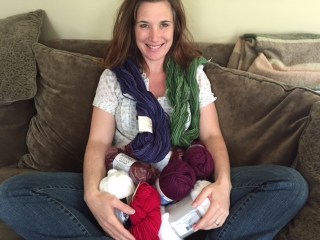
~ Bradie
 Healing Handcrafting