Healing Handcrafting


Leave a comment

Monday’s Musings~ Creativity and Defining Self

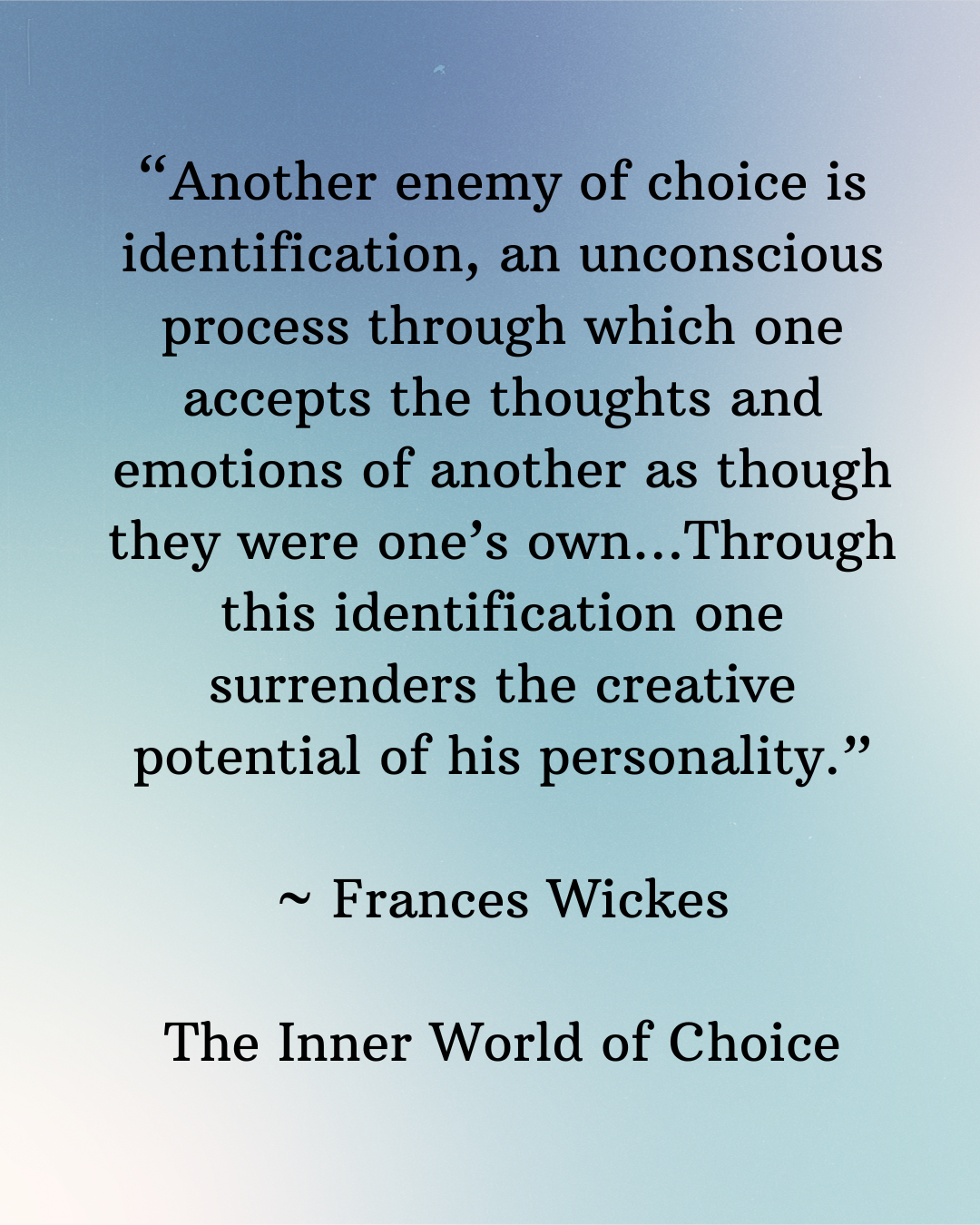
I spend a lot of time thinking about how we become more of ourselves in the way that Murray Bowen defined as differentiation. Simply put, differentiation is about how well we can hold on to our own thinking, even in the face of group pressure, others’ reactivity, and our own anxiety that arises in relation to these things. The better we are at regulating ourselves, the more flexible we are, and capable of maintaining equilibrium in a variety of circumstances. Conversely, the more anxious we are or become as a result of some emotional group process unfolding, the more we make decisions from a highly emotional place. Or, we find ourselves fully swimming in the waters of emotional process, and our decisions cannot be distinguished from those of the group.

Efforts to define self at any given time are the building blocks that help us develop a more differentiated stance in the world (and therefore less fused with the intensity of whatever system we are within). Checking in on, and keeping track of, what we think on any given topic is one way of doing this. For example, as I raise my kids, who are both teenagers now, I can defer to others and find out what they say is the right way to raise a kid and follow their prescription for how to do it, or I can think something like, “what is important to me as I parent my children through their teens, and how do I view my role in their journey towards adulthood?” And I think on it. And I answer the questions. Some of my answers might be informed by information I garner from people whose opinions I value. But first, they are run through the filter of my intellect. What do I think about what they think?

I’d love to say that I am able to do this all the time, but news flash: I’m a reactive person who’s been working on myself for years, and my success rate of defining my own thinking to myself before reacting to something is… well… it depends on the circumstances!

Anyway, this is where the bridge to my thinking on creativity appears on the map of my journey in this life. I think that by tending to our own creativity, we are greasing the gears of differentiation.

Here’s why:

Creativity involves having the spark of an idea. Anything new, innovative, functional, delicious, beautifully made or arranged, etc., happened because someone, somewhere, had an idea. And it didn’t end there. The idea became an action. “What if I do this?” became… “Check this out!” Suddenly, we had sculpted pots to hold things, woven or sewn materials to warm, adorn, protect, sail, contain, and tools to carve, cut, and shape… that spark of an idea is the seed of all that we have, for better or worse.

I see micro-expressions of this very thing in my own creative practice and in the conversations I have with other makers. As a weaver, I must make so many little choices, so many nuanced moves, adjustments, decisions. Each one is an articulation of an idea, an opinion, a preference. And while I learn from incredible teachers, like Rebecca Mezoff and Elizabeth Buckley, I also have to assimilate their teachings into my own mind and decision-making process. I think that when we have these opportunities in our lives to articulate choice and preference, we have ever more chance to articulate ourselves back to ourselves and to others! It’s amazing.

Why is this important? Because we all need to be doing our best thinking. Really, we should be trying to do this all the time, but especially if we are living in places that are in turmoil. The likelihood of losing track of our own critical thinking and judgment in the face of high intensity societal emotional process is increased. The more we are aware of this, the more we can keep our hands on the steering wheel of our own decisions, lives, and futures.

The more we know our own minds and tend to the sparks of our ideas, the more engaged we will be as a whole self.

And, the more of a whole self we are, the more choice we will have.

Bowen Theory Information:

https://www.thebowencenter.org/societal-emotional-process

https://www.vermontcenterforfamilystudies.org


Leave a comment

Tapping Into Your Creativity to Tend to Loneliness

I heard a wonderful program on NPR this morning and just had to share it with you. I found myself nodding and smiling and feeling this wonderful sense of “Yes, Exactly”! as I listened. The segment is called: Feeling alone? 5 tips to create connection and combat loneliness and was on Morning Edition. It features Dr. Jeremy Nobel, who founded the Foundation for Art and Healing decades ago and wrote the book entitled Project UnLonely. I’d never heard of it and am so grateful to know about it now. Here’s the link to the episode. I hope you enjoy it as much as I did!

Photo by Karolina Grabowska on Pexels.com


Leave a comment

Letting Go of Normal

“I just want things to go back to normal.”

How often have you heard this refrain, or uttered it yourself when you’ve just wanted to put a pause on having new information or issues to respond to? I’ve been thinking about our relationship with normal. It’s like a thick, strong, orienting rope that runs through a life and culture, and where we are in relation to it is always up for evaluation. We talk about physical health in terms of normal. Behavior, psychological functioning, intelligence, too. And then there’s the social norms that dictate so much of how our school years and work and social lives go. Oh, and then there’s what many pay attention to as parents when kids are going through developmental milestones. Music, weather, animal behavior, family functioning are all up for grabs in the context of normal comparisons. Really, is there any part of life that is not subject to an almost immediate assessment of how it does or does not relate to normal?

Such a bland word that elicits a broad range of reactions from people packs quite a punch and I think it’s worth looking into a little bit.

From Merriam-Webster, normal means: “conforming to a type, standard, or regular pattern characterized by that which is considered usual, typical, or routine; according with, constituting, or not deviating from a norm, rule, procedure, or principle; approximating the statistical average or norm occurring naturally; generally free from physical or mental impairment or dysfunction exhibiting or marked by healthy or sound functioning; not exhibiting defect or irregularity; within a range considered safe, healthy, or optimal.”

Like any concept, it’s the case that normal is not all one thing. It is not all good, and it’s not all bad. What’s good about normal? Why do we need it and rely on it so much? Seems to me like the opposite of normal is chaos, and chaos is, taken in extreme form, the primordial ooze from which all things began. It’s unpredictable, unstable, volatile and confused. It’s the seat of creation and true creativity. It erupts and changes things. It can be exciting. It can be terrifying. It’s necessary and feared.

Chaos knocks things into a new trajectory, but then guess what? An ordering principal takes over and helps the effects of chaos fall into a pattern. Patterns are stable and predictable. They can be known and understood, unlike their birth mother, Chaos. This must happen. I suppose that normal lives in patterns and normal dies in chaos. Chaos and Normal dance and work together to keep things moving. They are both necessary.

In life, people can deviate from the mean of normal in either direction. Further away from this mean is when we start to experience some things that are different from what everyone hanging out in the middle are experiencing. Bowing at the altar of normal can stifle the emergence of any new or unexpected material in an evolving system. This leads to the death or oppression of anything that is novel, creative, and life giving. Yet, diving full-bore into the waters of chaos and staying there for too long can mean that nothing is able to materialize into creative expression. It takes discipline to make creative energy bear fruit, and discipline does not live in chaos.

You can see the tension here. This is some dynamic stuff.

But here’s the rub as I see it: We do a miserable job as a culture allowing ourselves and others to be changed by what happens to us. Let’s take the pandemic. Rest assured, the amount of times I’ve longed for things to go back to normal cannot be counted. But even with less restrictions and people getting back to life as it was before, it’s not “back to normal”. We are changed and we will never be, as a whole, like we were before. The pandemic was a long-term, slow motion perturbation to our system which created chaos and confusion. We are still experiencing the natural inclination of a system finding its new orbit around this new reality, yet I see more and more a distancing from viewing it this way. I am longing for a greater dialogue about how we are changed and what that means not from the point of view that we have to get back to where we were, but more that we need to understand more fully where we are.

Where are we? I’m not the same. Are you?

I think the urge to get back to normal when the landscape that existed before doesn’t exist anymore causes tremendous pain and anxiety. We can’t go back to something that doesn’t exist anymore. But we can try to more fully understand where we are.

This is true after someone we love dies.

This is true after having a baby.

This is true after falling in love or breaking up.

This true when childrens’ parents separate.

This is true after losing a job or relocating to a new place for a job.

This is true after receiving a life changing diagnosis.

This is true after war, natural disasters, or exposure to and experience of violence.

This is true after experiencing a spiritual awakening.

Can we let ourselves be changed without judging it, hiding it, or stunting it? Can we let ourselves just be with what is true and talk about it all, and let others talk without pulling the “normal” card out of our back pocket? Life systems naturally organize themselves into new, mostly stable patterns. We can trust that this will happen, so we can relax and be more gentle on ourselves and each other and not force the issue. It’s okay if your best friend seems different now and doesn’t want to do the same things they did before. Be curious about it instead of judging it. It’s okay if you look different after grief. Look at yourself and be curious and loving and notice the hard earned scars of living a life that is filled with so many things. It’s okay if something big or little shifts in your psyche and you find a new and unexpected road to walk down. Check it out and see what’s there. It became visible because something changed.

Take the pressure of “getting back to normal” off yourself because, that normal? It’s gone. There’s a new normal to explore and it’s got a whole lot of new terrain for us to get to know.

That’s interesting, isn’t it?