Healing Handcrafting


Leave a comment

Busy, Busy, Breathe

It’s been busy. But not the same kind of frantic busy I was experiencing leading up to the holidays. That got bonkers. I seriously need to work on chilling the hell out in the months leading up to the holidays; has it always been like that? I don’t remember my parents seeming frantic when I was a kid pre-Christmas. Maybe they were and just hid it, or my siblings and I were comfortably and age-appropriately self-centered enough to not realize all that was going on for our folks. I don’t know. 

I am now fully committed to getting real peaceful with what I can do and what I can’t,  and what I want to do and what I don’t. I’ve definitely been reckoning with the fact that I could have done many different things in my little life, and that I’m a person with a bunch of interests. I’m often grabbed by something- an image, a topic, an idea, that with infinite time and energy I’d maybe be able to do something with. But I don’t have infinite time or energy, and I have certain commitments and have made certain love-filled promises that remain firmly at the top of the what I am doing list. 
Anyway, I’m noticing that busy-ness is not feeling freakish of late. I think maybe after paring down and getting realistic, the responsibilities and endeavors that keep me busy feel much more grounded in the truth of my skills and my limits. Melancholy and peacefulness can live together, surprisingly. Letting go of desired but untenable pursuits is sad, but the process of doing so opens up energy and time to do what’s right in front of me, what is fueled by inspiration and honesty. 

I guess those are my thoughts on this chilly Wednesday. 


Leave a comment

Hopes For A New Year

This Year:

I Wish For The Calm to Remember to Breathe and Look Around 

IMG_6474

I Hope to Listen to the Stirrings of My Soul and Respond Accordingly, With Courage, Not Urgency

IMG_6242

I Long to Expand Into and Learn More About Fiber Art, Spinning Wool and Doing Tricky Stuff with Crochet Hooks and Knitting Needles

I Look Forward to Learning From and Talking To Fiber Artists Who I Admire, Who I Love, Who I Barely Know and Who I Have Not Met Yet

I Will Remember Every Single Day to Honor the Blessings In My Life and To Really See My Children As They Grow and Change

IMG_6457

I Plan To Make More Handmade Gifts That Are Filled With Love and Intention, For People I Know and People I Don’t

FullSizeRender-47

And, This Year, I Promise to Trust Myself More and Make More Time to Imagine, Make and Create

Happy New Year to You!


2 Comments >


FullSizeRender-42

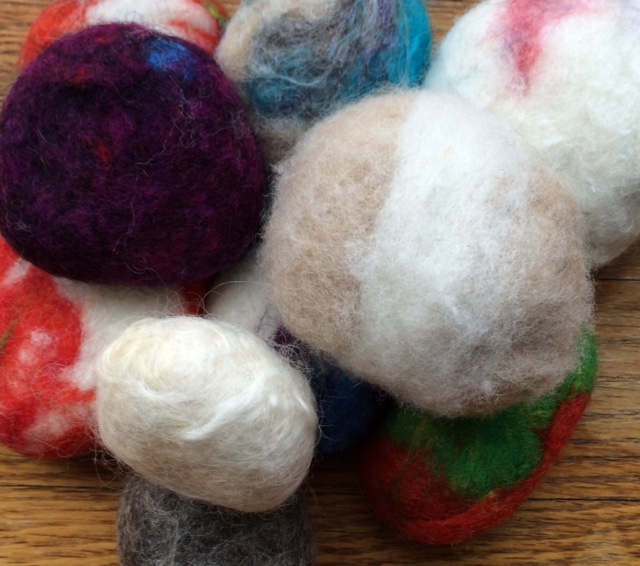
Well, Felted Rocks, Part. 2 happened before Christmas. In fact, it happened about a week before Christmas. I am just now catching my breath and thinking about what is ending with this year and what is starting with the almost new. I wanted to take a moment to document the wonderful experience of felting rocks with two 2nd grade classes (one of them being my son’s class).

Sometimes, I get bogged down by insecurity. I worry that I get ahead of myself and that really, all of my enthusiasm and energy is momentary, and maybe even a bit much for the people who I want to share it with. But let me tell you this: kids like to felt. And how ’bout this nugget of truth: kids think sheep are really cute and like to look at pictures of them and like to learn about them. For the 2nd graders, I opted to up the game a little by showing them a short slide show capturing the history of humans’ relationship with sheep. I learned so much in the creating of this! Like, humans have been working with sheep since the Middle Stone Age. That is when we humans first started developing language and learning how to manage and control fire. Our history goes way back, and sheep’s wool has been incredibly important to our survival, our society and our culture. Sharing some of this with the kids was great because they really got to see that our history with fiber and with sheep is part of who we are; it’s in our archetypal DNA, and it connects us to people around the world. I showed them pictures of where sheep originated (Iran, Iraq and Afghanistan). I showed them how some sheep made it over the land bridge from Russia to Alaska during the last Ice Age. And, I showed them pictures of children and adults all over the world spinning wool and knitting. I so hope that in that brief moment, they became aware of how unifying working with wool and other fibers can be; that we are all part of the same cloth. I cannot think of anything that is more important than that in these times of great pain and suffering around the world.

In a matter on an hour and a half, I worked with about 35 children. Not one child was uninterested in the fact that they were about to turn a bunch of fluffy wool into a felted piece of art. We got water everywhere. The wonderful teachers commented on having their tables cleaned really well, which was very generous. Next Time: Bring Towels.

FullSizeRender

It was a little cumbersome, getting the wrapped rocks into their nylon wrap, so I helped each child with that after they got their wool design how they wanted it.

I didn’t get to sit with all of the kids as they rubbed their felting rocks, but I saw some from a distance from where I getting other kids set up and I think many tuned into how peaceful the practice can be. Some children talked about who they were going to give their rocks to; others wanted to keep their big, fluffy stuffed animal looking rocks for themselves. I thought it was all wonderful. I think my favorite moment was when I walked back into the first class I worked with to say goodbye and check out their finished projects. All of the kids gathered around and showed me their work with so much pride and excitement. I felt like it worked~ my hope of bringing this wonderful practice to kids worked and they saw that they could make something beautiful with their own hands with a totally natural substance from animals they see all of the time here in Vermont. I was so happy for them, and for me.

It being right before Christmas break, I did not have time to just rest into the pleasure of it all, but now I do, and I am. I can’t wait to do it again, and to come up with other projects to do in the coming year. Stay tuned.

 FullSizeRender-31 FullSizeRender-30 FullSizeRender-28


Leave a comment

Felted Rocks In the Books! Pt. 1

Before I share how today’s rock felting project went in my daughter’s kindergarten class, I must first publicly bow to teachers. A deep, humble, grateful bow. You are amazing. My daughter’s teacher knows her students so well, created a wonderful set-up for the kids to move through as they waited for their turn to felt, and she celebrated their accomplishments and efforts. She is wonderful.

Today went beautifully. I arrived early and went through some of my books as well as found some books in the school’s library that were fitting for the class, for show-and-tell and for a bit of inspiration. While I sat there, something clicked for me. I felt like I was doing exactly what I wanted to do in that moment. There was no energy consuming worry. No shoulds bothering my psyche, and no pressures whispering in my ear. I’m trying to create a bridge for myself between my training as a psychologist, my passion for working with fiber and my strong desire to be with my kids. I’m not going into the classroom with my psychologist hat on in the traditional sense. Not at all. Where psychology and fiber marry for me is in the process of doing, the benefits of making, and the bounty that comes from transforming such an organic substance into something else.

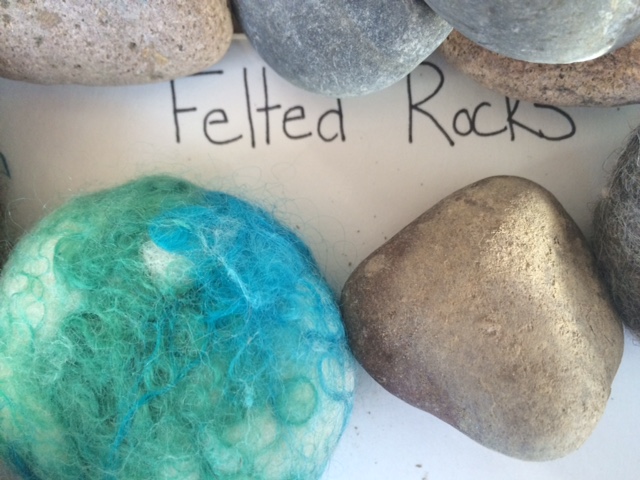
When my time in class began, we all sat in a circle and I let the children feel wool. They could pull it apart, smush it together, twist it and ball it up. They got to see how it pulls apart so easily and is fluffy and light. Then I passed around the felt from a felted rock that I made a while ago. It was cut in half, so they could see how stuck together the fibers were. They pulled on it, twisted it and tried to rip it but couldn’t! I told them that they were going to transform the same kind of loose wool they were just playing with into the felt that they could see on the example rocks I brought. I said that they were going to do some magic. That felt pretty exciting.

Then I shut up. It was go-time because for sure, my voice going on and on about too many details was NOT where it was at!

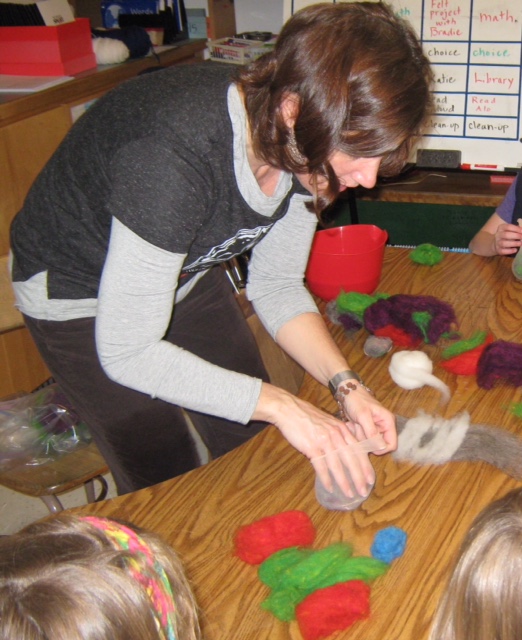
We ended up setting up the process in the following way: I was at a table that could seat up to six kids. I had the rocks, the wool, little nylon footies, a bowl of very warm, soapy water and paper towels. I laid out a base layer of white roving in front of each child as well as myself. Then I showed them how I lined up the second layer of wool on top of the base layer. I had a variety of colors to choose from. Children were able to pick the colors they wanted and for the most part, did not put on too much, although sometimes it was hard to resist. I definitely found that two layers of wool was plenty for the small size rocks they had.

Then they flipped it all over, laid their rocks on their wool and began to wrap their rocks. It did take adult help to hold the wrapped rock securely while putting in into the nylon footie. I got the footies here. Then, they dipped their rocks in the warm, soapy water and I showed them how to rub them all around. After that, they moved to another table with a parent volunteer who had another bowl of warm, soapy water. They continued the process for a few rounds. She had the brilliant idea of singing songs as they rubbed their rocks. I hadn’t thought of that, but now I will! It really kept the kids going and engaged in what they were doing. After about 8 to 10 minutes, I brought over a bowl of cool water for the kids to dunk their rocks in and we helped them to peel the nylon off their rocks. The nylon had become a bit stuck to the wool, but with adult help it was okay. I think if it were a smaller group, I’d have stopped them sooner, removed the nylon and just let them rub directly onto the wool, but these were quick moving groups and I couldn’t get to it all. The second group finished their rocks at the original table with the volunteer and I moved to the other table to get the third group going. There was a bit of movement, for sure, but with the adults working together, I’d say it went very smoothly.

I have to say, seeing each rock actually come out felted was awesome. I was even a little surprised. I think a part of me was waiting for it not to work and for someone to experience massive disappointment, but that did not happen! Some rocks were completely covered while some had some bear spots. It really seemed like if there was too much wool around the rock, it was more likely that it would slip around during the felting process. Some were smooth, some were chunky, and some had little woolen “tails”. What I loved was that they did not know about the “perfect” felted rock. Each rock got to just be its own unique, funny, snuggly thing that each child could be proud of.

I think most of the kids were quite pleased with themselves and their little woolen creations! I am so happy for them.


Leave a comment

Felted Rocks, Kids and The Beginning of Something New

I’m excited. In a nervous in my belly, hopeful, anticipatory and grateful kind of way. Tomorrow, I’m going into my daughter’s kindergarten class to do a felting project with the children. Felted Rocks, to be exact. And later in the week I’ll do the same project with two 2nd grade classes (my son is in one of them). I have come to seriously appreciate the benefits of working with, touching, experimenting and playing with fiber, and I feel utterly compelled to teach things to do with fiber-craft to kids.

The felting rocks project begins what will be a five- to six- week journey that picks up after the holiday break, and I will keep track of how it all goes here. I am calling my unit From Farm to Frame. In January, we will start with a dirty, smelly, lanolin rich fleece (or part of one), wash it, dye it, card it and in the end make a felted “painting”.

Over the last few weeks, I’ve been gathering materials for this project, thinking about why this is so important to me. One memory came to mind; the first time I skirted a fleece on my own. It was the big, smelly, creamy fleece of a Border-Leicester sheep that my friend Susi secured from a local farmer. I remember thinking, “dang, that smells”. But it didn’t offend me, and really, I got used to it very fast. I remember, after picking debris out of it and removing a lot of the gunky stuff, noticing how soft my hands had become. I was delighted to realize that it was lanolin! Lanolin had made my hands soft and shiny and smooth. I stood there in the warm May sun and it occurred to me that in the process of doing hard work and getting my hands dirty, that I had been softened, conditioned and made-over. I’d say that was a turning point for me, about two and half years ago. Since then, I’ve wanted to know more about why and how working with fiber can be so grounding and therapeutic in all of it’s stinky and at times tedious moments.

I want kids to have this. I want them to see a whole process through that involves fiber from a local farm. I want them to experience the rawness of the material and experiment with what they can turn it into. I want them to have an antidote to stress, pressure and worry. I want them to have a chance to touch nature and maybe appreciate the animals they pass on many a Vermont road.

I’m so grateful that teachers are letting me into their classrooms with these projects. Let’s just hope that the kids enjoy it. Tomorrow’s project will be a good introduction for all of us, I think.

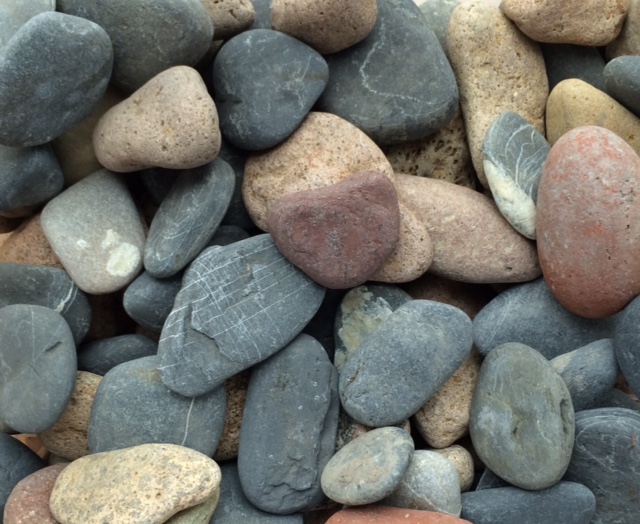
pictured above: rocks gathered from Lake Champlain, felted rock experiments, many bags of wool and a whole lot of roving to be organized for the classes, more roving because I thought it was pretty, and some of the colors that the kids will have to choose from.


Leave a comment

Handcrafting in Our Hurting World

I’ve been quiet on this blog of late. This is for a few reasons, some to do with simply being very busy raising my two young children and working. Others to do with starting a new endeavor bringing fiber and handwork to kids. The big reason, though, the reason why it has been tough for me to just sit down to write about handcrafting and all of the joy it brings is simply being Overwhelmed by all that is happening in our world. I do not want to talk politics on this blog, so I’ll refrain from discussing who I want to be president and who I think should be quarantined on a very, very remote island with no internet or phone. I will say, though, that I am sickened by the vitriolic, violent, hate-mongering that is dancing around in full sunlight of late in the good ole USA. The underbelly of racism, fear and projection is turned up and rather than it shocking our country into peaceful and humble reflection and sorrow, it seems as if it’s actually opening the floodgates of racism, violence and rage.

I am feeling deep and untouchable powerlessness. As I raise my children in a comfortable home, with plenty of food and with all that I need, in a state where I feel safe and as though I fit and am accepted, I understand that I am in a privileged position. I am not fleeing a war zone with my children. I am also not profiled or targeted due to the color of my skin. When I am pulled over by the police, my heart beats faster and I am nervous because of course I am, but I’m not afraid I’m going to be treated unfairly or acted upon with violence. I don’t fear that my children are going to be treated unfairly or with suspicion because of the color of their skin. I do know that I have a responsibility to understand my place in this social story and that this work on myself has only just begun.

I do fear “active shooters” in my children’s school and in any school. I do fear “active shooters” in malls, movie theaters, doctor’s offices, mental health organizations and airports. I fear becoming too afraid, and I fear enjoying the comfy position I was by chance born into, forgetting to remember that it’s all a fluke, a luck of the draw and that we are all, all of us human beings, in this living our lives thing together.

Tonight I got angry as I was thinking about yet another mass shooting, and I got really angry when I thought about my daughter asking about whether or not a bad person will enter her school to try to hurt her and her classmates. This question came following an active shooter drill at school that day.  (Note: the school does not use that terminology when explaining the drill to children). I got angry when I realized that the assurances that I give my children about their safety are backed up in my mind by fear and doubt. As I thought about that, I thought about the brave mothers and fathers that travel by foot and over seas to bring their children out of war zones to a safer place, only to have borders closed.

I thought about how hard it is to do things I love to do when it’s not helping anyone, or contributing in any way to solving any of these problems.

And then I decided to think about love.

You know what happens when you google things like, “knitting for love”, “crochet for world peace”, or “knitting for healing”?

You find out that people all over the world are knitting and crocheting, quilting and felting, braiding and weaving to help people, and to bring people together. You find out that there is a lot of wonderful stuff going on out there that directly relates to a desire to foster peace and love between religions. You find out that you can participate in peaceful protest using yarn and fabric, and that there are women of all different colors, cultural backgrounds, religions and minds who have in common an idea that through gathering and creating for others items imbued with love and peaceful intention, that we can heal. You find out that there are numerous organizations that want and depend upon handmade gifts of love.

I think that as I organize myself around political figures and get behind movements, ideas and rallying cries for change and appropriate response to mass- and micro- violence, it will be important for me to be able to make something. It will make tangible the overwhelming, and bring feeling, longing and loving into an item meant to leave my hands and enter another’s who I likely will never know or meet.

And I must say this: to all of you who are activists and writers and artists, brave voices for those who are not heard or listened to, and creators of change that force us to look at the truth and honestly reflect on our own positions in life, thank you and keep it up. And to all of you who are teachers, who practice drills with children so that you can keep them safe in the event of violence, you are brave. Thank you for what you do. You have energy and vision and patience beyond measure.

More soon. I’m going to go crochet.


Leave a comment

Knowing One’s Landscape

This summer, I contracted Lyme Disease. Mid-July, when I was feeling better than I ever have in my adult life, but for the achy joints and stiff neck, a big ole rash showed up on my back. I figured it was just a horsefly bite, but by the next day, it took on the tell-tale bulls-eye shape, and my symptoms went from mildly annoying and easy to pass-off as over-exertion from running and exercising to being really, fully and wholly awful. Before this, I was out in our field, our woods and our yard very often, looking for flowers and other things that I could throw into a dye pot. I have ridiculous amounts of wool to dye, and I made it my job to experiment with as much as I could.

IMG_4825

I don’t know where I picked the tick up. I didn’t know I had the bite and only recall asking my husband to see if there was something on my back a few weeks prior. He didn’t see anything.

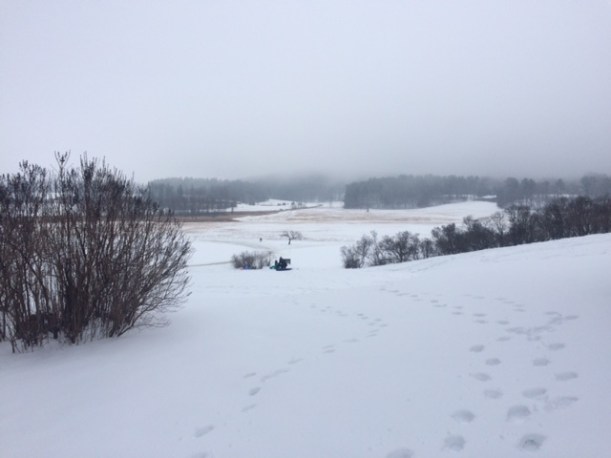
Since then, I’ve been gun-shy about field flower-picking and woods walking. I look at my back woods and wish I felt comfortable heading into that beautiful place, to look for fallen branches with bark I can use, or mushrooms I can harvest and experiment with. Just yesterday, after cleaning my shed and periodically picking up hickory nuts to dye with, I picked a minuscule tick off of my ear. It’s so small, I can’t tell if it’s engorged or not, but I think it is, which means I likely got it somewhere else and not from my yard.

IMG_4826

Why share this whole story here? Well, because I’m aware of the possibility of fear getting between me and something I deeply long to do. I can tell you with all of my being that I don’t want to get Lyme Disease again, and I wouldn’t wish it on any other living thing. Ticks are this crazy, mind-boggling paranoia inducing creature. If I lived near leeches, I’d have the same issue with them. Remember that scene from Stand By Me? Oh no. I’d perish on the spot. Spontaneous combustion style.

Anyway, I want to forage, pick and search for beautiful things to use to dye beautiful wool and I’m realizing that a very important mandate is demanding to be respected. Know the Landscape in Which I Work. I learned how to think this way while training at the Assisi Institute under the tutelage of Michael Conforti, Ph.D. He lectured frequently about how, when working with people, with dreams, with story and with symbol, that one must understand and be acquainted with the qualities and specifics to the given place, person, animal, landscape, etc. Know the landscape. This applies to all things. To teaching, to business, to swimming… Take swimming: the rules that apply to swimming in a pool are inherently specific to swimming in pools and different than rules that apply to swimming in rivers. And oceans. There are different mandates that apply to these different settings and one must honor them in order to navigate the waters safely and with success. Swimming in an ocean demands having an understanding of riptides, the sea-life specific to that area, tides and weather. One need not know these same specifics in a pool, but one must know about depth of water before diving, as well as whether it is salt water or chlorinated (some people are allergic to chlorine). These are not exhaustive lists, but you get the idea.

The same is true for gathering flowers and plants. One must know where one is in the world, what animals rely upon the plants one is gathering, how much of a plant can be taken without threatening future growth and what plants might have irritants (ever pick stinging nettle? That’ll ruin a couple of hours in a day if you don’t handle it properly). And, of course, when walking in nature, one must know of any possible dangers. I don’t live out west, but if I did, and if I were walking in very remote areas, I’d want to know about bear, cougar and snakes. Here, in Vermont, I want to know how to identify signs of bobcat and coyote. I know they aren’t likely to harm me, but they could do some damage to my cat who follows me everywhere on our property, and frankly, I’m not interested in running into larger predators with my kids. And ticks. I have to understand ticks and how to prevent tick bites, even when I’m not doing the typical things that one thinks of as being “risky” in terms of ticky situations.

I’m seeing clearly how much I need to respect my environment, and understand it, to fully enjoy its beauty and offerings. Maybe a full and comprehensive understanding will help me gently nudge my fear into caution.

IMG_2092


Leave a comment

Summertime Dyeing, Part 2

In Vermont, it is still hot. Too hot. I never thought I’d say that, but maybe after all of these years, the longing for the change into winter has evolved and grown. I’m catching up now, with projects begun in the early summer and late summer months, so that I might get some things in order to prepare for the coming autumn. I have a lot to make for the Women’s Festival of Crafts at the end of November, and there are new things I want to try. I would love to attempt weaving again, and I would love to try to knit something a little bit complicated, with color pick-ups, maybe, where gauge matters. I do worry a bit about getting frustrated or feeling defeated, but I think that’s exactly why I should try these things. If I want to make it, I gotta learn how to do it!

Anyway, before I wrap things up for the summer months in this blog, I wanted to document and share with you more about my plant dye experiments with wool. And I guess, writing a post that includes a “Part 1” in the title suggests that more is coming on the topic, right? Well, here’s Part 2.

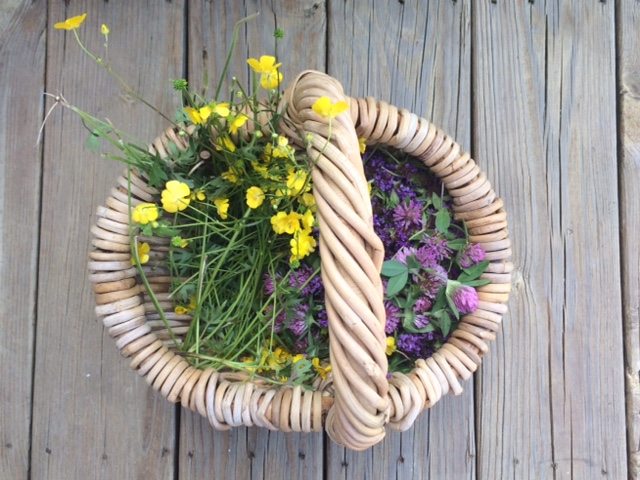
In June, I was gripped by the pull of flowers, trees and all things planty. I longed to see what came of what was all around me in my yard. Here is a part of my dye journal: 

“I am at a stage of dyeing wool where experimentation and flexibility are key. The mystery is so much fun, but I know that around the corner is more discipline and study. This morning as my children played with a friend, I wandered around our wet yard and gathered purple clover and buttercup flowers. I filled a small basket my mom gave me; purple on one side, yellow on the other. My daughter occasionally ran to me with small bundles of flowers. I saw little grasshoppers and butterflies and I breathed and felt the air and heard the laughter. I was aware at one point of my own hastiness and then remembered there was no reason to rush or to apply urgency to this job. Urgency is everywhere. I carry it on my shoulders like a silent, heavy monkey. Once I realized my company, I uninvited it with each little pick and pinch of the lovely weeds. I could feel my belly relax and gratitude enter.”

 What I did:

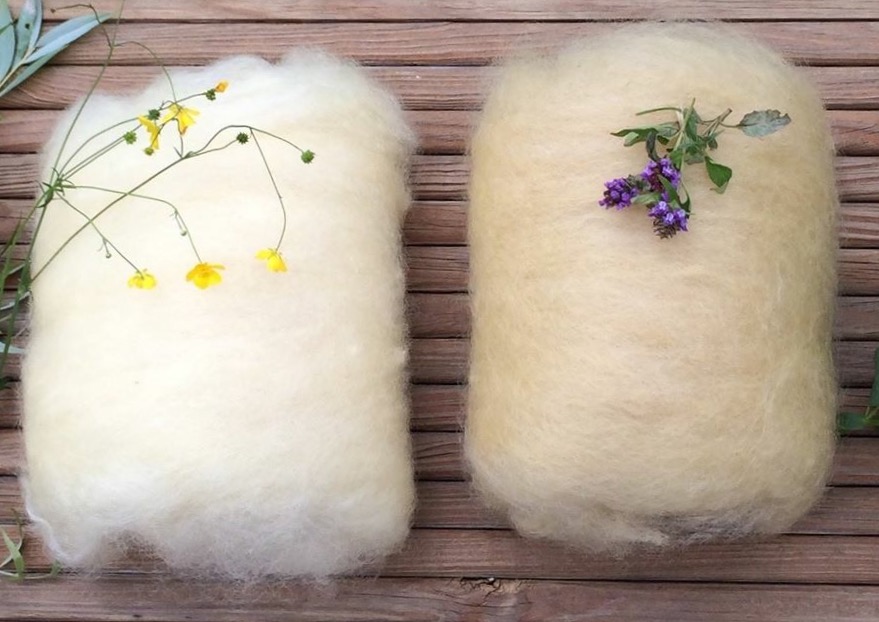
~ Buttercups with a few evening primrose flowers thrown in, plus stems from both. Mordant- alum.

~ Purple Clover, flowers and stems. Mordant- alum.

What I got:

It’s not especially easy to see, but trust me when I tell you that the buttercups made a lovely, light yellow, and the clovers made a very light brown. I was delighted with the outcome! 

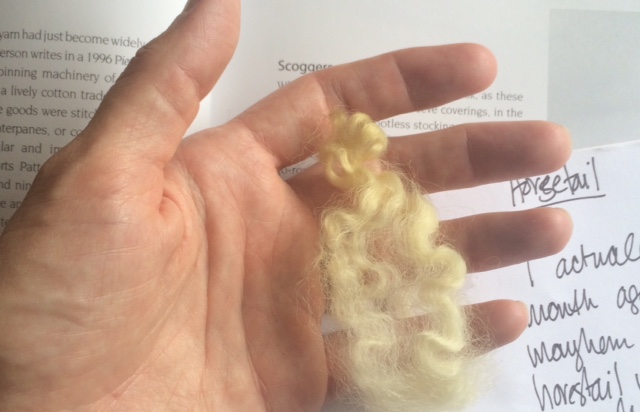
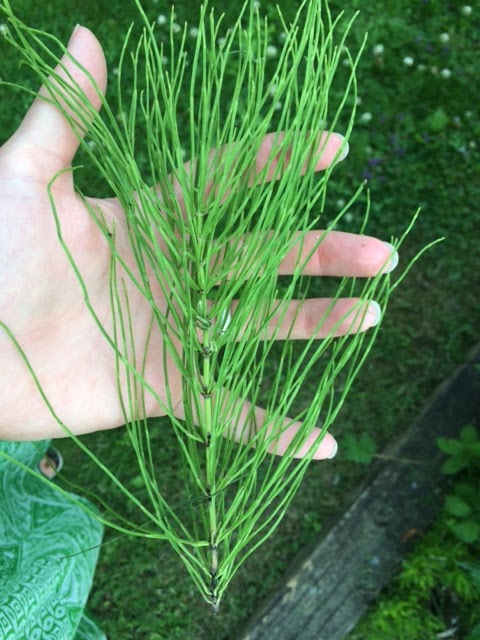
Around this same time, I did an experiment with horsetail. With this, I just poured almost boiling water over a lot of horsetail in a pot and let it sit in my garage for a few days. It was the boiling of that in my house that resulted in my moving my whole operation out into the garage. It sure did smell bad. Real bad. I didn’t admit it then in the face of the rebellion on my hands, but it did. I’m sure the soaking weed worked up a bit of gunk in those few days. The results though, were lovely! I got another nice golden yellow with a brown hue.

I’m sure by now, if you’ve read my other posts, you’ve noticed a theme. I seem to keep coming back to the idea of slowing things down. Way down. Maybe some of you are not afflicted by the sense of busy-ness, rushed-ness and too much of everything-ness always shaping a day, but I find those feelings or experiences of life impact even the most peaceful of days if I’m not careful. It’s sort of an automatic way of thinking and behaving. I think the act of going outside, collecting flowers or plants to dye with, when you don’t exactly know what the results are going to be, is an ultimate exercise in combatting that daily life habit. 


1 Comment

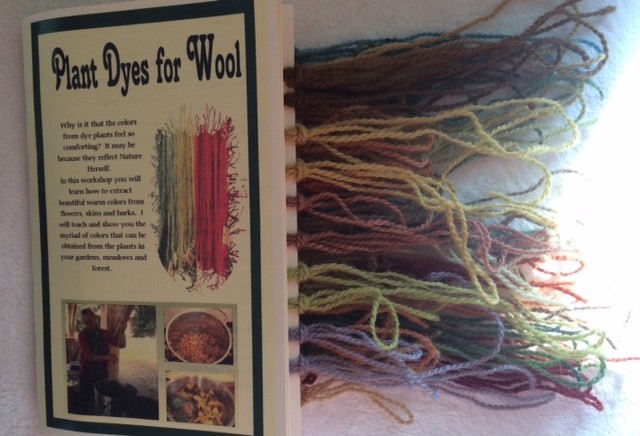
Marshfield School of Weaving- Plant Dyes for Wool

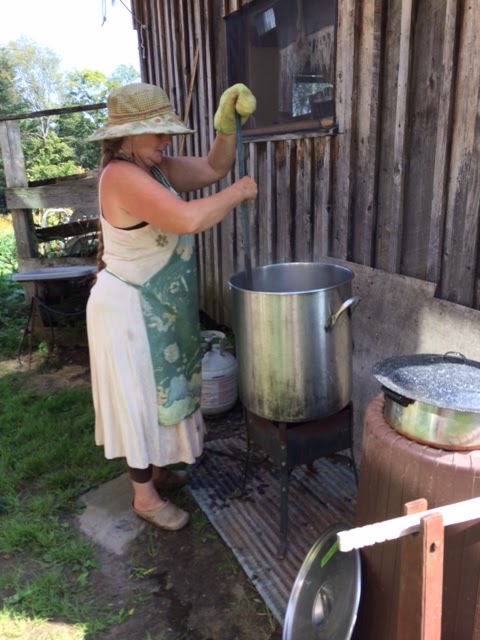
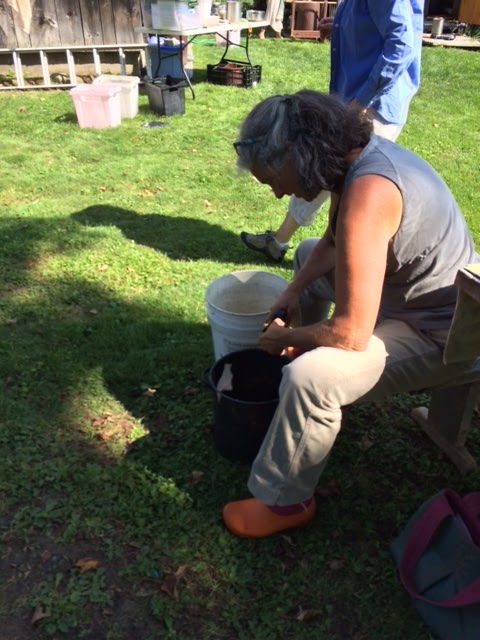
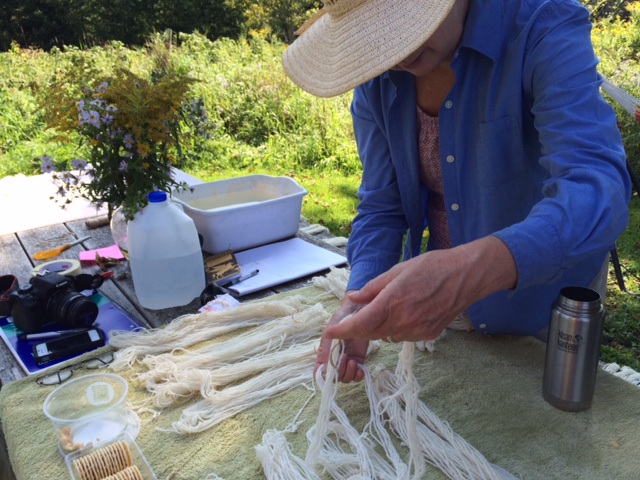
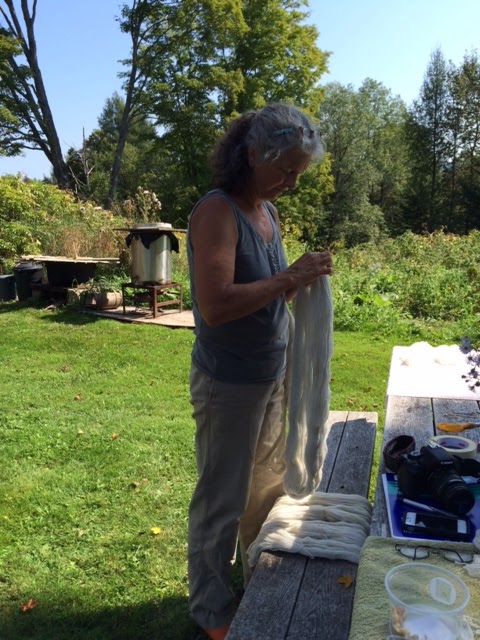
I had the great fortune to take a class at the Marshfield School of Weaving yesterday. This class was about dyeing wool with plants and other natural dyestuffs. Our teacher was Joann Darling, who is a weaver, dyer, soap-maker and plant expert (what is the word for that?). When asked what certain plants were, or what plant give which colors, Joann knew the scientific name; let’s just put it that way. Better put, our small group of five students was in very good hands. I think the best way to tell the story of yesterday would be to comment on each picture.

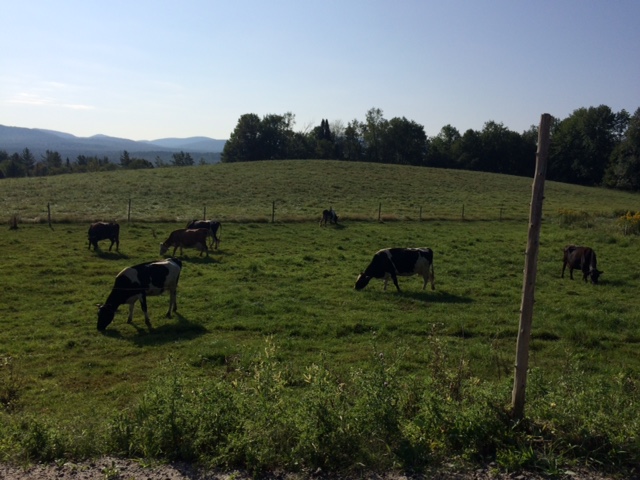
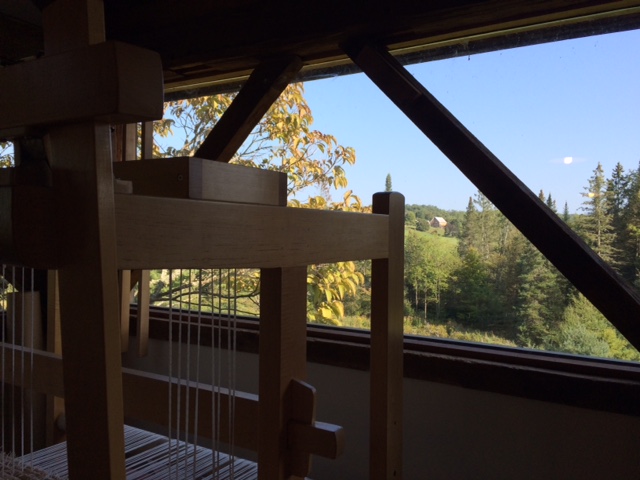
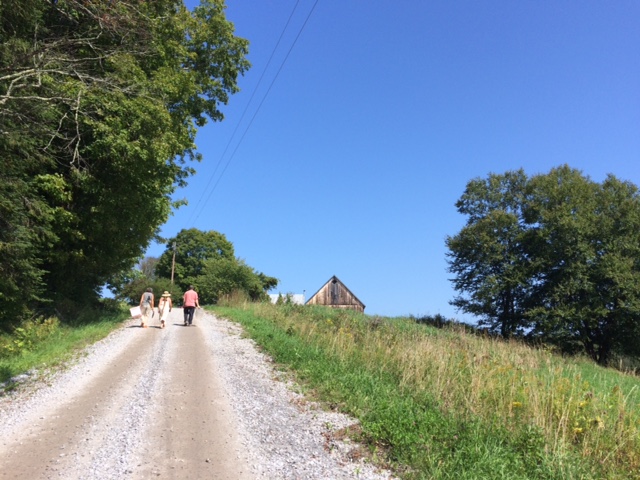
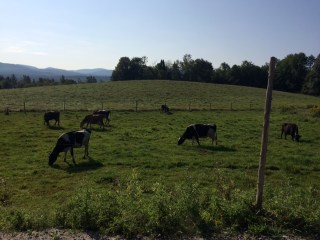
I left my home kind of early on Sunday morning to head down to the school, about an hour drive from my home. The front seat was full of food to bring for our potluck lunch, my sunhat, bags with snacks, drinks, notebooks and other essentials. It was a beautiful morning- dewey, quiet and kind of fuzzy around the edges. I felt a little nervous as I left, but more excited and curious about what was going to happen in the day. As I got closer to the school, I couldn’t help but be overwhelmed by, and grateful for, the beautiful views and the quiet. These are definitely a perks to living in Vermont. Oftentimes, where one must go to learn a traditional craft or skill is a beautiful place, set out of the way. Craggy land, full cows and swaying trees were balm to my eyes as I wove up these country roads I’d never been on before.
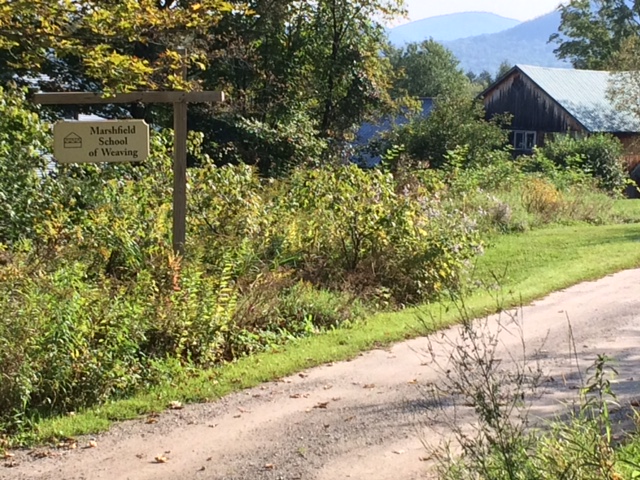
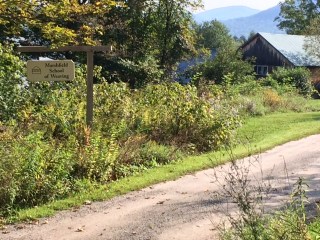
And here is the entrance to the school. I did laugh out loud with joy as I saw where I’d be spending my day.
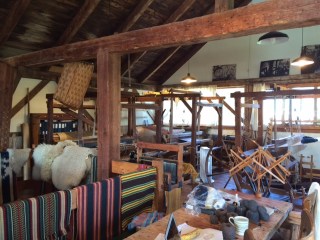
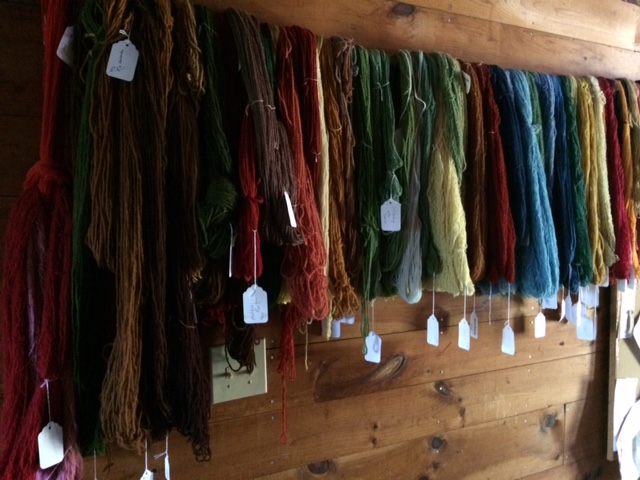
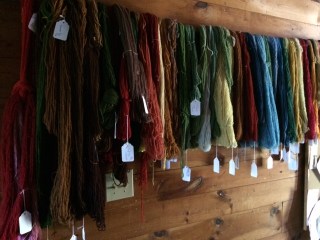
When I approached the building, our teacher Joann was busy outside getting things ready. She showed me into the studio and I felt immediately welcomed into the beautiful school. As I looked around, I was so happy to see yarn everywhere! And one whole wall was yarn dyed with natural dyestuffs. It was so beautiful. The light was soft and round, and every which way I looked, I saw things I wanted to touch, understand and look at.
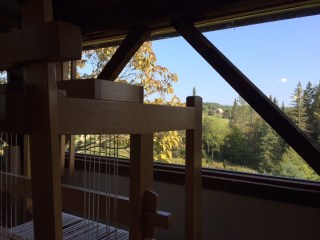
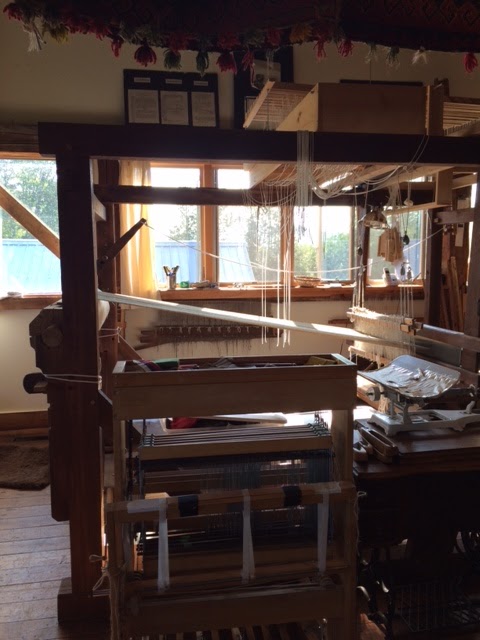
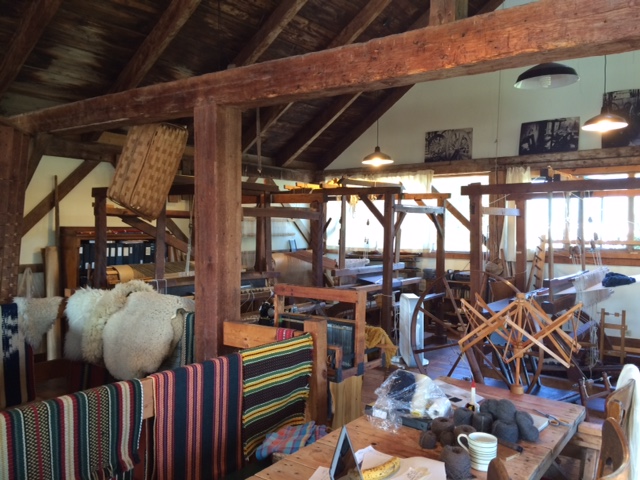
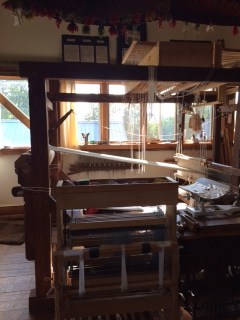
I wasn’t sure where we were meeting at first. I am so used to classroomy types of learning environments, so I made the assumption that there must be a place where we’d sit for a long time and take notes and get really official. I went upstairs assuming I’d find this. Instead, I found the studio. There were many looms of all different sizes. One gentleman was weaving at a very large loom (I don’t weave, so I don’t know what the different looms are called). And there were two women walking about, looking at things. We started talking and they were there to take the class, too. They are both weavers and were so generous with advice and knowledge about looms. I’m hoping to get a small one soon, and here already were two beautiful guides into that world. 
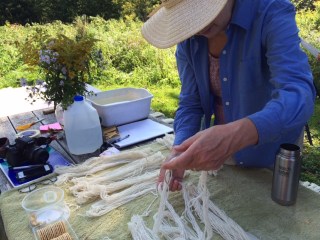
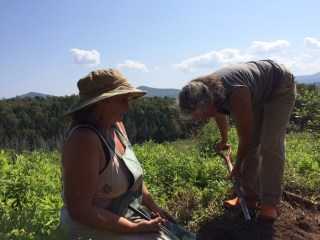
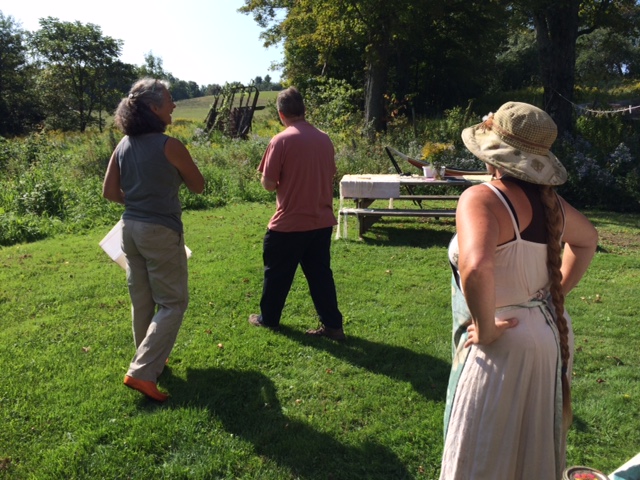
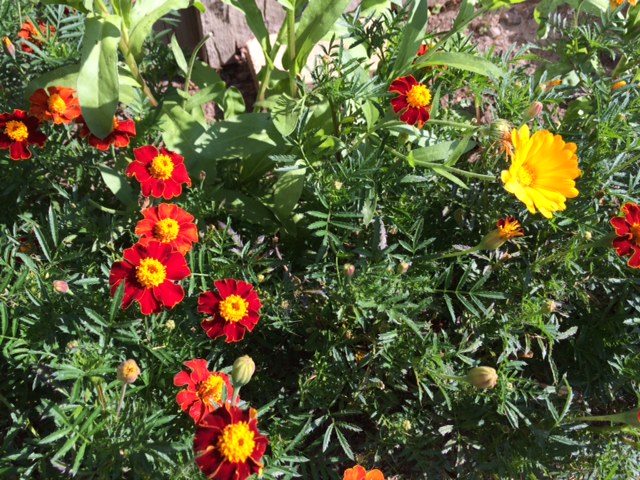
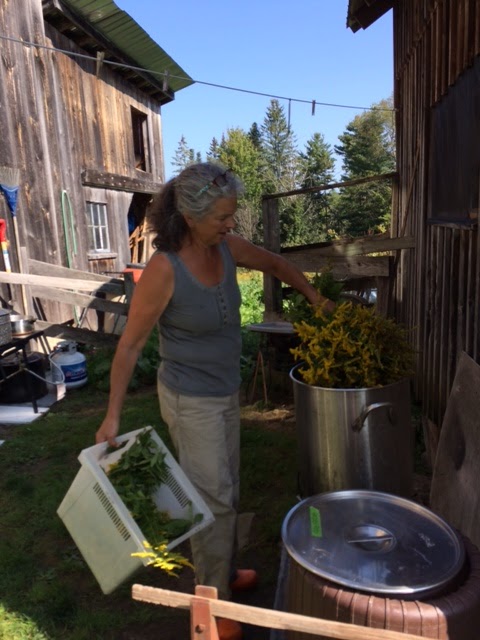
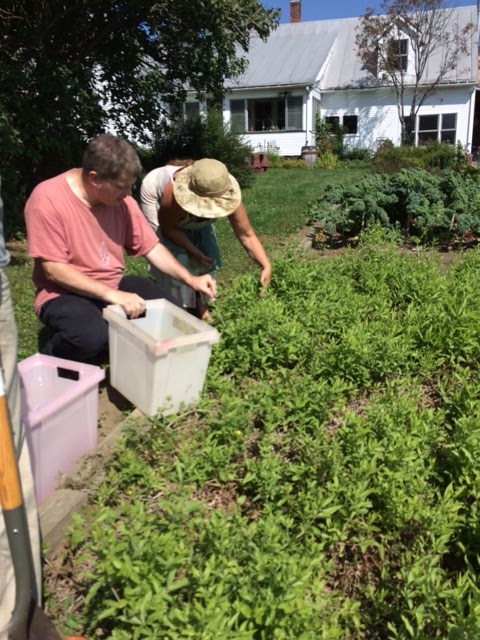
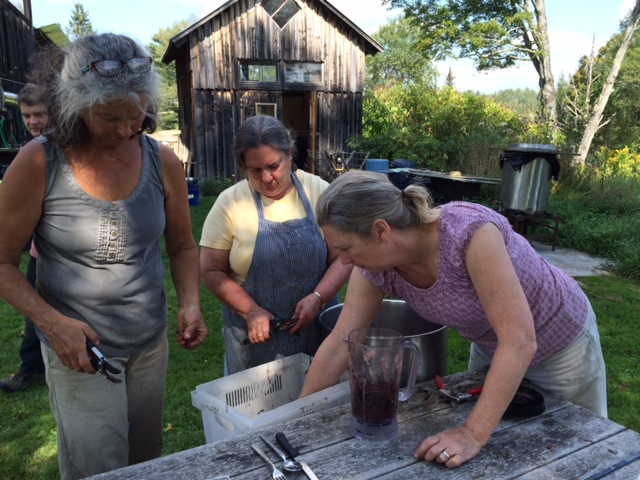
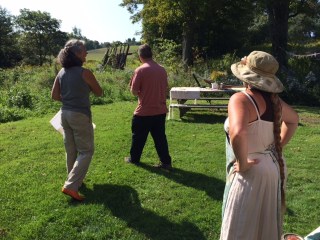
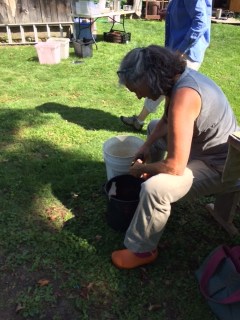
We learned soon that no, we’d not be sitting at tables taking notes. We’d be outside getting right into it with guidance from Joann. The other participants in our group were a sheep farmer and an herbalist. Within a short time, we found our rhythm and got to the work of collecting goldenrod, sorting mini-yarn skeins to be used in all the dye pots, chopping other plants, picking flowers, washing, tending to pots and listening.
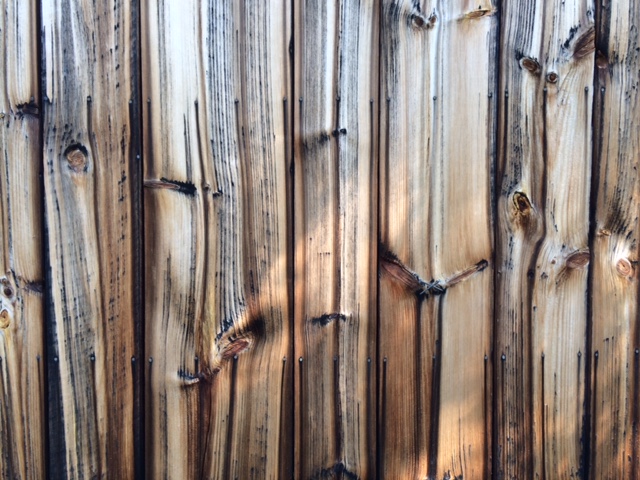
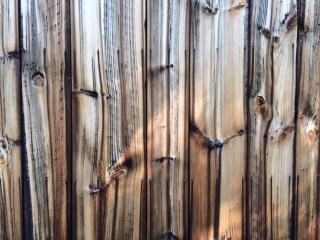
I just love this barn board. The colors and patterns are so strong. 
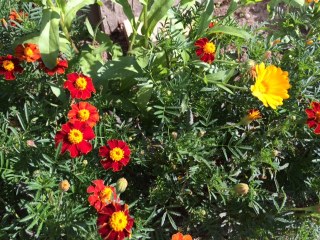
Below is a picture of goldenrod going into the pot.
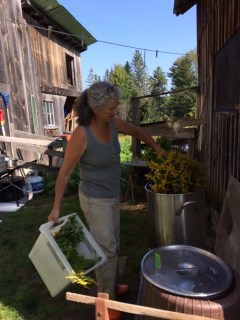
Here is a picture of Joann stirring the BIG pot~ I’m not sure what’s in there in this picture. There was a lot of boiling and a lot of rotating dye stuffs in and out. I love this picture. 
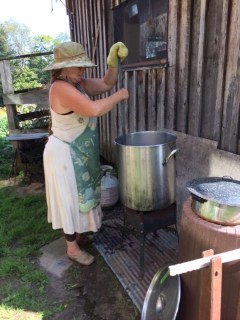
This is a student chopping up some flowers.
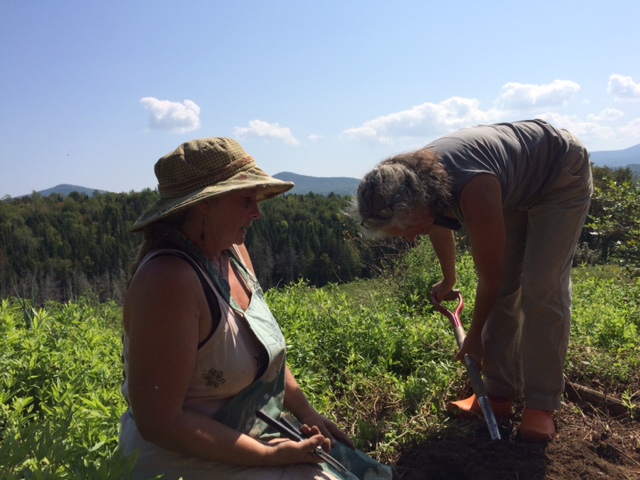
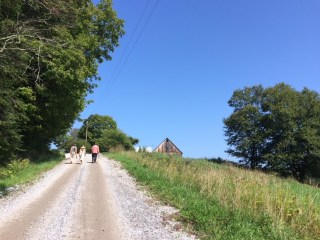
Once we got several dye pots going, we took a walk up quiet roads to the gardens of someone willing to share madder root and dyer’s greenwood. I haven’t gardened much this summer because of contracting the dreaded Lyme disease, so to get my hands in soil with a sweet purpose was just what the doctor ordered. The views and the quiet were also incredible treats.
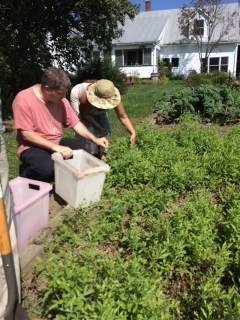
Once back to the pots, we broke for lunch in the shade, and then got to making more dyestuffs and hanging our wool to dry. We also did lots of overdyeing experiments with indigo. 
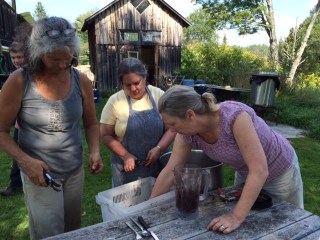
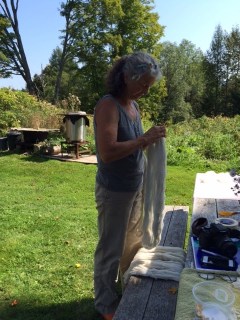
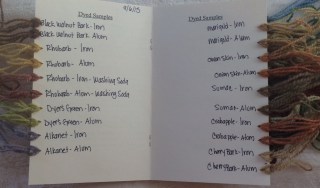
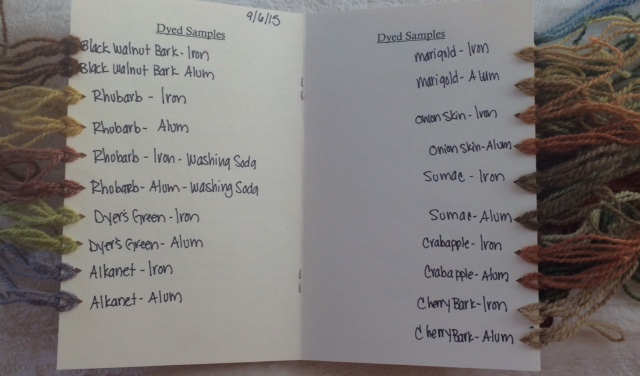
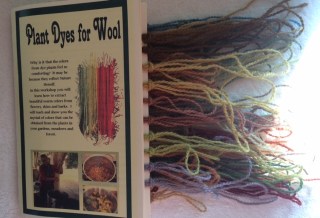
I wish I had taken better pictures of the yarn on the line, but you can see many of the colors we achieved in our efforts, and especially our teacher’s efforts, over the course of the day. Every dye pot had samples of yarn, half mordanted in alum and half in iron, so we got two color results from the same plant, plus a third if it was overdyed with indigo. As we got our books ready, Joann was available for questions and stories, and as each color was added to my book, I felt more and more proud and impressed by the outcome of our work. 
It was hard to leave this beautiful place. You know, the people going there to weave, to dye, to spin… I can only assume are not in a rush. Maybe I am projecting, but I think it must be true. Towards the end of the day, when I knew it was time to hit the road to get home to my family, I felt the first twinges of urgency, but that was only to do with my own inner need to reunite with my littles. There, in this extremely beautiful and entirely functional setting, I felt as if the sun and my stomach had become my clock. When the big beautiful tree covered us in lovely shade as we ate, it marked the natural passing of time, the pots simmering away with their unique and seasonally affected color potions.

On the way home, I could only daydream about following up on things I want to learn about, and experiment with. I think a forever student I’ll be.

Leave a comment

The Strength of the Warp Thread

“A true friend is someone who thinks that you are a good egg even though they know that you’re slightly cracked.” 

~ Bernard Meltzer

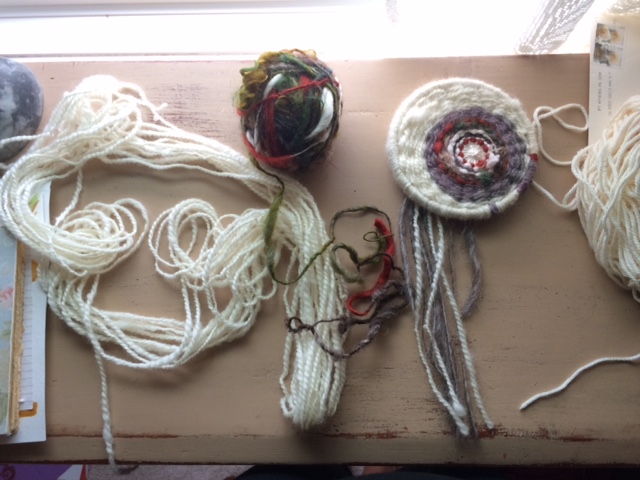
I like this quote. It is on a card that I bought a while back because I loved it, and it made me think of the friends I have that have kept being friends with me, even after they’ve seen the really me.  I thought about things kind of like this as I made a small circular weaving piece over the last few days. The warp thread in this is strong and sturdy. (The warp is the thread or yarn you attach to the frame to hold the tension and to give you something to weave around). When I chose it, I knew it wouldn’t break as I wove the weft yarn through. (The weft is the yarn that you weave over and under the warp thread). Here’s the thing about some of the weft yarn I used. First of all, I used almost all handspun, the majority spun by yours truly. Some of what I chose is from a skein I made using a lot of different fibers. There is wool roving in there, wispy locks and cotton from punis. It is strong in some parts and weak in others, and very inconsistent in thickness. I love this yarn. I love it so much it’s hard to use because I don’t want its texture and variations to get lost in stitches. I love how in some places I could pull it as hard as I might in opposite directions and it wouldn’t break, yet in others, it is so fragile that gently tugging on it would result in a tear.
I chose to weave with this special, fragile-strong yarn because it invites feeling and touching, and I knew that the warp yarn would hold it in place. I knew that using a solid, predictable and consistent yarn would protect my at-times-breakable treasure. And it worked. As I wove, I was sometimes able to move quickly, leading the yarn above and below the skeleton yarn without much thought. Other times I had to carefully push the yarn through so it made it to the opposite side in one piece. It didn’t always make it, requiring a quick repair, or a dedicated wrapping around the warp yarn. That extra twist, done by hand, of one yarn around another reminds me of the way sea horses hold on to seaweed to stay safe and secure in strong currents, an entwined tail around a grounded sea plant. It’s the same sort of thing.

The finished product shows the lovely handspun yarn in its full personality. I honored the weft yarn, though. It is the center of the circle. It is strong and sturdy and sits as evidence of what holds the whole thing together, its many arms reaching out to securely hold the frame with confidence.

We can be all of these things, all at the same time within ourselves. And of course we are different parts to different people throughout our lives, sometimes strong and reliable to another’s fragile and inconsistent fibers. We can also be the ones in need of the sturdy frame on which to lean and around which to wrap in times of frailty and moil. It takes both aspects responding to the other with the right amount of tension and just enough give to make a thing with depth and honesty. Mr. Meltzer had it right.