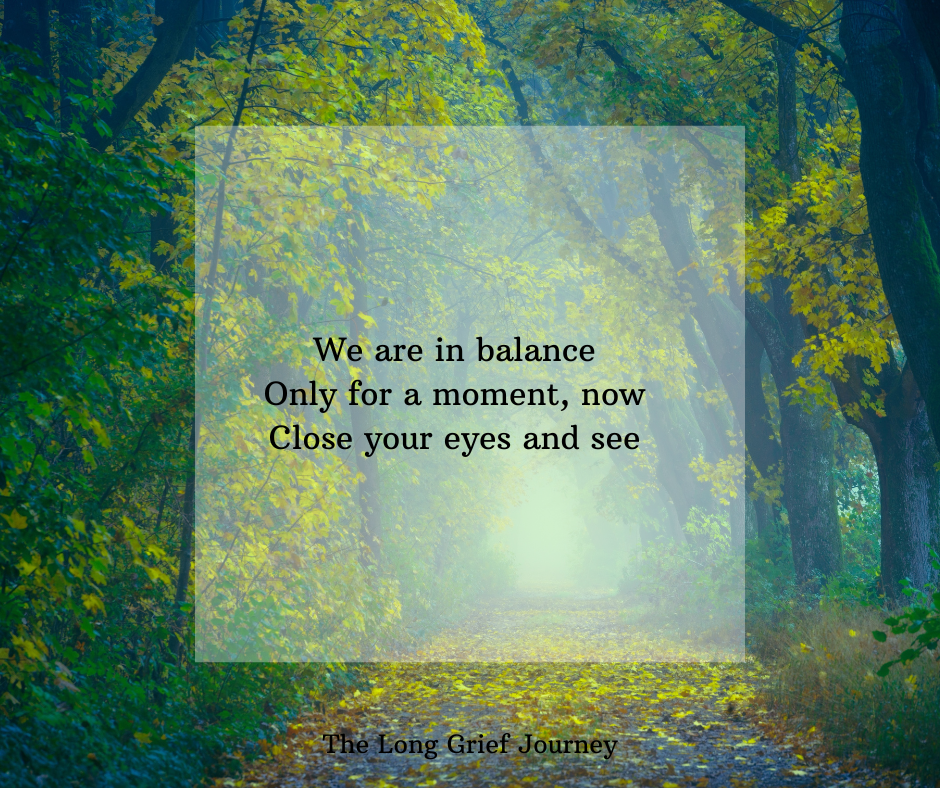
Balance means many things to people. I’ve found that at any given time in my life, my scales are always tipped in one direction or the other, but that sought-after feeling of just being still in equilibrium is fleeting. Especially when I’m tired, struggling, weary, afraid, or grieving.
Lately, my balance has been way off. A lot of push with not enough rest, quiet, or solitude. I know this pattern well in my life and it never fails that I get sick when I’ve not adjusted the scales with enough care.
I love the invitation of this day. In the northern hemisphere, we get to think about what we have sown in our lives that we can harvest and make use of, and what should be thrown into the compost bin. What can we put to bed as we head into the time of increasing dark?
Can we let ourselves rest?
Can we let go of things that don’t serve us?
Can we let go of things we wish we had or could do but with only so much time in a day, we must come to the aching realization that some things have to remain undone, unmade, unwritten? That hurts.
And in the southern hemisphere, as you head into increasing light, what will you sow? How will you prepare yourself for what you are hoping to bring into being?
In this nature-made time of reflection, what will you be tending to?
(This is reposted from The Long Grief Journey, a website dedicated to the book I wrote with Pamela Blair. I wanted to share it here because of how precious I feel the equinox is.)
Thursday is Children’s Grief Awareness Day. You can read about the origins of this important day here. If you have a child in your family, classroom, sports team, extracurriculars, or community that you know is grieving the loss of a loved one, you can find wonderful information on the Highmark Caring Place website about how to support them.
Definitely check out their Facts and Stats page for some insights into the breadth and depth of grieving children and the long-term flow of grief so many of them experience.
Below I’ve shared an excerpt from The Long Grief Journey in hopes of contributing to this very important conversation. There have been many times over the years where I’ve worked with children who appeared to be struggling with learning or behavioral issues who also had lost a loved one. Sometimes it was long enough before I became involved for educators and other important adults in their lives to not be aware of the child’s loss. Sometimes too, the assumption was made that so much time had passed between the child’s loss and whatever was happening at the moment that the two issues (or more) weren’t related. What we found, time and again, was that with tender care and raised awareness, support of children was more full-bodied, relevant, and empathetic when the picture of the child’s life was viewed as a whole, grief included.
I hope that if you are supporting a grieving child, you find this useful.
The Long Grief Journey, excerpt from Chapter 15:
Helping Children Cope with Long-term Grief While Tending to Yourself
It can be tough to help kids deal with grief when you’re grieving as well. It’s important to take care of yourself…
Amy Morin, LCSW, psychotherapist
A life built around a core sense of absence is its own type of grief and for many is difficult to describe in words. The journey begins early if your child lost a significant loved one at an age where they don’t hold any memories of them. If you’re helping your child grow up with the absence of a precious loved one, you already know you have a crucial role to play. It’s important to keep their deceased loved one in consciousness, by name and by image, to tell stories about them, saying their name in fluid, non-whispered ways. Consider also this truth: children will grieve and will process their grief in some way, no matter what we do. The more open we are, and the more space we can hold for them, the more fluidly their experience will go.
SPOTTING LONG-TERM GRIEF IN CHILDREN
When a child loses a parent…that child grows up feeling different and alone. A story is written in a secret place in that child’s mind—a story of loss and pain and the triumph over that pain.
Maxine Harris, PhD, author The Loss That is Forever: The Lifelong Impact of the Death of a Mother or Father
As much as we’d like to insulate ourselves from untimely loss, it’s proven to be impossible. Some people lose a loved one when they’re infants, and others after a long life lived together. There is no official roadmap detailing how loss will impact a life, but some themes emerge worth considering.
Here, we write as though you are a parent or caregiver to a child who has lost a significant loved one, but if you are reading this section with yourself in mind, hold a space for remembrance of your age and your thinking and needs from that time. So often as children go through their own grieving process, they are supported by people who are also grieving and who have varying levels of knowledge about developmental ages and stages and the needs associated with them. Those who are in the acute stage of grieving don’t generally have a lot of extra energy to spare.
Let’s begin with what unifies us all in the experience of long- term grief, regardless of the age you are at the time of loss. In the beginning, common feelings and reactions include anger, ambivalence, longing, and the persistent striving to recover the person lost. Age is what tends to dictate how these emotional reactions appear and are understood or expressed. As a rule, adults have more life experience than children and have more reference points for identifying feelings and for asking for what they need. Children are often confused about what their feelings are about and may even struggle with naming them. Anger can feel more like an urge. Persistent longing might be expressed through obsessive ritual and magical thinking. When young children lose a parent, sibling, or other precious loved one, the effects can last for years, especially if they are not supported by the important adults in their lives in a way that allows all of the feelings and fears to be expressed and processed. Michael described how his granddaughter continues to process the death of her father who passed away five years ago.
My granddaughter has hundreds of cuddly toys. So many around her bed that she can’t get in it! She fixates on keeping them all in the same order. She is ten now and she doesn’t look to be abandoning her teddy bears any time soon. We just accept it.
It’s so important for caregivers, teachers, and other adults to know that even years after a child loses a dear loved one, especially a parent or sibling, issues can arise which look like anxiety, depression, attention deficit disorder, autism, obsessive-compulsive disorder, and academic delays. In a child’s life, loss changes the shape, texture, flow, and rhythm of most everything. It doesn’t mean they can’t go on to live wonderful enriching lives, but it does mean the relevant and important adults in their lives need to keep an open ear to underlying issues as they express themselves.
Older children and adults understand time and finality, whereas infants, toddlers, and young children do not. Forever can be both an impossible concept to understand as well as terrifying when applied to the deceased loved one. It’s easy to see how immediate grief reactions can evolve and morph into long-term and unresolved grief as the child learns to have a relationship with someone who isn’t there. Even years later, people of all ages report “seeing” their loved ones in passing cars or in groups of people. Pam swears she saw her father sitting in a diner eighteen months after his death. “I saw him sitting in the window from the parking lot wearing his favorite baseball hat, and I almost approached him!” This kind of seeking behavior is found in people of all ages.
No matter the age a child is when they lose an important loved one, they are likely to regress to behaviors from a younger developmental stage, at least for a while. Children who were potty-trained may bed wet again for a time. Teenagers may want to sleep in their parent’s room or may not feel comfortable going out. Moreover, adults may wish for someone else to manage the nuts and bolts of life, responsibility feeling too burdensome and stressful. Herein lies the potential for a complicated battle of the needs. It’s easy to imagine that if an adult is feeling the pains of grief for a long time and needs a release of pressure, it might be doubly hard to care for children who suddenly are not only grieving but are also doing things that are unexpected, appear immature, or even are annoying. The way children’s caregivers respond to these regressions has a lot to do with the way grief is metabolized in the long run. That’s why getting support and gaining increased under- standing of how children express is so very important.
A LIFE REDEFINED
Ian was twelve when he lost his father. When he was twenty, he asked, “I wonder what kind of man I would have been if I’d had my father all this time.” Now he’s forty-one and told us, “I still miss him every day.”
Pam
Another thing to remember is that at every developmental stage or milestone, life is redefined. Graduations, new jobs, greater independence, a committed relationship, parenthood—all these things that come to pass in a life stand out as one more life event a parent didn’t witness, and one more moment to grieve. Over a lifetime, metabolizing this loss and incorporating it into one’s identity is the goal.
Those who lost a loved one at a young age might not feel free to talk about them. Some feel as though bringing up their name or names will make others uncomfortable. Some suffer from feelings of sadness and jealousy when they witness others having close and bonded relationships. There is a sense of difference, of otherness that marks a person’s life and can make special moments at best bittersweet, at worst, emotionally intolerable. It seems there is a value placed on the recency of loss. The further back one’s loss goes, the less room it gets to take up in conversation. Meanwhile, the person who lost someone at an early age may feel like this fact of their life is the first part of them that enters a room, the rest shaped by this loss.
Whether we’re healing our inner child, tending to our adult wounds, or helping another person on their long journey, it helps us to be oriented to where a person was in life when they sustained their profound loss. It can also help us serve ourselves from a tender and compassionate point of view.
~~~~~~~~~~~~~~~
A Book Recommendation: a dear friend of mine whose family has been impacted greatly by loss recommends the book The Invisible String, by Patrice Karst. She said this book was invaluable to her family when they were supporting her grandchild through grief. There are other books in the series that are all wonderful and deeply supportive of children and those who care for them.
Do you have books you recommend for grieving children?
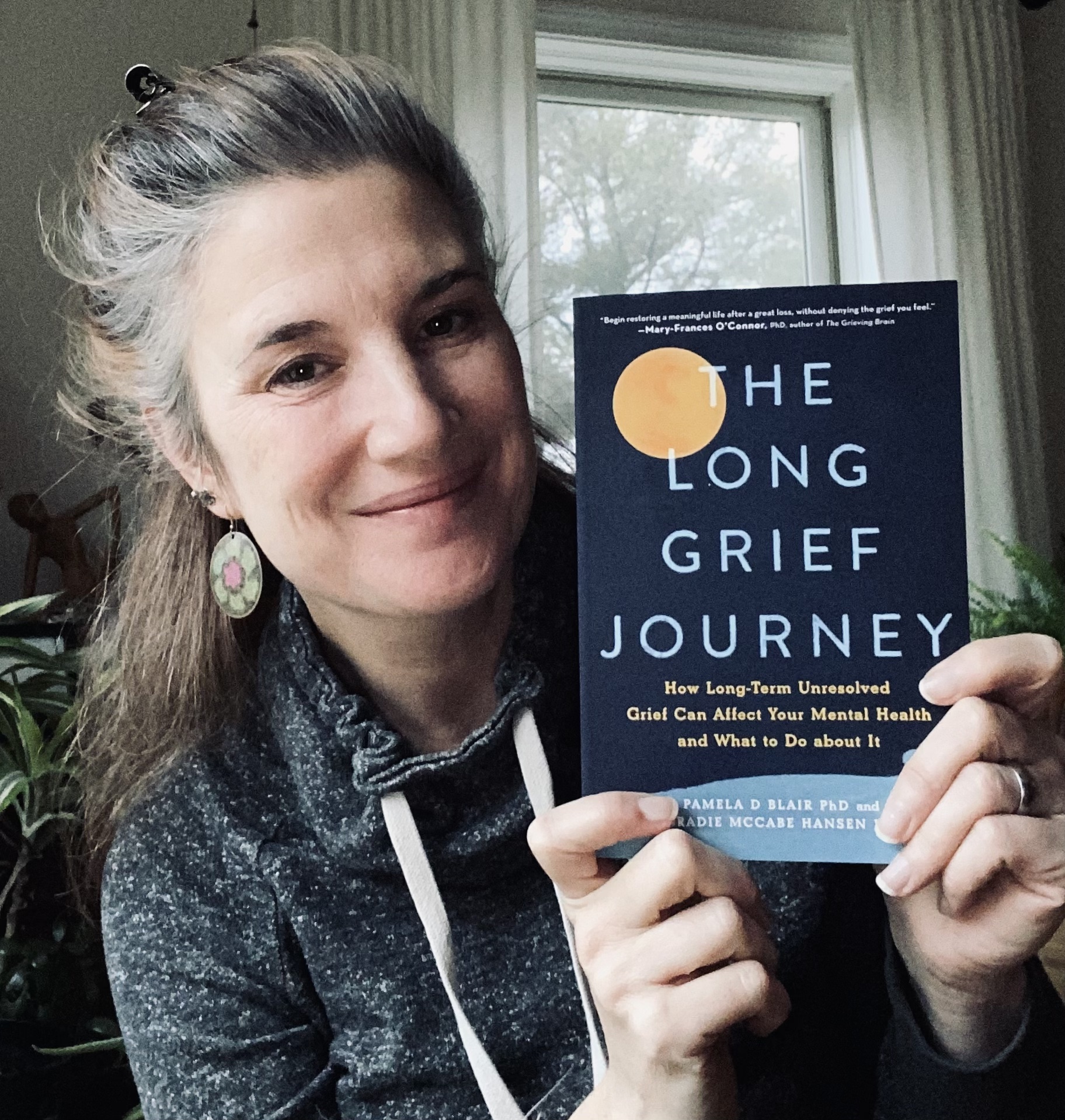
I can’t believe it’s finally happened, but this week I received a box of books, all of them The Long Grief Journey: How Long-Term Unresolved Grief Can Affect Your Mental Health and What You Can Do About It. In spring of 2020, my friend Pamela Blair who co-wrote I Wasn’t Ready to Say Goodbye and is the author of several other titles, asked if I’d be interested in writing a book about long-term grief. I wrote about that moment here. And now, a month before its release (on February 14, 2023), I get to hold it and read it and show it to people. Wow. What a trip!
It’s been a long time since The Long Grief Journey was picked up by Sourcebooks and I owe a debt of gratitude to the wonderful editor who saw the value in making our work available to people and helping us to shape it and edit it well- thank you Erin! In the last year, the waiting for the book to come to print was starting to make it all feel a little bit unreal, and a little scary and then a little disorienting- wait, we’re almost at the release date?! I need to get a new outfit or something! But now, holding the book in my hands, I remember it all: the first invitation to join Pam in the project, the jumping into researching and brainstorming and writing, rewriting and collaborating, submitting and waiting and hoping and praying and now… here it is. And I am proud. Grateful and maybe even a little bewildered, too. To be able to use my own grief experience while being honored by so many people sharing their stories with us has in many ways brought an intimacy and more open heart to my day to day than ever existed before. Maybe the word is humbled? My heart feels tenderized.
If you end up reading the book, I hope you find it useful. We really are all walking this road together.
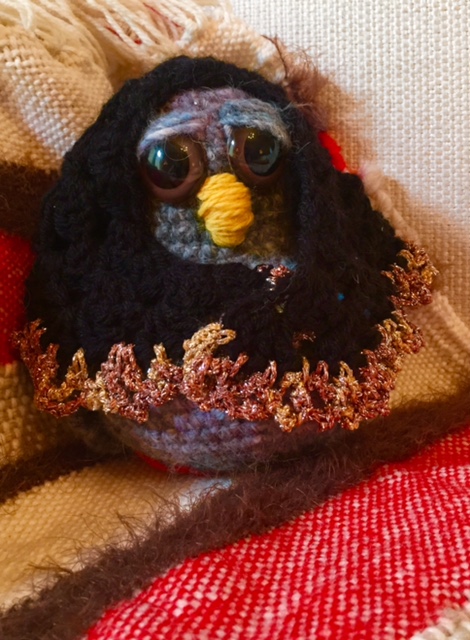
We have a new guest speaker to introduce. Please meet Nanna. She has come to us after many of life’s trials and tribulations. These include heartbreak, loss, grief and change of plans. But, Nanna is more than her pain and her burdens. She is wisdom and she has carried on through prayer, practice, ritual and faith. Nanna has also enjoyed the throes of romantic love, the blessings of motherhood and the anchor of deep friendship. She is a rare bird in these parts, these days, and she wanted to be able to share what she has learned during her long time on Earth. Realta and Sherman are overjoyed to be with her.
HH: Nanna, it’s so nice to have you join us. What is on your mind today?
Nanna: It is wonderful to be here and to have someone want to hear what I think about. It’s been a while since anyone has asked. Today, I am thinking about ritual, and work. After meeting many folks, feathered and otherwise, I am sensing great longing and hearing some confusion about what it is to have faith and practice. Not all beings need to embrace religion, of course. I am of the old world. Church does not offend me or scare me. I see it as a place to commune with God, the Great Spirit, the Holy Mother and Holy Father. I see it as a place to meditate, to pray, to find peace. But that is not what I mean by faith. Using that word is a choice and is meant to reflect rather a sense of connection with everything. To believe that there is a connection to Every Thing. I have also been thinking about ritual. Quiet prayers. Kneeling, standing. Chanting. Ritual has been a part of lived experience for millennia, and to some extent, I see it’s absence in modern culture creating vacuums where anxiety and distraction lie.
HH: What do you mean by ritual? To many, that word conjures images of formality and discipline within a dogmatic religious sphere.
Nanna: Well, I’ve learned over time that cultures and religions all have their own rituals. They are merely repeated acts, usually done in a certain order to support some kind of ceremony. Of course it is true that ritual plays an enormous part in what we do in the religious context. But that is not the only place where ritual lives.
What I think about is, why ritual? Why have we been doing ritualized things for so long? There is some kind of ordering principal to ritual, perhaps that establishes a mood, prepares the psyche for a set of experiences, etc. It seems important when considering how we have evolved over time.
HH: As someone who does not attend church but has enjoyed the rites and rituals of several different faiths I’ve been exposed to, I understand what you mean. What would you say to someone who does not identify with a specific religion?
Nanna: I’d say that ritual is all around us and that likely if we tune in to what we are doing, we’d see the pull towards ritualized archetypal practice. Look at the weaving you just completed. My guess is that before you began your piece, you had an image in mind, an intention, a hope. Maybe you thought of a person, or a place when you sat down to begin your work. You went through the process of warping your loom, walking back and forth, wrapping yarn around the peg. Did you do that rhythmically? Was there a beat? A resonance? Likely there was, even if you weren’t conscious of it. It’s hard to do that kind of work without it.
Once warped, you set to the process of weaving, back and forth with the shuttle, up and down with the heddle. You may have been praying, thinking, spacing out or tuning in , but you were making. Here and there on your piece, you can see areas where you got stuck or maybe had too tight or too lose of a warp thread. Learning and life captured in fabric. The work of the hands with materials, in my mind, is a form of ritual.
HH: I never thought of it like that. It’s funny that you can see my warp errors. Definitely still learning. But even though this is new for me, to weave on a rigid heddle loom, I still found the rhythm and the flow eventually. It’s the thing I love about weaving. Once you hit that flow you can let go and create at the same time, and make something tangible and useful. Spinning, too.
Nanna: Yes. That is what I like about it, too. And you know, there are cultures around the world for whom weaving and the dyeing of wool was a very spiritual and symbolic process. Patterns, shapes, the weavers themselves were and still are all part of the act of creation. Look at the goddesses all over the world who are associated with weaving and spinning: Frigg, Arachne, Maya to name a few. These goddesses’ stories tell tales of life, death, the merging of spirit and the corporeal.
I like this quote from John O’Donohue’s Eternal Echoes. I think it captures the aspect of weaving and other crafts that is of the hands. I am making an arch between the essence of using one’s hands to create and ritual, which creates a deeply personal relationship with our world and nature, our functionality and our usefulness.
“The whole structure of the human body anticipates and expects the presence of others. Hands reach out to embrace the world. Human hands are powerful images. Hands painted the roof of the Sistine Chapel and the heavenly women on the wall of Sigeria, wrote the Paradiso, sculpted the David; in Auschwitz, hands rose to bless the tormentors. Hands reach out to touch and caress the lover. Hands build walls, sow gardens, and direct symphonies… The whole history of our presence on earth could be gleaned from the witness and actions of hands. One of the great thresholds in human civilization was the development of tools with which we changed and civilized the landscape. The use of simple tools still meant personal contact with Nature. In these times, we have crossed another threshold where the tool is replaced by the mechanical instrument. The instrument is a means of exercising a function. With the development of instrumentalization, so much of our work and engagement with the world is no longer hands-on. Rather, our hands press the key and the instrument expedites the action. Instrumentalization saves labour but at the cost of direct contact with the world.” (pgs. 60-61).
I chose that piece to share because it is relevant to what I see happening today, a call back to the traditional skills that requires that individuals touch tools, land and nature. There is a reason handcrafting is such a powerfully moving medium these days. I do not believe it is a fad. I believe it is a call to re-engage with our hands, with our connection to Earth, to Nature, to our own resourcefulness and perhaps to having a good appreciation for what something is worth. Weaving, in many ways, can be seen as ritual made physical; ritual made practical. If one allows for it, weaving, knitting, crochet, spinning fibers… they all can serve as grounding and meditative experiences. That is beautiful because that is day-to-day life. Religion or no religion, engagement with materials can be meditative, instructive of our own nature and can bring us into alignment with our surroundings.
HH: So, you don’t think attending a specific church is necessary to gain this wisdom?
Nanna: Of course not! People all over the world have their own ways of attending to their relationship with their own spirituality, if they so wish. Organized, not organized… this is an entirely personal choice. What I am saying is that the call to ritual is apparently very important to the core of being, as it has been with us since documentation of any kind began. And, we can access that call through handwork, through handy-work, through engagement with our land and through an abiding respect for nature. Isn’t that wonderful?
HH: You are making me want to warp my loom again!
Nanna: Good.
You can expect more from Nanna here on Healing Handcrafting in the future.




 Healing Handcrafting