Healing Handcrafting


Leave a comment

Co-creating after death

My mom was a very talented artist. She had an eye for alluring shapes, luscious textures, intricate details that could easily be missed if one didn’t stop to look closely at whatever-it-was. In Florida, we lived on a bayou and the whole back of the tiny house on stilts opened to a view of it, tree and mangrove lined. The bird life there was epic. Alligators glided through the water, occasionally lumbering up the bank into our yard. Oh, do I have some stories about them.

Much of what my mom made included materials found in our yard or on the island. She had this uncanny ability to use the natural contours of something to house or nestle around little sculptures she’d make, usually faces. Once, when I went home for a visit after I’d moved to Vermont, one of the walls in the open space in the middle of our house was adorned with her pieces of art. I was breath-taken. They were exquisite. I went directly into agent-mode, wanting her to get her work into local galleries. I wanted everyone to see what I saw.
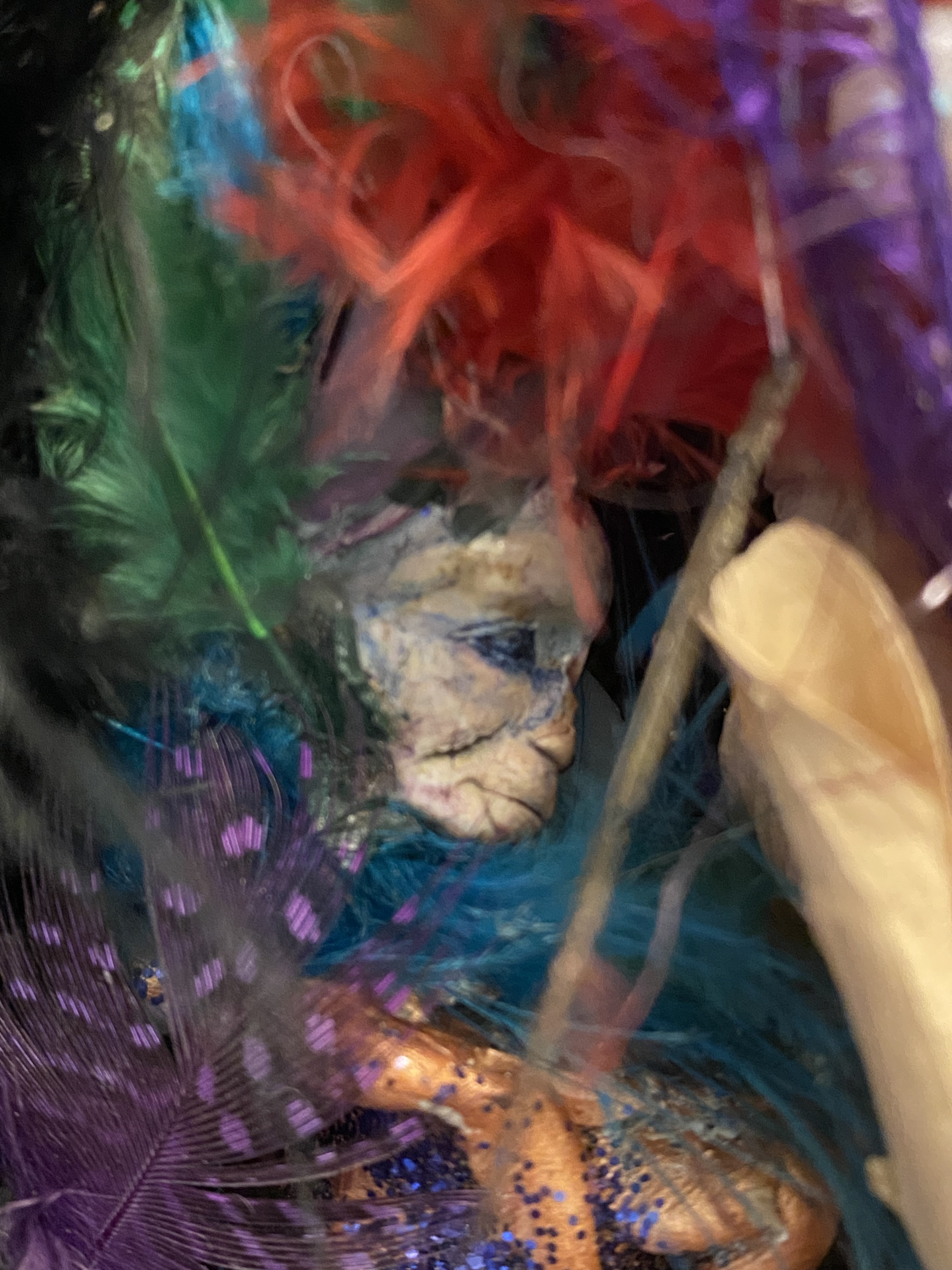
After my mom died, eight years ago now, many of the materials she used in her art ended up with me. One piece in particular has hung on the wall in my studio for a long time. It is a material that comes from palm trees and is like netting or burlap. It’s the most amazing material, woven by nature, strong, pliable, beautiful. I’ve wanted to make something with it for years but nothing was coming to me so I let it simply be itself.

Last week, I was in the midst of repurposing a piece I’d made about a year ago for an art exhibit. It was fabric of very fine grey linen, knitted loosely. I wanted it to be something else and was letting myself play. After treating it with a stiffening agent so it didn’t unravel in my hands, I moved it around and “asked” what it wanted to be and netting came to mind. As I sat at my table strewn with materials, I thought about my mom. Then, I invited her to play. What does that mean? I welcomed her to participate in what I was doing. I talked to her in my mind and imagined how she might have approached what I was doing. Then, I remembered the palm netting. It was at that moment when I felt, “oh cool, we’re making something together”. And then I got to it.

When people ask me how I use fiber art or handcrafting to process grief or life events, I know I answer the question, and I have a lot of things to show for my efforts. But in the moments I’m describing here, I got to observe myself while in the process of doing it, and I wanted to share some things that came clear to me. I believe anyone can do this, with whatever materials they have on hand, whether they or their loved ones were/are artistically inclined or not. And by the way, I truly believe all humans are creative beings. Creativity is not just for some people. It is an energy and a gift available to all of us because it resides in us.

Why am I sharing a personal moment like this in such a public way? Because I think about grief and love all the time, and help people process their own when I can. And I can tell you with absolute confidence, creating while in the mindset of connecting with a loved one* or processing grief does something. Many things. Here’s some details:

~ It creates a space in which you can think about and talk to your loved one.
~ It can be playful, which benefits our mental and physical health tremendously. You can read about that here.
~ It fosters the bond between you and the one you are grieving – read about continuing bonds as described by Dennis Klass here.
~ It’s a worthwhile effort, even when the relationship was painful or your grief is complex.
~ You make something meaningful to you. There’s no getting it right or wrong.
~ New thoughts, emotions, and understandings have a way of coming forth when you allow the time and space for them to emerge. When this happens in a creative zone that utilizes some form of action (art making, cooking, gardening, singing/playing music, writing), these shifts are metabolized through the body. All the thoughts and emotions are no longer only housed in the mind, but flow through the body, which can lead to greater peace.
~ You might be able to repurpose things that would otherwise be stuck in a drawer or thrown away.
~ You hang out with yourself, which is something I highly recommend. You are worth your own attention.
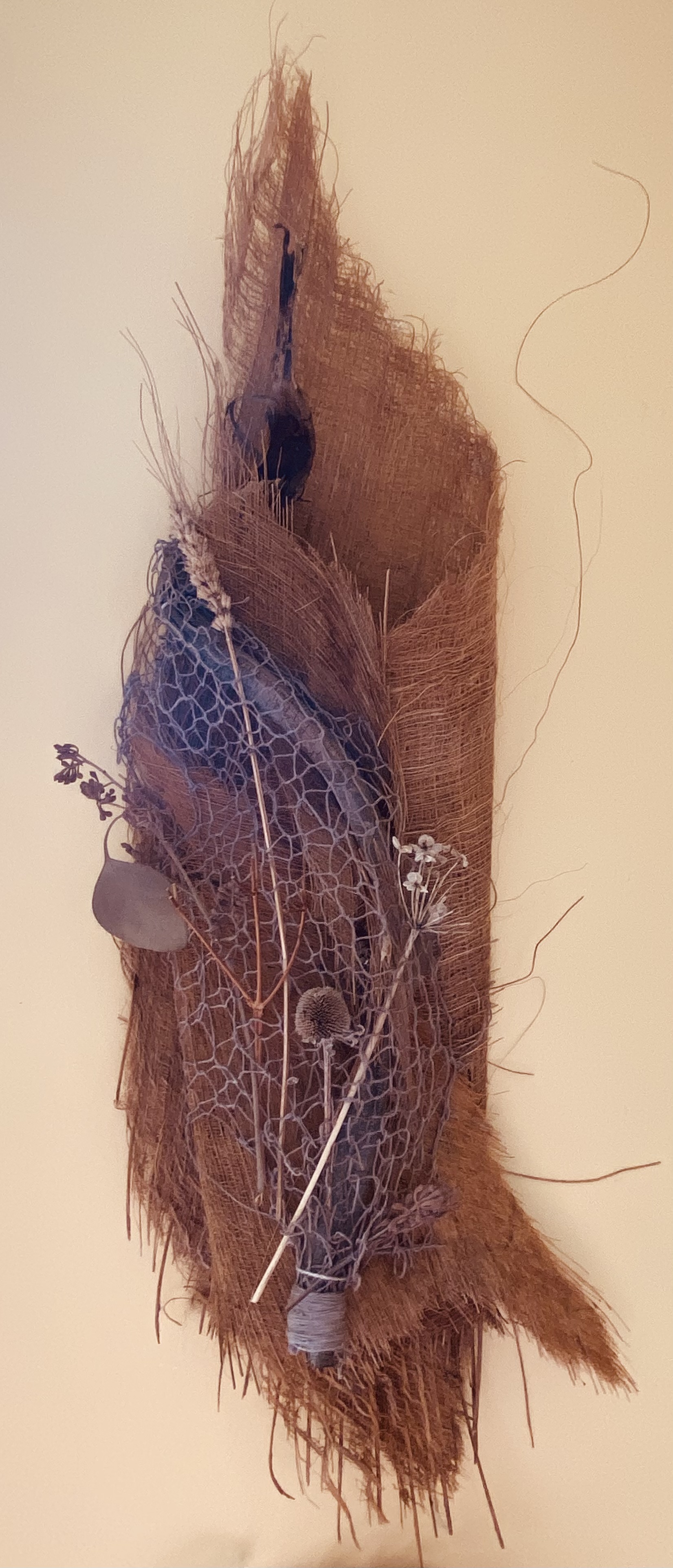
unfinished co-created piece by my mom and me

This new co-created piece between me and my mom is not finished yet. It’s hanging in my studio in a spot that is important to me and commands my attention. I find myself looking at it and feeling all of the textures and imagining what it will be when it is finished. There’s no rush to get it done and I suppose this is a chance for me to just be in my thoughts with and about my mom. It’s an ongoing invitation…

Until next time… ~ bradie

* I often use the term “loved one” to refer to the person we are grieving. This is not to imply that all has to wonderful and conflict-free in terms of the relationship one had with the deceased person. I should figure out a new way to refer to the person who has died that allows for imagining processing all loss creatively, not just the loss of someone we had a generally good relationship with. It is possible to do this, and is very valuable. Even if grief is complicated, there are ways to work it out through creative expression.
Leave a comment

Grieving While Knowing About Grief

(this post was originally published on The Long Grief Journey website)

This year is off to a very raucous and rather painful start. I know I am not alone in feeling this way, but I wanted to share with you what has been happening because it is so relevant to the topic of this site, which is in a word, grief.

Just over three weeks ago, my father died. Six weeks to the day prior to his death, my grandmother died. In a matter of six weeks, my family lost two elders, and the reality of this is continuing to seep into my mind, heart, and bones.

Several people have asked me if the book I wrote with Pamela Blair has helped me deal with my grief. It’s been an interesting thing to think about. Going through the process of losing my dad with my family, I often thought to myself, “my god, I cannot believe how much this hurts.” There were times in the hospital as well as at my dad’s wake when I didn’t feel my feet on the ground. There were times sobs erupted from my body without warning. There was a lot of sleeplessness and anxiety.  What I realized was that knowing about grief doesn’t alter the pain of grief. But what it has done for me is to normalize my experience of it and not judge myself for anything. Steeping myself in research on grief and talking with so many people about their experience of it, I see that when we go through grief, we know it. When we listen to people who are suffering without trying to rush them to feel better, we absorb and open our hearts to humanity. We become part of the fabric of our shared experience, and it is textured, layered, real.

Our “culture” is often accused of not doing death and grief right. Collectively, we don’t talk about it enough, we keep it away from us and fear it. We try to outlive death and deny its existence. There is evidence of all of that, for sure. But I can say that going through these last couple of months, I’ve witnessed far more people getting grief than not. At my father’s wake, tons of people came and not one person said anything that made me bristle or think, “wow, they just don’t get it.” Mine and my family’s pain was held, responded to tenderly, and with deep interest and compassion. I wasn’t able to attend my grandmother’s services due to having COVID-19 but I feel sure the same energy was present for my family then.

What I do see in our culture is that capitalism and our bowing at the altar of work is a huge problem. One family member of mine had two unpaid days of bereavement for the death of a close family member. Two unpaid days. What? Is that a joke? Several others’ jobs had policies that were a little better than that and their management was very accommodating given the unbelievable losses affecting our family. But it’s important to know this: federal law does not require organizations or companies to include bereavement leave in their benefits packages. As of April 2023, only five states in the US had bereavement leave laws; three additional states had bereavement legislation efforts in the works. “As the Family and Medical Leave Act stands, bereavement is not an acceptable condition for taking unpaid leave from work.” Time minimums for bereavement leave as well as payment structures vary from state to state (or those five states that have actual bereavement laws). citation

For the rest of the country, it is up to the company or organization to determine their own bereavement policies including whether to have them at all. The typical scenario is three- to five-days leave. Sometimes these days are paid, sometimes not, sometimes a hybrid of the two. The size and financial constraints of companies obviously affect this to some degree. Also important to note, only 56% of the population works for places that even have benefit packages. What do hourly workers or those that are self-employed do when they suffer a loss or a family tragedy?

With this kind of pressure to get back to work, there is an underlying communication which is basically, “get yourself together enough to get back out there”, which for many people following the death of a loved one requires faking it. Big time. Feeling distracted, depressed, exhausted, confused, and vulnerable are very common emotional experiences following a loved one’s death, and having to fake it can make things more difficult for people. In fact, for some this is an added layer of trauma that complicates grief in the years to come.

I feel incredibly fortunate to have been in a position where I could take the time I needed to gather myself back into a place that was fit for work. I continue to be in a place where I can do what I need to do to take care of myself. But I am aware that this is not the case for many people, and that is unacceptable. I think this cultural problem of not “doing grief right” is less a human problem and more a political and economic problem.

In sharing these thoughts with you, I am channeling the energy of my dad. He had strong opinions about politics and policy. I loved talking to him about these kinds of things and often called him to get his opinion on something or his long-view perspective on issues I didn’t fully understand. I’ve gone to call him numerous times in the last couple of weeks, looking to catch up and shoot-the-breeze. I’ll miss doing that so much but hopefully he knows (and I believe he does) that I’ll keep at it and continue to advocate for what I believe in.

And if you’re reading this because you are grieving, you are not alone. I hope you are taking all the chances you can to be tender to yourself and that you hold yourself with all the compassion you would afford another person. ~ Bradie


2 Comments

The Long Grief Journey

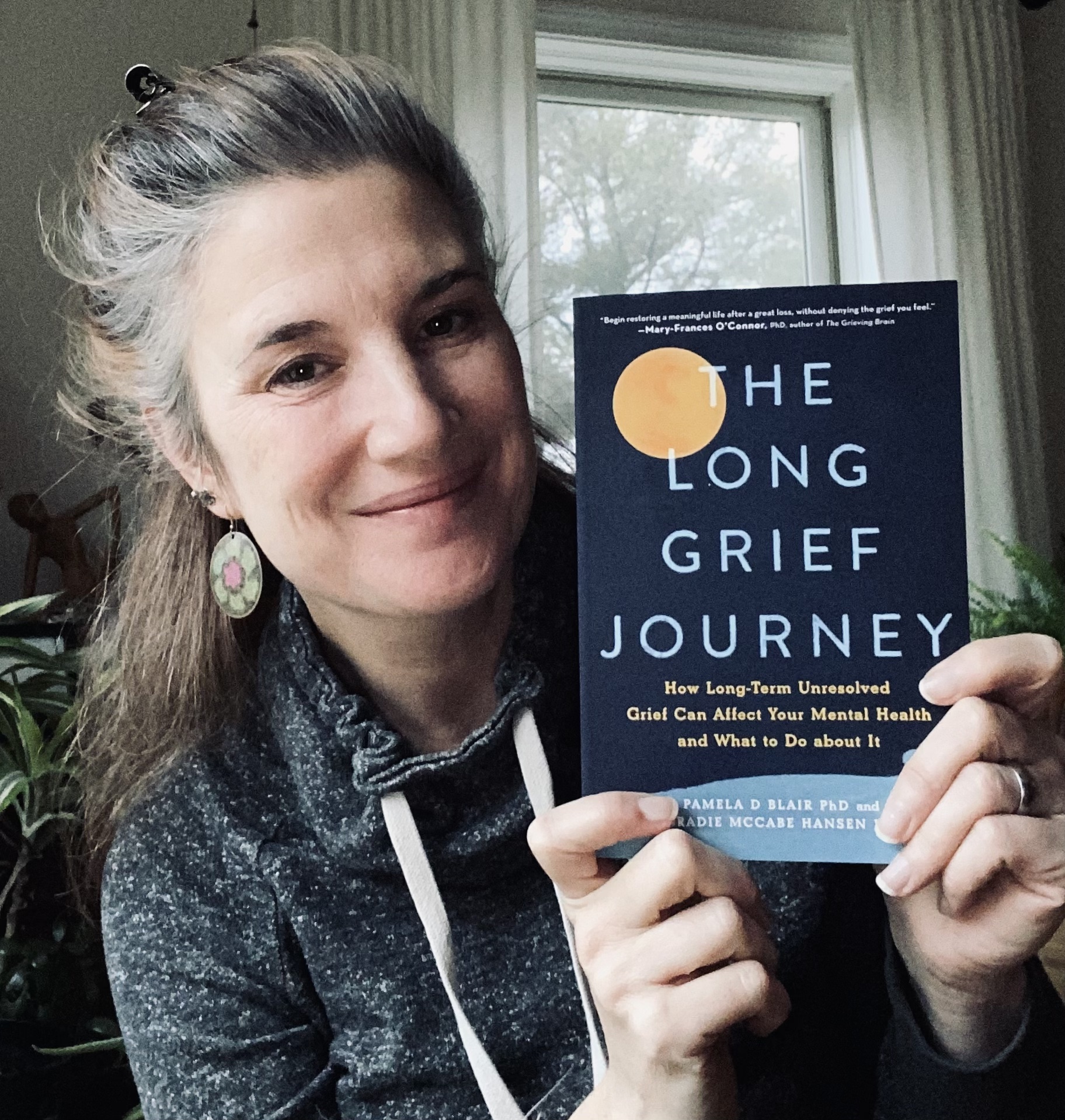
I can’t believe it’s finally happened, but this week I received a box of books, all of them The Long Grief Journey: How Long-Term Unresolved Grief Can Affect Your Mental Health and What You Can Do About It. In spring of 2020, my friend Pamela Blair who co-wrote I Wasn’t Ready to Say Goodbye and is the author of several other titles, asked if I’d be interested in writing a book about long-term grief. I wrote about that moment here. And now, a month before its release (on February 14, 2023), I get to hold it and read it and show it to people. Wow. What a trip!

It’s been a long time since The Long Grief Journey was picked up by Sourcebooks and I owe a debt of gratitude to the wonderful editor who saw the value in making our work available to people and helping us to shape it and edit it well- thank you Erin! In the last year, the waiting for the book to come to print was starting to make it all feel a little bit unreal, and a little scary and then a little disorienting- wait, we’re almost at the release date?! I need to get a new outfit or something! But now, holding the book in my hands, I remember it all: the first invitation to join Pam in the project, the jumping into researching and brainstorming and writing, rewriting and collaborating, submitting and waiting and hoping and praying and now… here it is. And I am proud. Grateful and maybe even a little bewildered, too. To be able to use my own grief experience while being honored by so many people sharing their stories with us has in many ways brought an intimacy and more open heart to my day to day than ever existed before. Maybe the word is humbled? My heart feels tenderized.

If you end up reading the book, I hope you find it useful. We really are all walking this road together.