Healing Handcrafting


Leave a comment

Farm to Frame Felting Fun with First Grade Friends

I am so very lucky to have standing dates on Fridays when I teach kids how to do things with wool and with yarn. These Fridays are now known as “Fiber Fridays”, and have become a part of my life I am extremely grateful for and proud of. I think about it a lot, why I want to do this stuff with kids. First of all, I have two kids of my own and I relish any chance I get to participate in things in their classrooms. I get to meet their friends, know their teachers and just be part of their school world for a small time, which is amazing. I never leave without internally bowing to teachers, para-professionals, one-on-one specialists, reading specialists, special educators. They make the world go round, in my book. Their love and dedication to the field, and the skills they have, just blows me away.

Okay, so yes, I love being in my kids’ classes. I also love going into other classes and meeting even more kids and answering questions and getting excited about new stuff. It’s just fun and a beautiful complement to my work as a psychologist. I’m not being a psychologist in any formal sense of the word when I am in with children on Fiber Fridays. However, I am sharing something that I truly believe is deeply healing to the human spirit, and is a restorative practice. Handwork/fiber craft tie humans together in a most fundamentally ancient and organic way, and exposing kids to as many ways as I know how to work with fiber has become a prized part of my career.

In one of my first grade classes (the one my daughter is in), we’ve been exploring wool. We started with real free flowing exploration. I brought in big wool batts, smaller mounds of wool in a variety of colors, some fabric, some yarn, and a needle felting tool for just me to use, just in case some quick stick-togetherness was needed. I showed the class first different ways we can play with wool. I pulled it apart, I twisted it, I formed it into shapes and wrapped them in fabric and tied yarn around it. I encouraged them to just play and sculpt and imagine, and I let them know that there were no specific things they had to make at the end. Each table got its own basket of a big assortment of wool and then, it was off to the races! I was actually amazed, and I learned so much that day of free wool play. Children made babies, cradles, nests, birds, balls, clouds, old ladies, and animals. They played and laughed and shared. For some reason I was really worried that they’d be confused or adrift without a specific goal in mind, but I was wrong! They were happy to just go for it! I was lucky to have plenty of help from the teachers and a parent volunteer with cutting fabric, wrapping, needle felting and tying. It was peaceful and joyful. I do believe working with wool is magical.

Two weeks later in the same class, I referred back to our previous experience, and said, “this time, we are going to experiment with wool mixed with soap and water!”. Our project was to make felted balls. Before we began, I first showed them balls I made at home. I also showed them my “oops” items… a disc that was supposed to be a ball… a nest that was supposed to be a ball… a weird creasy ball that was supposed to be smooth. You know, it’s kind of hard, at least for me, to get a wad of wool to felt into a perfectly smooth felted ball with just warm, soapy water and your hands. I don’t know how Martha Stewart does it!

I then quickly showed them this book:

oops

And we talked about having one idea in your head when you go to make something and how sometimes it doesn’t turn out like that. I told the kids that we are learning, experimenting, having fun and seeing what comes out of our efforts.

On the floor I had set up a drop cloth with towels covering it. On that were six plastic mixing bowls, two with soapy water and four with clear water that had to keep being replaced as kids dipped their creations into them to rinse the soap.

Water + Wool + Soap + Being Okay with Oops = Felting

Balls were made. Some were smooth. Some were crinkly and seamy. We got a mushroom, some discs and some wild looking blobby alien life form planets, or maybe coral? I saw a bunch of children totally okay with experimenting and just seeing what happened and I think that right there is a major piece of wisdom gleaned from mindful handwork.

Freedom to experiment and see what happens, within one’s own heart and spirit, is such a beautiful thing, and it’s something that I think we all should tend to as often as we can. I am often guilty of hanging on so tightly to what my plan is that I forget to see what’s actually happening right in front of me. I forget to loosen my belly and breathe and just let things be as they are. It’s so easy to forget that.

You know what else blows kids’ minds about wool and felting? With some simple ingredients and some agitation, soft and fluffy wool is transformed into felt and it is impossible to return it to its original form. I can’t explain why something so obvious is so mystical and amazing to kids, but it is, and I need to meditate on the symbol.

Stay tuned. I’ll be sharing more projects and ideas and insights from this cool gig I have.

2 Comments

I Love These Two

Recently, my children and I hit a sweet, melodic flow. It’s not a coincidence that this occurred organically after I made some concrete decisions to simplify my life a bit, pare down the number of things I consider top priorities (how many top priorities can we possibly have?!), and just let myself live a little, without letting the constant internal judge that resides in my psyche like a doomsday specter screw up the sweet life I have. 
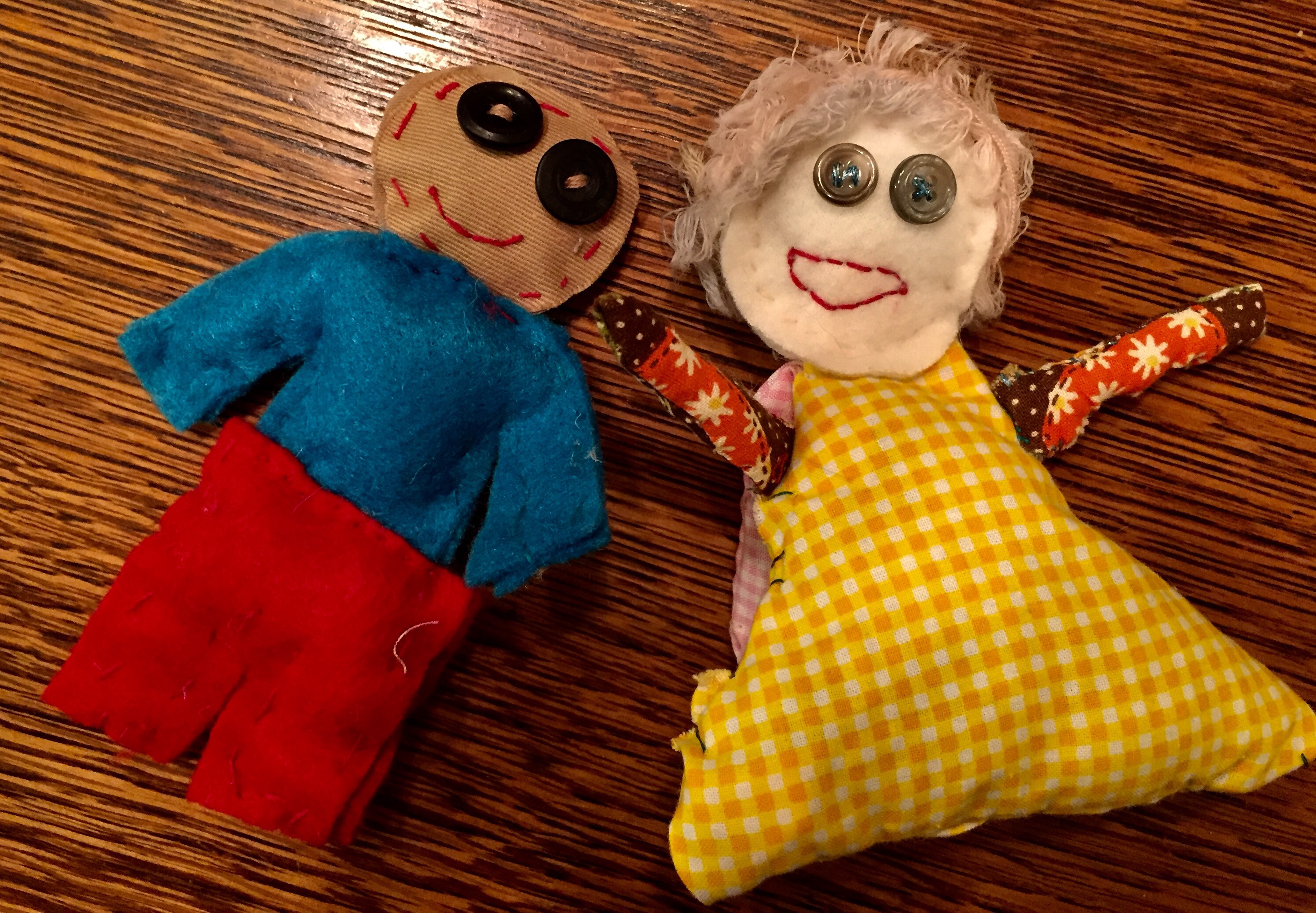
Afternoons after school, I worked on a gift for my cousin and her soon to be born Bebe, and my kids finished these wildly awesome dolls that they have played with every day since. I adore them. 


I’m learning, people. 

On the bus heading to my cousin and her full with baby belly, I just read a cool quote I thought I’d share, too. 

From, Will-Developed Intelligence: Handwork & Practical Arts in the Waldorf School, by David Mitchell and Patricia Livingston, it speaks to why making things from start to finish is so deeply satisfying and important for human beings. I’m working on curriculum ideas for my Farm to Frame series and find this quote a beautiful buttress to my efforts. I’m learning so much from this book. I did not go to a Waldorf school, nor do my children. It’s wonderful finding language, research and guideposts for teaching according to developmental stages. A true gem. 

I hope you have a lovely weekend, wherever you are in the world. 


1 Comment

Yarn is Medicine

Is the planet spinning faster than usual? Quick upticks here and there? Here’s a bit of life lately…

First of all, there’s more evidence that shows that my yarn obsession is good for me! Read this great article! And, jam making is most definitely in my future. 

Below is a piece I made that started out as a woven boat, but as I had to keep tinkering with a too-loose warp I began thinking about those fleeing war-torn Syria on boats too small, too packed and too weak. It became a meditation for me and I decided to donate the money from the sale of this boat to the Refugee Resettlement Program in Vermont. It will be for sale at an upcoming Holiday Pop-Up. 

Here’s my littlest love feeling the Christmas spirit. 

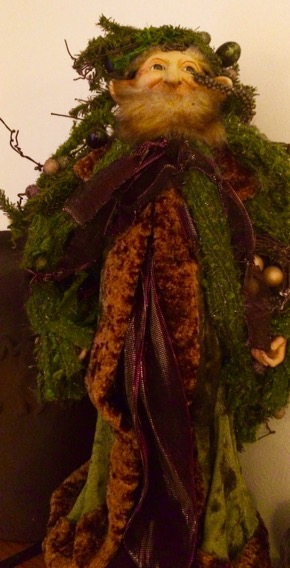
My mom always put dolls and fairies and magic in our Christmas trees. I hope I can do it even a fraction as well. 

Beautiful tree lights our mornings and evenings. 

My spinning wheel has been busy, busy! I have much more yarn to make but it’s been lovely! 

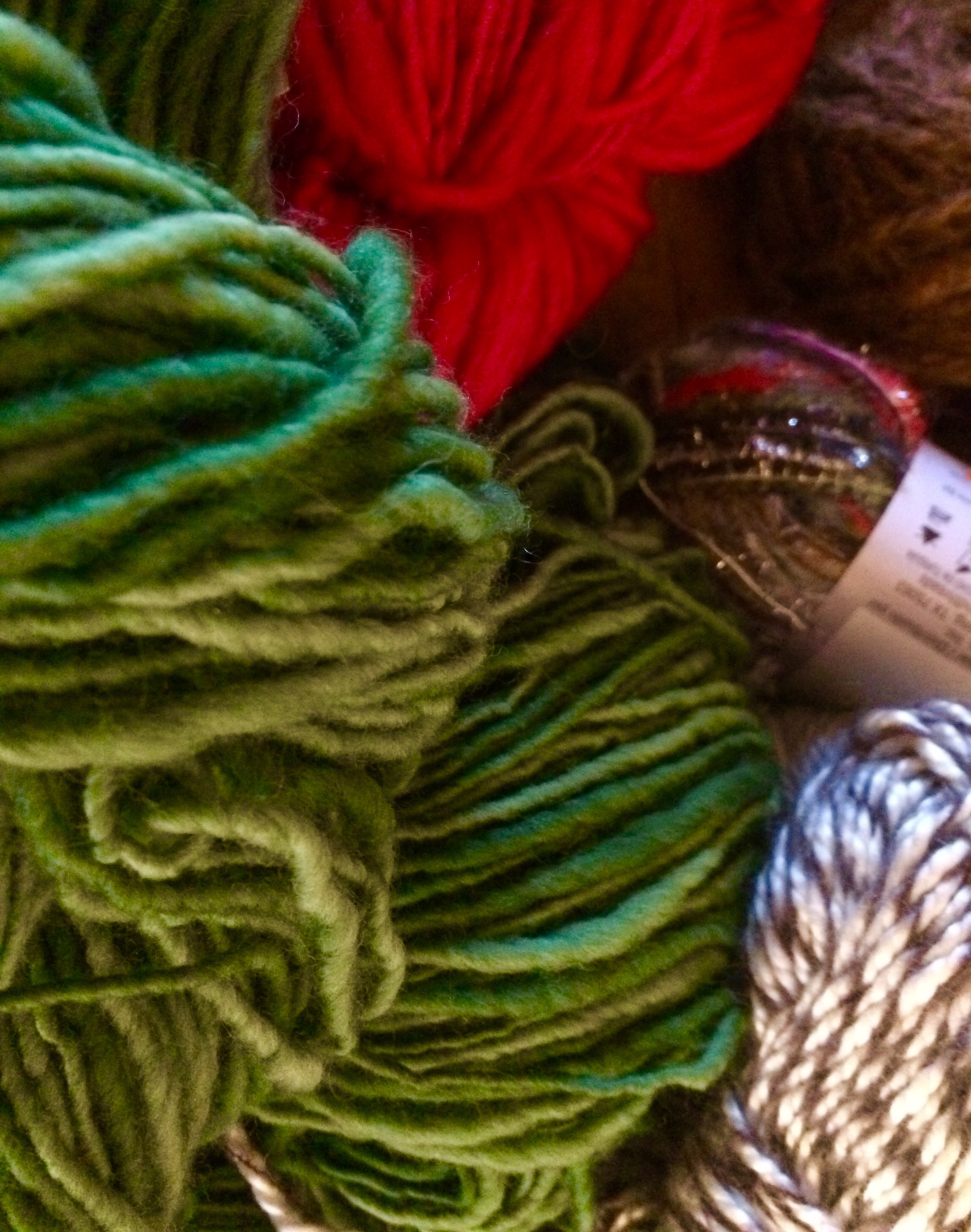
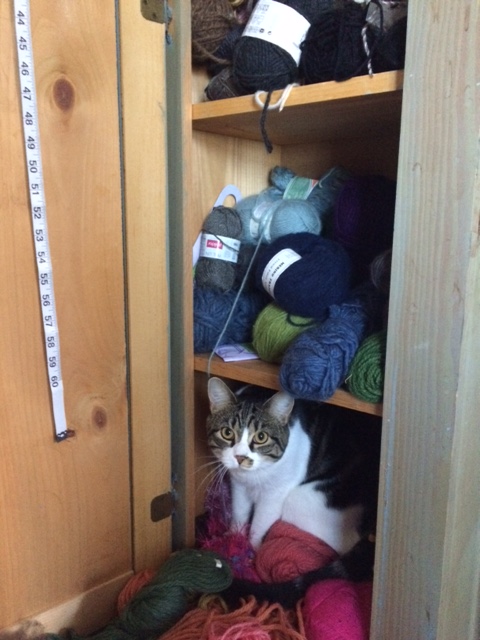
A basket of color from my store bought stash. I think a wildly outrageous sweater is in there somewhere, waiting to be born. 

I’m not sure what to say except that every year these things make me smile. 

Him, too…

The sun’s departure time most assuredly has a bit to do with my sense of speediness. I have to alter my idea that things need to be done by dark, or be fine with not as much getting done. The latter is hard for me…


1 Comment

Recovering, Crafting & Learning Post-Election

Hello to you. It’s been a while. Given that my blog is about the healing benefits of handcrafting with a little bit of elbow room to talk about other things, I made a choice not to write every day about how I’m metabolizing the election outcome in this here United States of America. But to be frank, it’s all I’ve been thinking about. My Slow-Stitch journey has taken a pause and will resume soon (I apologize to any who might be following that and stitching along). I really found it hard for a bit to do anything that was remotely and technically enjoyable because I could not emerge from my own dismay. Things that have helped: attending a peace rally, going to a lecture addressing white privilege and US history, talking with people about their ideas and reactions, many similar, many not, and making a clear decision to be vigilant, to listen and do my best to be an active participant in my community. Joining fellow knitters and crocheters in our local group that contributes items to Knitting4Peace has also proven yet again to be a refuge and a joy~ making things with people for people all over the world is soul medicine. And, walking around outside.

I received an invitation a few days ago to participate in a local Holiday Pop-Up for area vendors and decided to do it. This is also taking some attention away from my Slow Stitch work, but it’s a good and important process for me, to get back involved with making things that I love with wool and yarn. It’s allowing me some room to let myself have fun and just enjoy being random, with a goal in mind, which I need sometimes. I’ve been spinning yarn, weaving and crocheting here and there as I can. My kitchen table is covered with my ongoing projects, my kids are excited to felt rocks and make things too, and it’s just plain feeling good.

Supermoon, bird’s nest and what I think to be coyote scat.

img_1020

Can I hide in there, too?

Some ongoing projects and yarny explorations.

Have a sweet week. I hope it includes doing what brings you calm and peace.


1 Comment

Slow Stitch Stitch-Along, Week 4

I like having this Stitch-Along right now. It’s keeping me connected to what I really, really want to be doing but am having the hardest time devoting time to. It’s a constant struggle for me these days, to pick up what I love (other than my children). I plan on writing more about this in the coming week, but I feel rather sure that this election cycle here in the United States is one culprit in a cauldron of stressors.

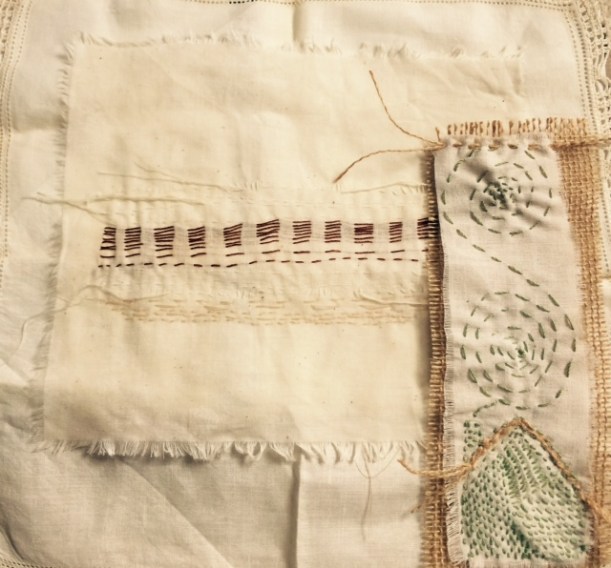
I found time today, though. Time to sit and complete my bookmark. I turned the design into a house with a chimney and gave it a thatched roof. When my daughter saw it, she decided she wanted to write a story about sewing bookmarks. I hope she does! I mounted my other experimental piece on an antique handkerchief and I thought about time and the apparent coming of a new age of politics in this country.

I thought about ways I might be more gentle in my approach to life, and more disciplined so that I might do at least some of things I long to do, but hadn’t written in to some original plan of adulthood. I thought about adjusting, letting go of some things and turning towards those things that call to me, including service to this aching world.

The coming 4th week of the Slow Stitch Stitch-Along will include learning a new one (for me): the fly stitch.

One square or two. Fly stitch. Different patterns, directions, colors, fabrics. We’ll see. My hope is to do one square on plain linen, and one piece including a few fabrics using both running stitch and fly stitch. We’ll see how it goes.

Again, for those who might want to join, we are using the book Slow Stitch: Mindful and contemplative textile art, by Claire Wellesley-Smith as our guide. I am a brand new stitcher and am finding my groove. Anyone is welcome to join us, with any skill level.
fullsizerender-126


A Stitch-Along In The Making…

I am very excited to share that Melinda, of the beautiful blog called Knit Potion, is collaborating with me on a stitch along. We are using the book called Slow Stitch: Mindful and contemplative textile art, by Claire Wellesley-Smith as our guide.

fullsizerender-117

If you have not already, you ought to check out this gorgeous and inspiring book. The writing, the photographs and the suggested exercises make it seem possible for even a brand new hand-stitcher like myself to dive in and explore and play.  It’s funny…I feel like I afford myself a fair amount of space to mess around with yarn and wool and all of that. I definitely don’t need things to be perfect or measured just so. I aim to address that so that I can make a sweater I’ve had my eye on. But really, precision makes me nervous. Always has. Sewing and hand-stitching have been, in my imagination, things only really precise people do. Making clothing and hemming and all of that has felt so far away from where my skills lie. The stitch along, for me, will serve as a way to bridge skill and technique with experimentation and play. I’m looking forward to that challenge.

I’m also a crafter without a project at the moment. I have loads of yarn, loads of wool, way too many ideas and scattered thoughts. I need to reign it in. The loose and unorganized energy, it’s become uncomfortable. I need a place to put it, and I need to have that place be one that invites new learning, growth and freedom, but also discipline.

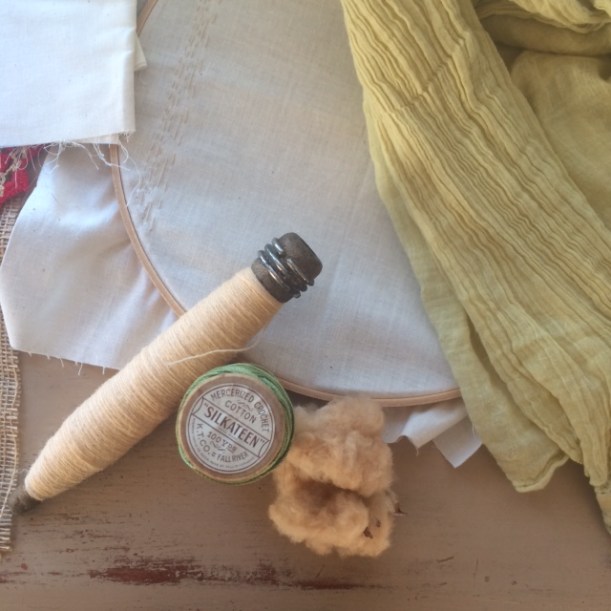
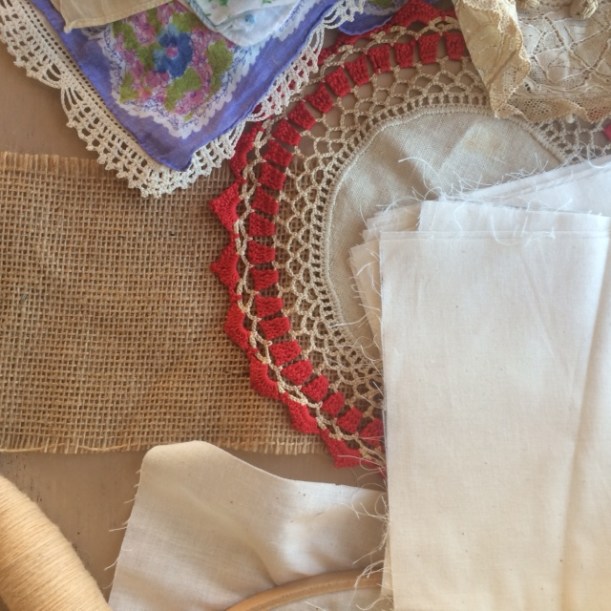
So, this is the first week of our Slow Stitch stitch-along. The task is to start collecting materials. Fabrics, threads, needles, loose bits, maybe some dyes… It is the time to turn the gaze towards the project and set the intention, or intentions, that revolve around the practice of hand-stitching. I’ve gathered many items over time and am looking forward to using them is whatever way makes sense on a given day.

Linen fabric scraps, antique handkerchiefs, a lace collar…

fullsizerender-123

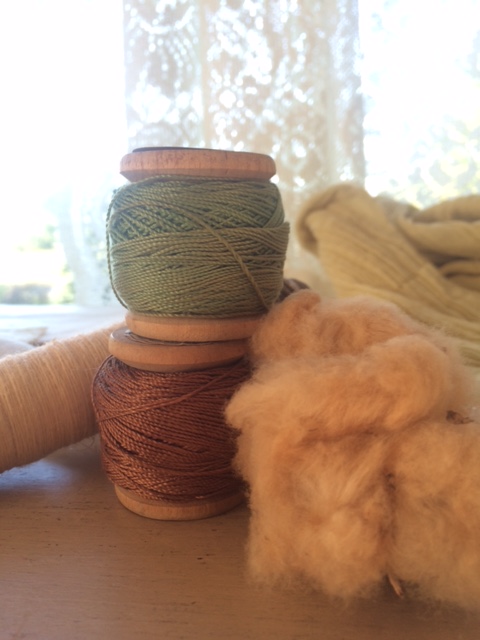
A favorite cotton shirt that may have just lived its last summer as a worn item, an antique bobbin filled with woolen thread, antique cotton thread, the beginning of a hand-stitching attempt using the running stitch, and a fluff of raw cotton…

img_0506

Doilies and burlap…

img_0507

img_0509


If you would like to participate in the stitch-along, feel free to contact me! I will be posting the week’s exercise/intention/focus each Sunday (I hope!) and will update my own progress as we move along. I will also link to Knit Potion’s blog posts about her work. We will spend the first several weeks just learning new stitches and playing with them using a variety of threads and fabrics of our own choosing. The idea is to have this stitch-along maintain a peaceful and non-urgent flow. Non-pressured discipline. There are only so many hours in these short days, and we likely have other projects wanting attention (not to mention families and jobs and self-care and sleeping), so do not fret if you feel like there just won’t be enough time to keep up. Imagine the Gulf of Mexico on the Florida coast in August. The water then is very warm and very still most of the time. It is quiet and if you allow it, the small, lapping waves and the hazy sun-packed air can lull you into an awake daydream. That is the feeling I am going for with this project.

Are you a hand-stitcher? What projects are you working on? What are your favorite materials to work with?


6 Comments

Thoughts on Weaving, School and Staying Creative

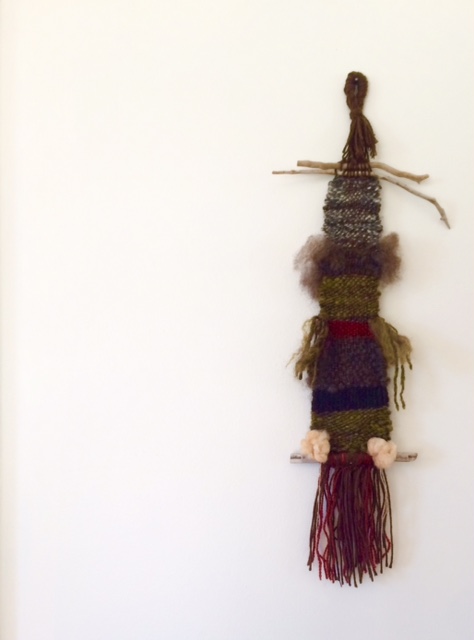
I finished a piece yesterday that I have been working on in a sporadic kind of way for a long time. For Mother’s Day, my husband made me a loom that was detailed in Kids Weaving, by Sarah Swett. I’ve mentioned her before and love her book. And her blog is absolutely gorgeous and inspiring. I wanted to delve into weaving from the ground up, and figured before I start daydreaming about owning my own loom, I’d better start by understanding them. Why not start on one that is simple in many ways, but still uses things like heddle bars and heddles, shed sticks and shuttles?

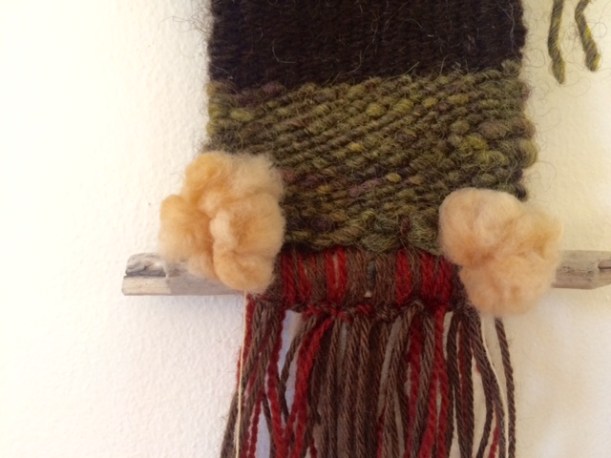
I like how this turned out. It is purposefully chunky and wild and not at all a project from Kids Weaving, although I do plan to go back and do a project from start to finish while following directions. I got carried away by my desire to throw all kind of handspun yarn into my piece, and as it came to life, I imagined it hanging on a wall, rather than as I had originally planned; it was going to be a wild scarf with a crocheted edge and weird fringe. I love using loose roving in things, and I love unravelling yarn so one can see the many stages in a yarn’s life in one spot. Once the weaving was done and the loose ends cleaned up, I was not entirely satisfied, so I looked at it a lot, touched it a lot and went into my “Closet Of All Things” and found two bits of soft cotton still attached to their seed pods. Perfect. My piece needed a little more balance given the wonky stick placement on top. I love the two soft puffs from nature that sit and hold the piece secure.

FullSizeRender-118

FullSizeRender-119

Finishing this yesterday was grounding for me. With my kids starting school and my professional work life picking up, I have felt a bit out of rhythm. The couple of weeks leading up to school beginning are weird ones for me. My mind goes into preparedness mode, which I have found completely derails my creativity and my will to just be. In my mind, the lists of things to do become omnipresent and the worries and fears and pressures come alive. Yesterday, while holding my woven piece and getting it right for me, I was afforded the chance to remember some big picture ideas I have, and to remember to recommit to them.

I’m reading a book right now called Handicrafts of the Southern Highlands, by Allen H. Eaton. I learned about this book during my day at The Marshfield School of Weaving in July through a wonderful conversation with teacher, Bruce Engebretson. I thought I’d share a quote that moves me, and swirls into the thoughts and images and hopes that come alive  for me when I am working with fiber. Here it is:

“He who does creative work, whether he dwell in a palace or in a hut, has in his house a window through which he may look out upon some of life’s finest scenes. If his work be a handicraft he will be especially happy, for it will help him not only to perceive much of the beauty of the world about him but, what is man’s greatest privilege, to identify himself with it. If it enables him to earn his daily bread then he should rejoice, for blessed is the man who has found his work; but if, as will be the case of many in our day, his handicraft is not a way of making a living, but through self-expression a help toward a fuller life, he too will rejoice, for he has all the privileges of his fellow-craftsmen without the need of fitting his product to the market.

“Each handicraft has its own special reward, but there are a few compensations which all handicrafts bring to him who works at this open window. First, and perhaps greatest, as has been said, is the opportunity for self-expression which much of life’s work with its modern advantages does not give…”

from: Handicrafts of the Southern Highlands: A Book on Rural Arts, by Allen H. Eaton, pgs 25-26.

I think maybe these words reflect back to me some of the struggle I experience as my children and I approach a school year. Busy-ness, competing forces for attention, energy and discipline, these things can easily pull me and us from ourselves and from a center seat of simplicity and creativity. This early morning before school, maybe more peaceful because I spent time weaving yesterday, I sat with my daughter and we listened to geese fly overhead, their distinct calls marking the hint of autumn and their eventual pilgrimage to warmer climes. At the same time, the endless and calming drone of cicadas soothed the part of us that wants summer to hang on a little bit longer. The window we are welcomed to look through by engagement in the process of making is one I long to keep open and clean, and I hope by maintaining a daily practice I won’t forget. Much easier to see and hear the birds that way.


1 Comment

In the Presence of Masters

I have not written in a good long while because my work with fiber stalled out a bit. I am one of those people who struggles with some of the more rare side-effects of antibiotics and of late, this has been quite an issue. BUT, I am here to say that yesterday was a gift beyond gifts, and has helped me to find my bearings again.

The Marshfield School of Weaving is hosting a five-day spinning class this week. I was only able to attend one day of the series and was not sure what to expect, but I went ready to absorb anything and everything I could in this limited time. I went to this school last year to take a plant dye class with Joann Darling. You can read about that here. Attending class yesterday, I knew I would have the opportunity to meet Norman Kennedy, the man who started the school in 1974. He has taught spinning and weaving, he speaks Gaelic and sings old and beautiful waulking songs and other traditional songs that can be sung to help keep time during the melodic and repetitive processes of carding, spinning and weaving. He joined Bruce Engebretson who was a visiting teacher from Minnesota. I had never taken a class from individuals who were so steeped in their craft and wondered what it would be like. I was definitely nervous. Primarily self-taught, I prepared myself for having to re-learn ways I do things. I was right to get my mind in order for that type of expansion.

I traveled down with my spinning wheel, some roving, my spindle, a batt I carded from Border Leicester that I processed myself and dyed with willow bark, and a whole lot of eagerness.

Let me say this, I took a lot of pictures but don’t want to post them without permission from those who are in them, so please pardon the lack of visual detail.

Driving up to this school in Marshfield offers the chance to resettle the mind in its own right. I was so struck last year by the functional, humble beauty of the barn, the rooms, the tools and the “stuff” kicking around. It is entirely calming and completely not intimidating. When I walked in, I was warmly greeted by Bruce, Norman and the four other women in attendance. They were in their groove already because they had been together all week, but at no time did I feel like an odd man out. What shocked me was that I, according to Bruce, was not carding wool at all correctly, so I learned his way. The old way. And it took a long time. So long I worried I might have dyslexia in my hands. For real. But he was kind and patient and kept at it with me. I had introduced myself already to Norman and tried not to be too intense; I have wanted to meet him for a long time after I saw this YouTube video.

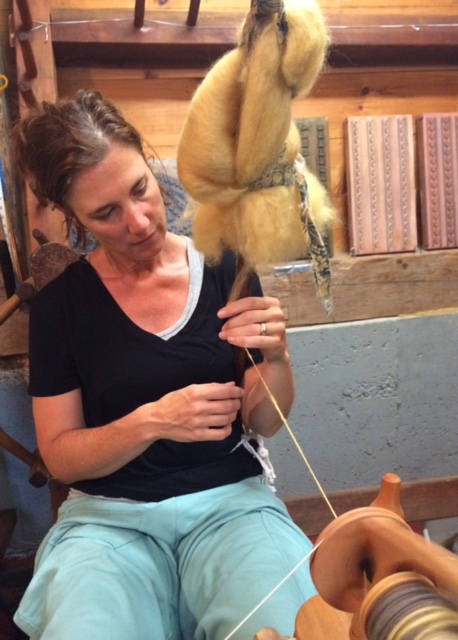
While I was fumbling through carding wool, I showed Bruce the batt I brought. I think I just wanted him to know that I know how to do at least something and he was into it, and he asked me to show Norman when he came back in the room. I’ll not go into all of the mini moments that were incredible, but showing Norman the willow-dyed batt led to him showing me how to spin off of a distaff. I had never even seen a distaff in person before, and here was this beautiful man, in his 80’s, with a long white and golden pony tail and kind face, spinning my wool onto a spindle with the merest flick of his hand, his other hand totally free. He commented on the luster of the wool, the strength of the yarn it can make, and he told stories and historical bits about the use of these ancient tools. I was in awe and in love, and then he let me learn.

DistaffandMe.jpg

It took some doing, but soon enough I was spinning right from the distaff onto my wheel. He said I was doing pretty good for a beginner. I’ll take it.

Later, we watched Norman prepare flax and place it onto a distaff to spin. As he spun he sang a tune in time with his treadling. We watched Bruce load and use very old combs to prepare gorgeous wool for spinning. I watched in awe a woman use a walking wheel… truly incredible, and I learned about the spindle that was on the wheel that Sleeping Beauty pricked her finger on. Norman told stories of how it was long ago, when children worked alongside their parents all day, when fiber craft was not a luxury or a hobby, but when it was a necessary and integral part of life. Bruce talked about how children would prepare wool all day and how women would spin all night. I think about this all the time, about how so many fairy tales are about old women saving young women from the fate of spinning all day long, so that they could go about with their husbands and be in their world. Habetrot is one such goddess. More to come on this topic in the future, but I suspect that fairy tales and ancient myth show us the trajectory of the feminine archetype in relation to fiber art and craft. Habetrot and her magic family are underground, hidden away from view, a foreshadowing of changes to come, both positive and negative, to the ways in which people relate to one another, the relationship between people and Earth and the ways we understand and experience time, work and patience.

Some other highlights for me include being called a lass, having my spinning wool technique ridiculed in the most kind of Scottish ways, and simply enjoying the company of people who were all there to learn and be in the company of masters. It was truly a wonderful day.

And, I will be fashioning my own distaff and spindle soon. Tales to come…


5 Comments

How to Fit Fiber Work Into a Full and Multifaceted Life, One Glimpse

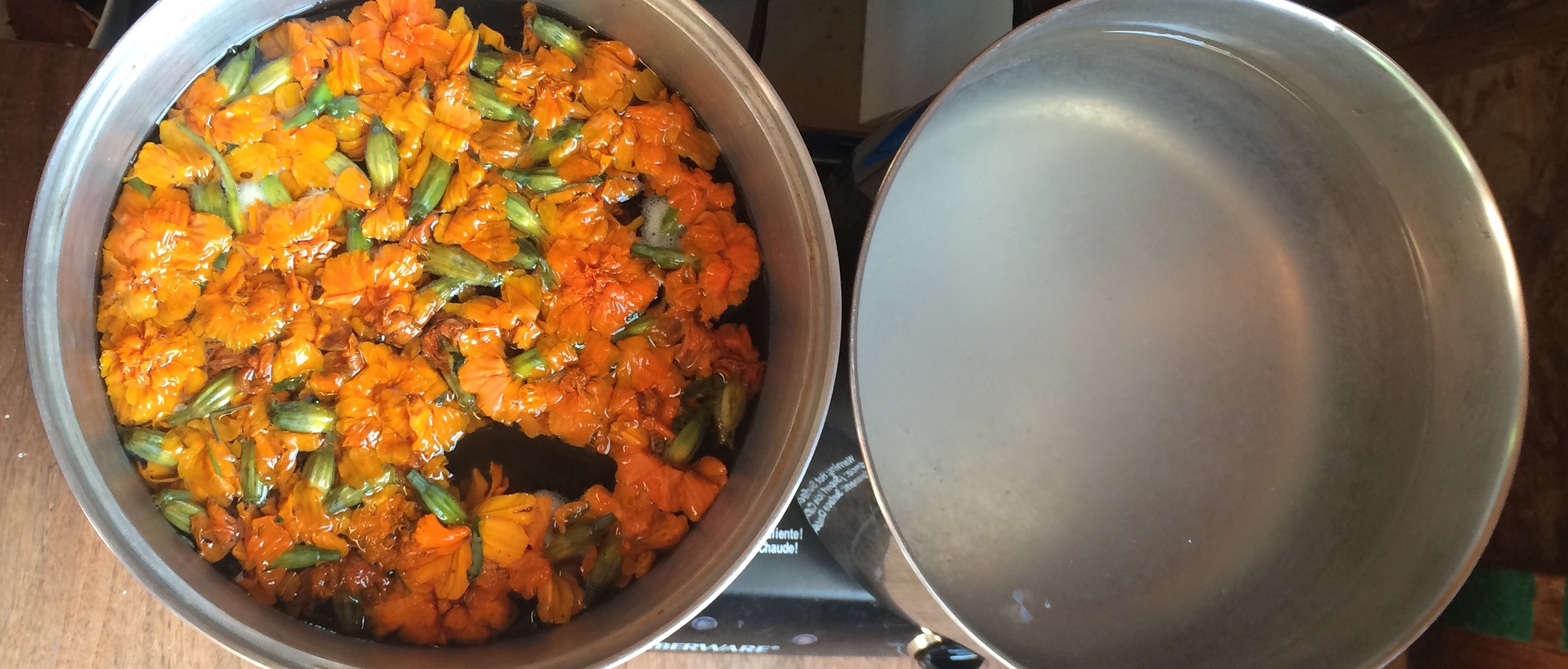
Yesterday began early for me. It promised to be a full day with lots of seemingly unconnected tasks and engagements. I really wanted to dye wool though. I’d already steeped marigolds and coreopsis the day before and I had some clean whitish Shetland to play with. After looking through the wonderful natural dye book, Harvesting Color: How to Find Plants and Make Natural Dyes, by Rebecca Burgess, I decided to quickly get an alum mordant bath going to prepare the wool I had on hand. 

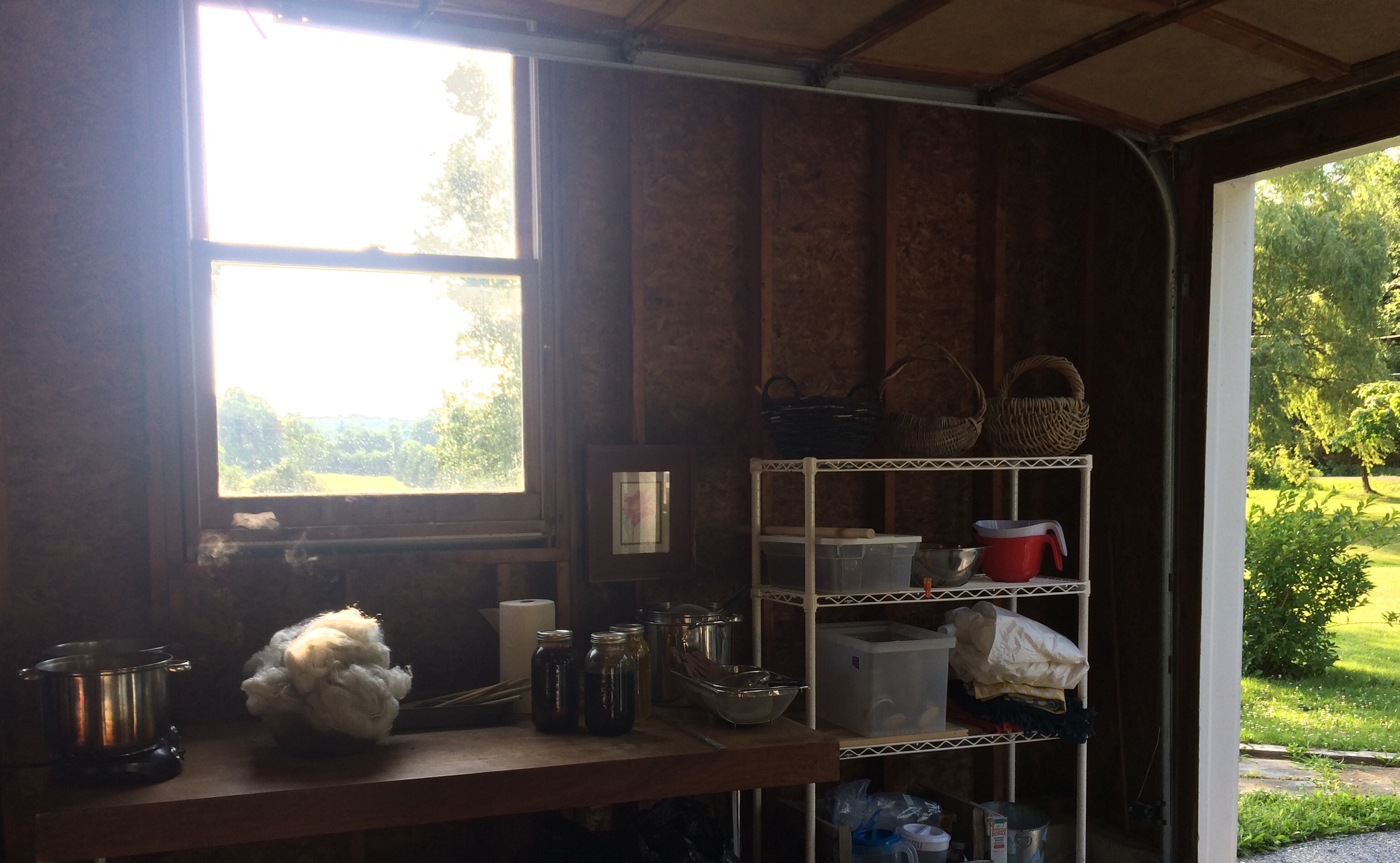
I’ve taken over half our garage with a dye pot section, a carding section, storage for weird, beautiful driftwood and other gifts from the world I collect on the way. I’ve got a scale out there and some paints set up for my kids. 

So, at around 7:30am, the alum/Shetland mordant bath was going, and my marigolds were on some heat. I weighed 7 ounces of wool to be dyed, and used 0.7 ounces of alum. Not much, but my dye bath operation is small, and I love little batches of specially dyed yarn for weaving or embellishments on crocheted and knitted items. 


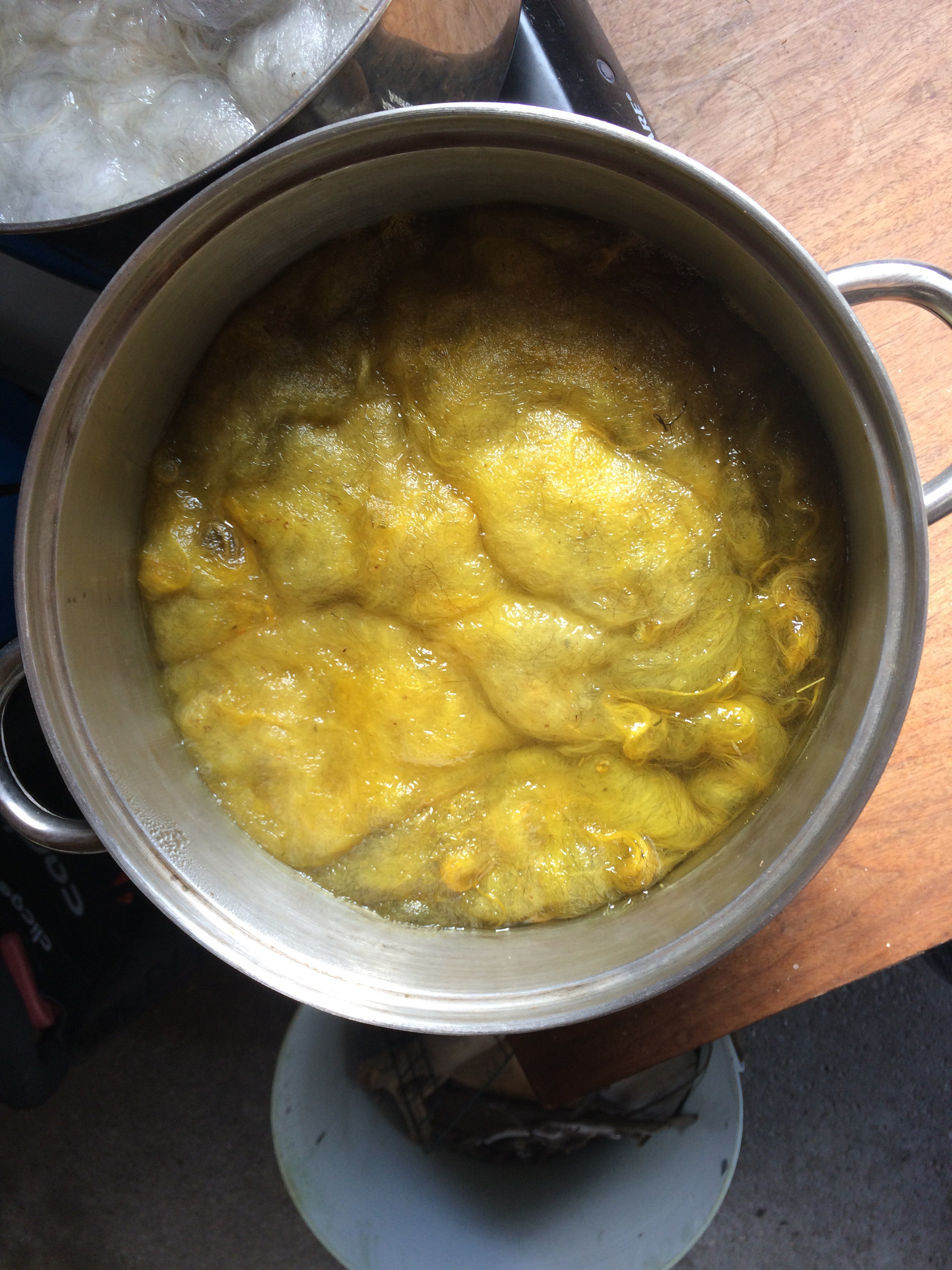
Once that was all set, I got on with my morning. Took care of my littles. Made a work call. Took everything off the heat and ran some errands, came back and after rinsing the wool in warm water, put half in with the strained marigold bath and set that to heat, and put a quarter in one bell jar with the coreopsis flowers and bath, and a quarter in with half coreopsis and half marigold dye mix. The jars were set in the sun. 


After an hour on a simmer, I took the marigold bath off the heat and let it cool for the remainder of the day. 

By then it was almost midday and it was time to switch gears completely with my kids and fully engage in what we three were doing. 

Tending to life while tending to the practice of working with wool can be difficult sometimes. Some tasks require a chunk of uninterrupted time. Others can be worked into and throughout a life. I imagine that was how it was done over the ages, but I don’t know for sure. There are chores and responsibilities that lend themselves to certain seasonal tasks. Tending to dye baths can be done while gardening, cleaning up outside, doing laundry, caring for children, and even making that business call. Having a dye pot operation set up outside or in the garage helps as messes are far easier to clean up and create less smelly havoc than in a kitchen. 

I was able to rinse the wool after dinner. It is still drying. A late in the day rain storm put an end to the sharp, hot, drying sun. I’ll post pics of the final outcome soon. 


10 Comments

Let the Dirty, Smelly,Wonderful, Softening Labor of Skirting, Washing and Carding Wool Begin!

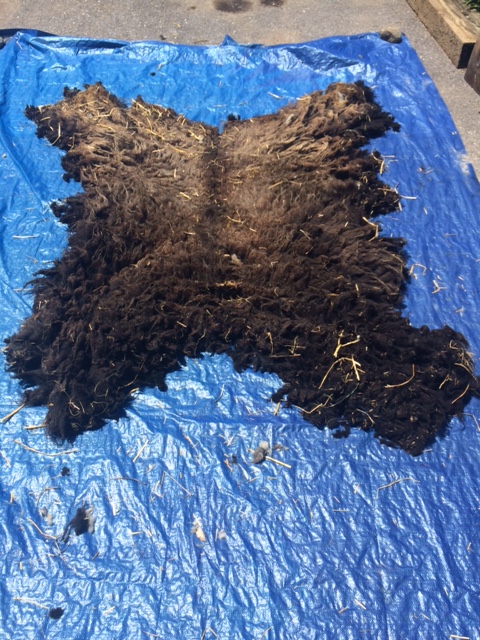
This week, I grabbed the bull (or sheep) by the horns (in my imagination), and started processing a whole lot of wonderful wool. After my son, then my daughter and then I got through strep throat this summer, I needed to really get in gear and re-find my focus. Knowing that this week would be hot and sunny, I decided to use the sun’s marvelous power to do most of the work of scouring for me. But I’ll get to that. I started with some lovely Shetland I picked up about a month ago from a wonderful couple who absolutely adore their sheep.

Here is a picture of some of the beauties with their summer do.

IMG_0446

When I first began working with raw wool and learning how to spin, I’ll admit to just jumping in and not doing a whole lot of homework first. I remember with my first fleece, I felt guilty about not using every last bit of wool, but for the very dirty parts. I washed and rinsed and washed some more, picked, flicked, carded and re-carded. I could not bear to waste it. I’ve since learned that there are different parts of a fleece that are much better than others, that seasoned spinners do not use every last bit for yarn, but might use the not wonderful parts for stuffing for toys, compost, insulation, etc… Before starting on these fleeces, I found a bit of literature that is so incredibly helpful on the topic of skirting fleeces. People who take the time to share this sort of expertise in such a generous way are really so kind. I am grateful to them for describing so well what they know. Check it out if you are looking for some skirting fleece information.

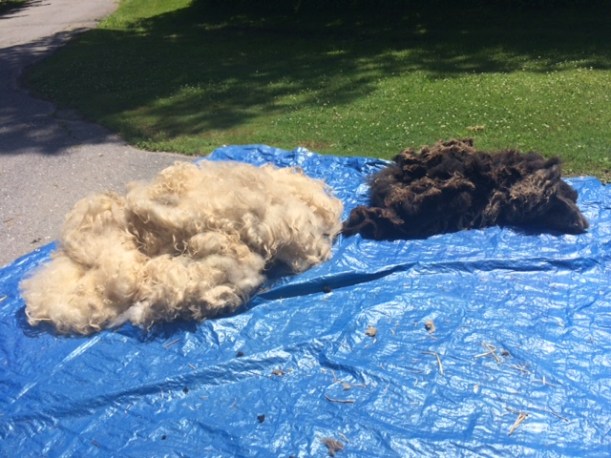
You can see below the pile of wool from one fleece, already skirted, and another two waiting to go.

IMG_9681IMG_9687

Then it was time to scour. I like doing this before carding and spinning, but I know many do not. I do not overly scour, I don’t think, because I love keeping the lanolin feel as much as I can, but I do want it to be clean. I wish I had taken a picture of my hands post-skirting. They were shiny and soft from the lanolin. I never grow tired from the irony of having silky, soft hands after doing the hard and dirty work of skirting a raw fleece. It is a marvelous metaphor, I think. We must get our hands dirty in life. We must fully dig in. Work. Feel. Love. Grieve. Get into the thick of it. We will be made softer, humbler, and maybe even shiny every now and then, if we allow ourselves to be hewn by the at times roughness of life.

IMG_9688

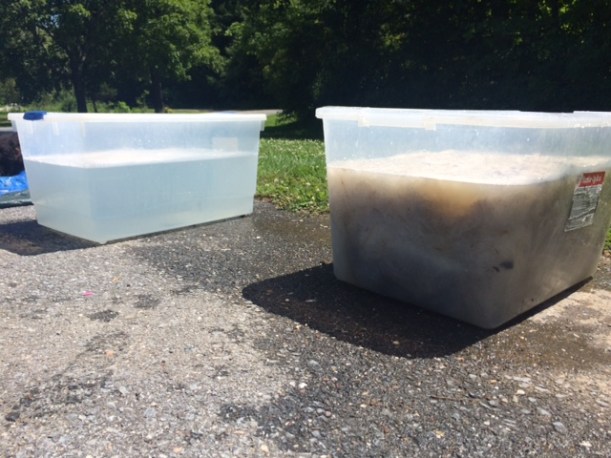
While I love hard work, carrying pot after pot of hot water outside to fill my bins in order to scour wool is not what I had energy for. It occurred to me that the sun could do most of the heating work. So, I filled the bins with hose water, plus two big pots of hot water to get a jump start, and then some soap. After the water rose to a lukewarm temperature, I added the wool and let it soak for a long time. Later, I passed it to the rinse bin of warm water and let it soak some more. I did this with all three fleeces and have to say, I see no reason to go back to another way, at least not while it’s so hot! With the lids on the bins, the water’s temperature rose very significantly, but slowly, making the scouring a gentle and simple process.

IMG_9691IMG_9693

I love the look and smell of drying wool. I see bits that will get shaken or carded out once fully dry. Mostly I see fingerless mitts, a hat and hopefully a big fluffy cowl to keep warmth and raw beauty alive in the midst of our stark winters.

IMG_9700

Oh, last but not least, I’ve started some solar powered dye baths using in one jar, marigolds and in another, coreopsis. I think I’ll dye up some of this white Shetland tomorrow.

IMG_9698