One of the classes I teach at the Shelburne Craft School is called Weaving Your Story. The chance to meld my love of weaving with my passions for healing, growth and creativity has been a true boon in my life. The program is fully grant funded by grantors and an anonymous donor making it cost free for participants. The Vermont Arts Council, being a grantor and a great supporter of the program, recently interviewed me to talk about Weaving Your Story and I wanted to share the article with you here. It captures so much of what the class is about and how I feel about it!
In case you are wondering how weaving and creative expression can be healing, I think the conversation gets at it well. Enjoy!
I spend a lot of time thinking about and talking about grief. It’s part of my job as a therapist. I co-wrote a book about it. And I incorporate working through grief into certain of my weaving classes, both with groups and individuals. It’s a subject that is always relevant because all of us, at some point in our lives, barring few exceptions, lose loved ones or experience losses of other kinds, like endings of relationships, job loss, or significant life changes due to chronic illness, bankruptcy, natural disaster, war. The list is long. The news of late has been devastating and heart crushing when viewing what is happening in the Palestinian Territories and Israel. So many of us are grieving locally as well as globally. So many of us have been doing this for a long time.
There’s nothing to say about it that can take away the reality of the pain, anguish, trauma, and truth of the matter, which is that human beings can be so utterly monstrous to each other. It’s shocking, and then we must think on the reality that we have choices to make every day about how we are going to be in the world. And sometimes even the most peaceful of us disappoint ourselves. I guess that’s where the truth is, too. It’s always a choice, and always it is true that how we are to others impacts our experience of our lives and our relationships.
I’ve noticed a few things lately that might seem obvious, but that have been moving me and making me look above and beyond the chatter. These observations help me connect with my choices in a way that mitigates feelings of helplessness and despair. I’ll share them with you here.
~ There’s a lot of dialogue about how much our culture gets grief wrong and how there is this pressure on people to “get over” grief quickly. I don’t disagree with that, but I have been noticing how many individuals and organizations are out there, all over the world, talking about how grief really is, and how much it changes a person and a life. As I’ve looked more deeply into remembrance and awareness days to do with grief, I’ve seen a lot of realistic information about what grief is really like as well as how we can support others when they are struggling. I’ll write soon about an upcoming awareness day to do with grieving children. I wonder what is getting in the way of the honest messages to do with grief from landing and changing the experiences people have when they are suffering. How can we release the pressure we put on ourselves to stay the same, no matter what?
~ Giving people the space and respect they deserve and are entitled to when processing life events and grief is a wonderful thing to do. When we can get out of the mindset of having to make someone “feel better” and instead hold space for them to simply be where they are, a sort of alchemy takes place. A bridge of trust grows, and often it looks like recognition. Almost like a version of namaste, it is as though the spirit says, the grief in me sees the grief in you.
~ As I talk with and listen to people, something is becoming crystal clear: long-term grief is not always solely about the loved one lost, but sometimes is a result of the anguish of trying to get back to normal too fast, whether this is a self-imposed pressure or felt as pressure from others. As a result of that anguish, there are multiple layers of complexity piled on and on and on. As people try to find their balance and figure out a new normal after any kind of grief, part of that often entails facing the pain of how their grief was received and responded to. This is tough stuff, but it seems important to me.
~ There is something incredible that happens when people let themselves process life events through the practice of making. We do so much thinking about so many things. And I’m a fan of thinking! Thinking helps us make choices that are less reactive, more informed, and ideally lead to better outcomes than when we fly by the seat of our emotions. But… sometimes we get lost in the weeds of words and self-analyzing. Creating spaces where people can translate lived experience into artistic form works, and what we get from that is insight and healing from angles that might not have been approached if the senses weren’t involved.
~ Listening… the most wonderful kind of listening… is medicine. The kind where you’re not waiting to say the next thing, or thinking about your words as the other person is still talking. Slowing down and absorbing what someone is saying and letting it affect you or work on you in some way- this is true relating. And it doesn’t require hours, or even many minutes. It just requires deciding that the person you are engaged with is worth your time and attention. Can you imagine if we all treated everyone like that? And were treated like that all the time?
What helps us meet the people around us where they are, not where we want them to be? How do we maintain compassion, patience, love, and curiosity? The first thing that comes to mind and is the only one I want to focus on at the moment is self-compassion. Sometimes it’s just the truth that our cups will not be full before we give to others, and we can sustain that for a while. Sometimes we are tired and grieving ourselves, when we are at the same time showing up for others. And sometimes, we can’t give in the ways others want us to give or we wish we could, and we need to pull back and refocus that energy. That’s okay. It helps to remember and keep remembering that it’s not anyone’s job to take grief away from others or somehow fix the pain of it. And sometimes energy needs to go back into the self for a while before it can go out again. It’s just the way it is, and there’s nothing selfish about it. It’s okay to think about how you can show up for people at any given time, and be honest about.
How do you tend to yourself and nourish yourself as you go about life and relationships? Do you have ways you tune in and respond to your heart and body? Do you take the importance of this as seriously as you do your love for and support of others? And, when you can’t be there in the way you always have and feel worried about that, or stressed or resentful, do you have ideas about alternatives? Can you imagine communicating them?
So here’s the thing. It is so damned hard for me write and post and write and post when the world, politics, social issues and social traumas are so profound. Over and over again, it seemed so important that I just stop and be with what is happening and listen. Listen to the people who are speaking and sharing and telling the truth. Be with reality and look at what is right here, right now. That became my job as a human on the planet, as a parent and friend and family member. It continues to be my job and I am learning and trying to continually listen and show up.
Through these last few months, my hands have touched yarns, threads and fabrics, sometimes to start and finish a project. Sometimes just to experience a texture that brings me out of my head and into my body. Touching linen, wool, an embroidered patch, I either feel potential or potential brought to being by someone else’s hands. I’ve learned new things and am gearing up to learn more. I tried to fashion a weekly fiber arts group online to support the kids I’ve grown to know and care for so deeply, but I found that with kids being online so much for the remote learning switch they all had to make in early spring, they were weary of being online! So was I. It was overwhelming, moving my clinical practice online, helping my kids navigate schooling online, connecting with many people in my family through Zoom meetings. It got to where, if I wasn’t seeing my friends, family, clients or the news, I couldn’t look at one more thing. “No. I don’t want to see anything else on this screen. I can’t take it in. I want to look at the sky. I want to look for the bugs that are eating my plants. The turkey that visits my lawn. The eyes of the people I love.”
I felt and continue to feel like there are thousands of hugs stuck in my elbows. When I see someone I love and I restrain myself from the automatic hug, it actually kind of hurts in a tingly way, like a laugh stuck in my chest, or tears stuck in my throat. I marvel at how much I took those physical connections for granted and how often I must have hugged to have this feel so heartbreaking.
I’ve noticed though, that when I touch yarns and fabrics and create my own things or admire the things others have made, this wonderful thing happens. It’s like a shrinking of time. I recently started to learn how to tablet weave and in the process read a bit about the history of the craft.
That prompted me to make a miniature version of a warp-weighted loom using a bit of a tablet woven band to serve as the top decorative piece and the warp. As I worked on this project, which by the way is wonderful to look at but wobbly as hell, I couldn’t help but feel connected to the old. The really old. I thought about people who wove on warp-weighted looms thousands of years ago and considered the fact that there was evolution, trauma, creativity, fear and love happening then, too. I thought about the threads that run through time that show themselves in their myriad colors and levels of softness, fuzziness, usefulness and beauty. It occurred to me that this will always be the case. People will always be making things that connect them to the past, tie them to the present and hint at the future.
I find this to be soothing on a big scale. A dedicated focus on a tangible task allows me to look down with specificity of attention, and then up and out with a calmer mind. The back and forth accordion-like thinking in, thinking out is making the metabolizing of this time a bit more like the tides.
What do you do to balance your nervous system with the need to stay connected to what is happening right here, right now in time?
Hello All~ I sure do hope you are doing okay, wherever you are. I have so much I’d like to say and share about what this COVID-19 pandemic is teaching me. I may have to do that in another post. But here and now, I will share with you a project I made up for wonderful kids I get to spend time with, even though we are all doing some wicked epic social distancing. I have spent large bits of the last seven years teaching fiber art in my kids’ classes (and in some others, too!) and I can tell you, the kids inspire in me so much longing to keep making, keep creating and keep sharing. Now that our Fiber Friday classes are happening on Saturdays via Zoom, I’m trying to figure out lots of yarn-y things to teach using materials we might have kicking around at home. The thing with weaving is, you can make a loom out of so many things! “Homework” for this week is to look around the house and yard to see if we might find weird, unexpected, unique or random “looms” that could be woven on. These could be sticks, frames, chairs, trees… whatever! I hope I see some good ideas next week!
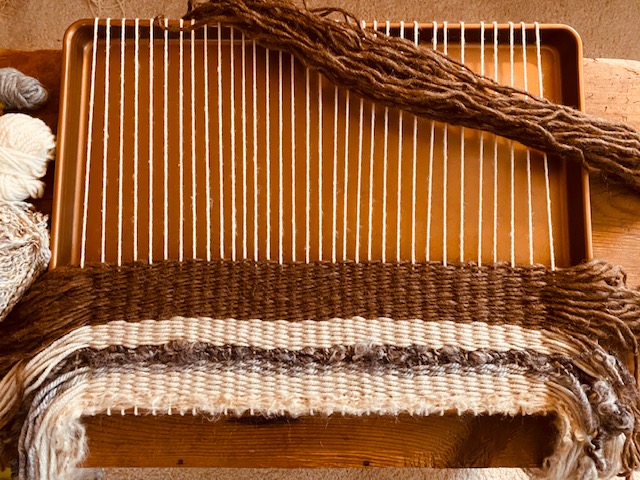
This project is aptly called the Cookie Sheet Weaving Project. As you can see, I’ve used a cookie sheet, yarn, and tape to make this loom. I’ll give step-by-step instructions and maybe you can give it a go!
Materials:
cookie sheet, any size
yarn
scissors
tape
Optional Materials
fabric
large eyed tapestry needle
lots of variety of yarn- this is a great project for using up small bits of yarn stash
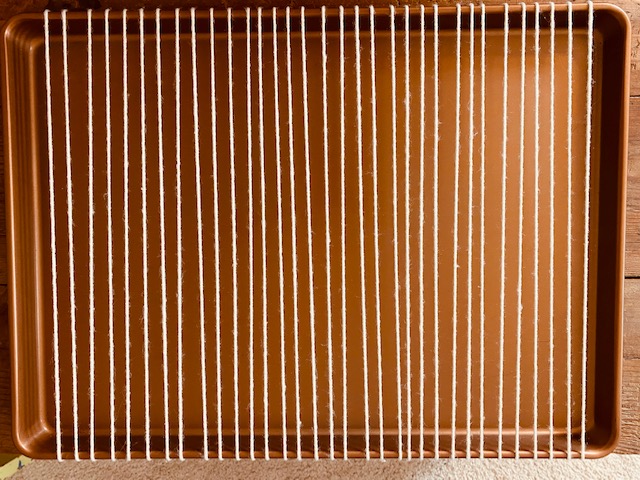
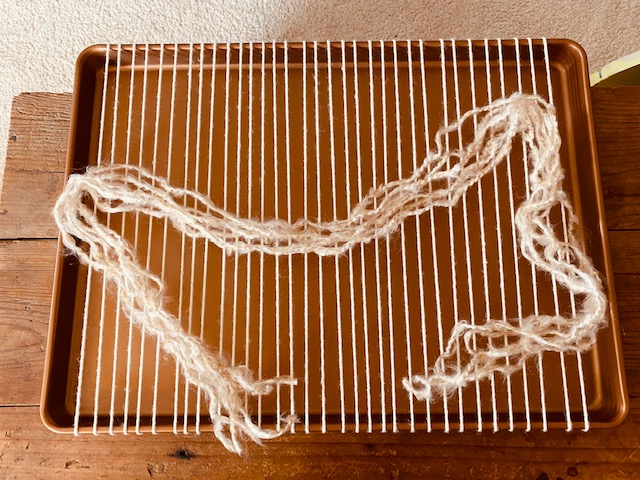
This is what your loom will look like once it is set up. I’ve chosen to warp my tray the long way, making my weaving piece wide. You can do it the other way, too. You can also choose to warp only a portion of the tray.
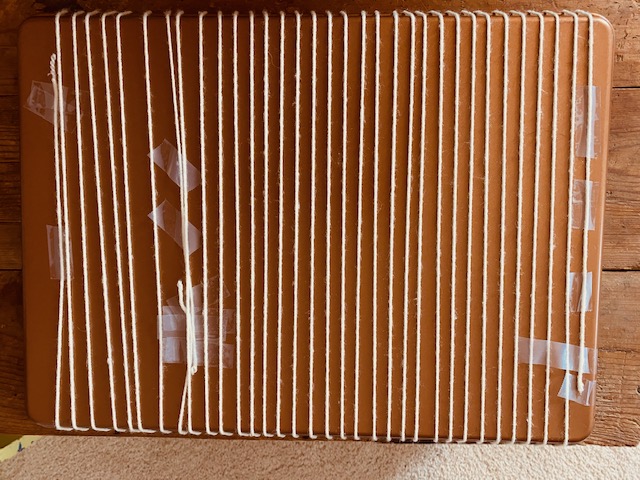
To secure the warp, tape the end of skein of yarn to one side of the bottom of the tray, and then start wrapping the yarn around the tray, with about a 1/4 inch to a 1/3 inch between each wrapped thread. You can see, the underside of the loom isn’t gorgeous, with tape everywhere, securing the warp. Don’t worry about that. It’s most important that your warp is securely fastened onto the tray. Since my tape wasn’t turbo sticky, I used a lot of it.
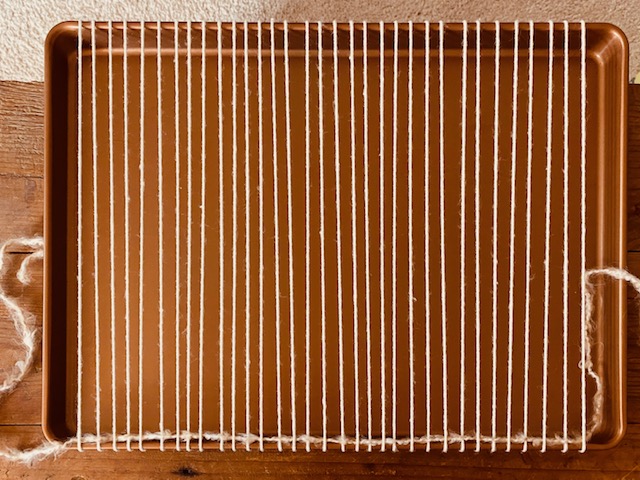
I opted for making a very fringy piece. Rather than moving back and forth and back and forth with the yarn, leaving no fringe on the edge, I chose to cut lengths of yarn that were several inches longer than the width of the cookie sheet. I wove each thread individually and then made sure that the remaining yarn was about equal on each side. If you don’t want fringe, just keep weaving back and forth with a long length of yarn, being sure not to pull too hard on the warp threads as you come back the other way.
Row 1: I started by taking one end of a cut length of yarn and going under the first warp thread, over the next, under the next, and so on.
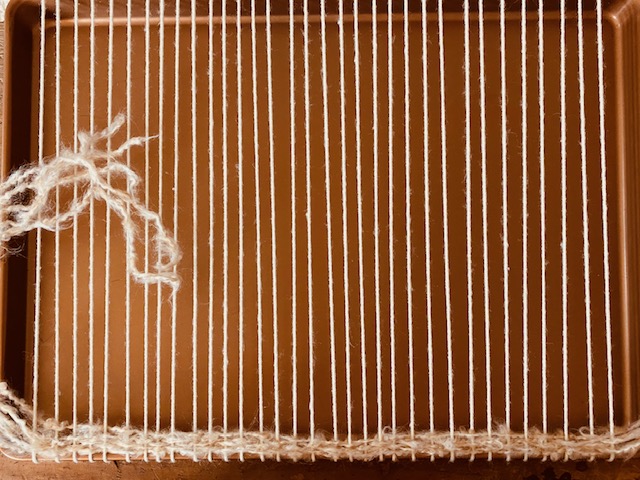
Row 2: With the next cut length of yarn, I went over the first warp thread, under the next, over the next, under the next and so on. In this way of weaving, I noticed that I liked weaving from right to left, over and over again. This is different than when you weave with a very long length, moving back and forth from right to left, and then left to right as you head back again.
Because I have a LOT of small balls of yarn, I chose colors and textures that go well together and I cut a bunch of lengths at a time so I could just get into the flow of weaving. This is a very portable project, so I had it all over the house depending on what I was doing.
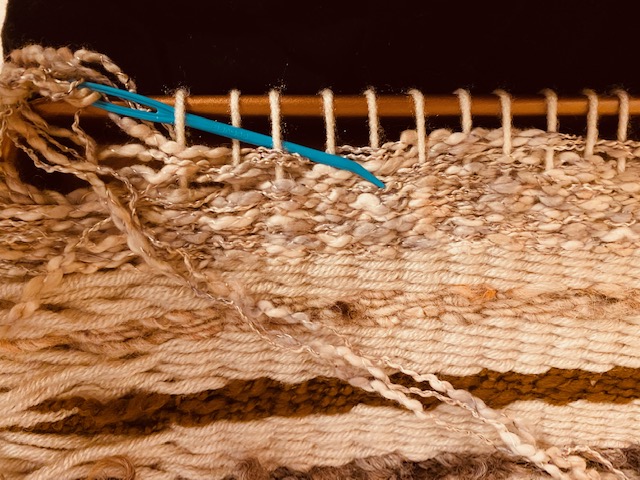
And I wove, and wove… and wove… Once you get to the top, you’ll notice that there’s not much room for your fingers to move the yarn around the warp threads.
If you have a tapestry needle, this is a good time to get it. Threading it with the yarn you are weaving with (the weft), you can really get up to the edge of the tray.
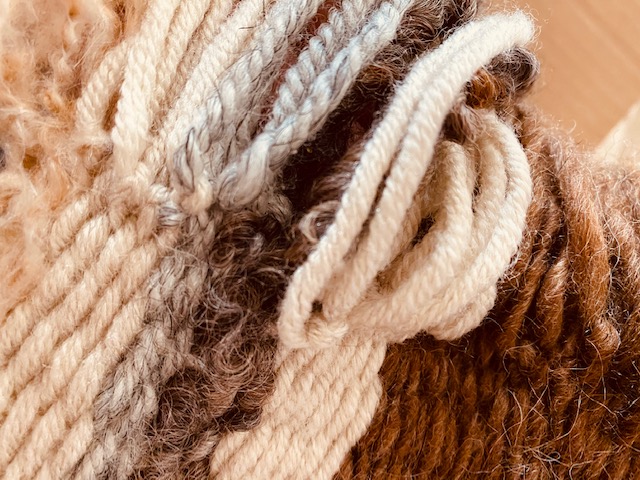
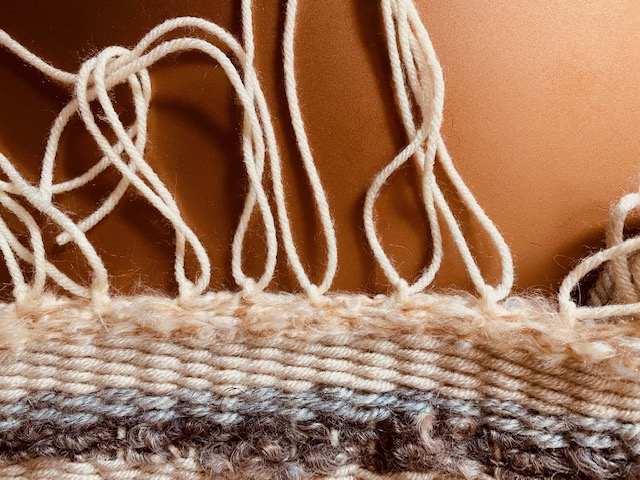
Before I thought about taking the project off the loom, I tied off the fringe on each side. You just take one weft thread, and the next one, and tie it in a double knot. Make sure that the two edges you tie are on opposite sides of the warp thread. This will ensure that the warp is secure and your piece won’t become loose and/or unravel.
When your fringe is all tied up, flip the tray over and remove the pieces of tape that are securing the edges of the warp. Then, cut across the middle of the warp threads, freeing the piece from the tray.
You have a choice to make here. For both choices you should tie off the warp threads in the same way you did the fringe, tying one thread next to its neighbor. If you have an extra one at the end, just include it with the two next to it.
Then, the choice… Do you leave the warp as fringe, too? Or do you sew it into your weaving? There is no right answer except for doing what you think is best for your piece. If I had used a thicker, more interesting or robust yarn for my warp, I think I would have left it as fringe, but the yarn I chose is kind of tame compared to my fringy side, so I opted to sew it in.
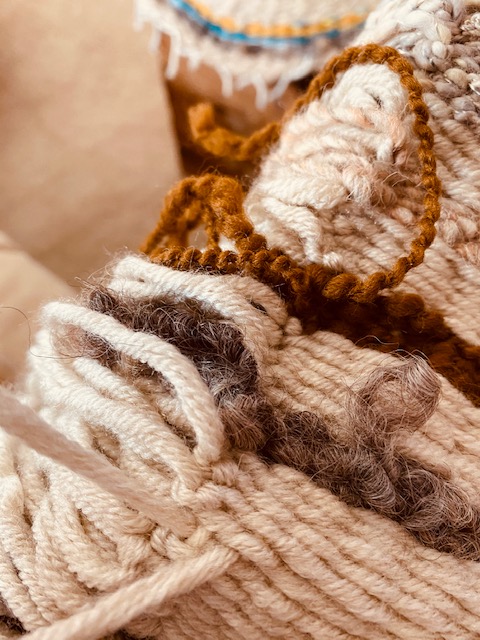
Here’s the warp threads tied off.
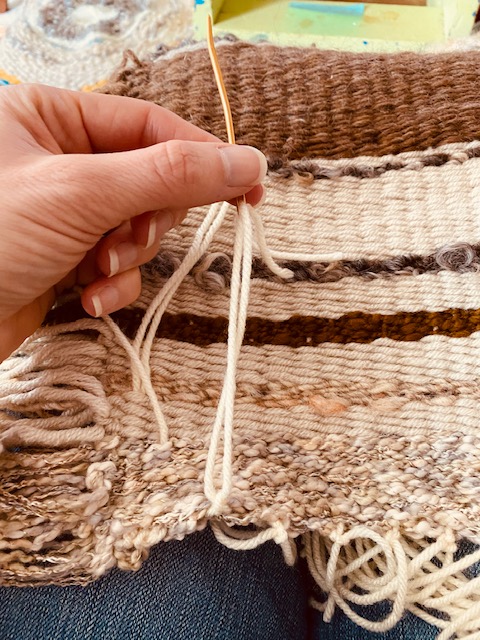
I chose to sew the two tied threads at a time, because they are already tied together as one.
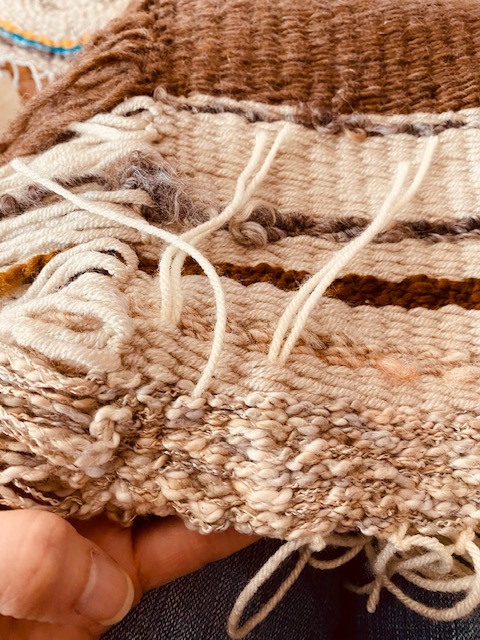
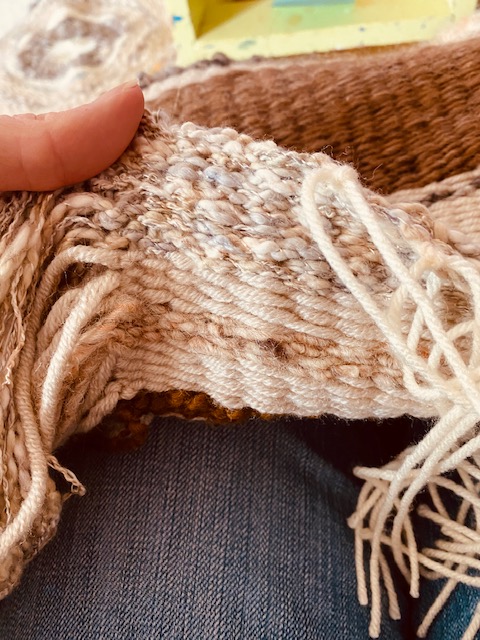
Using your tapestry needle, bring the warp threads back through the weaving, drawing the needle through the column of the woven piece that is right under it. Don’t pull too tight here as you’ll pucker your cloth.
Flip your piece over to make sure the warp threads are really hidden in the column of weaving. Sometimes they peep through too much and you have to do it again.
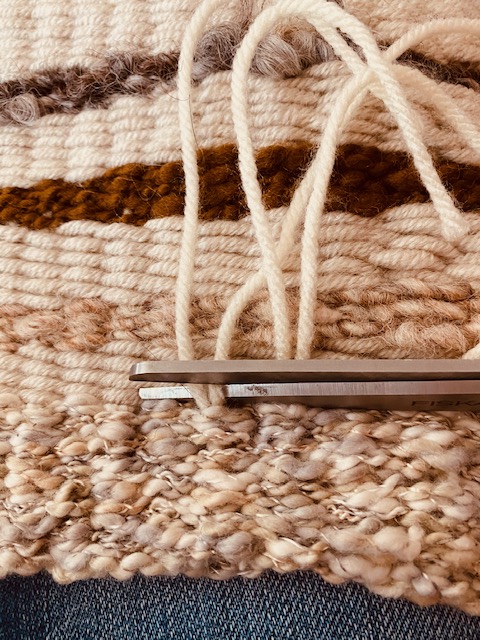
Once you’ve gone through a couple of inches, you can snip the remainder off.
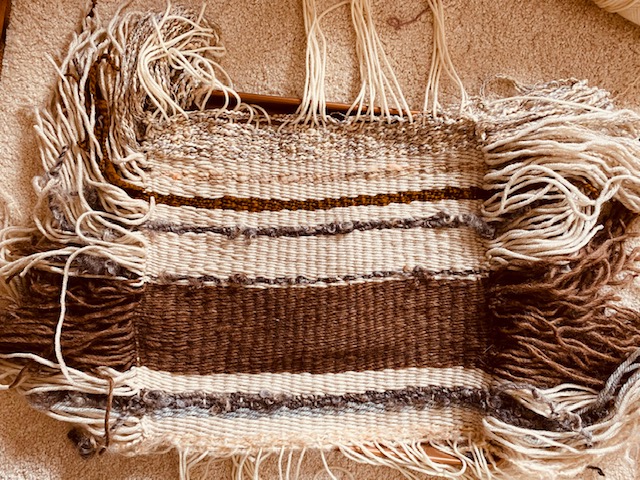
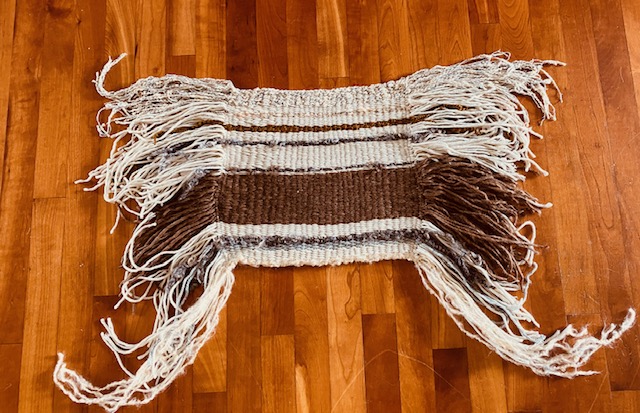
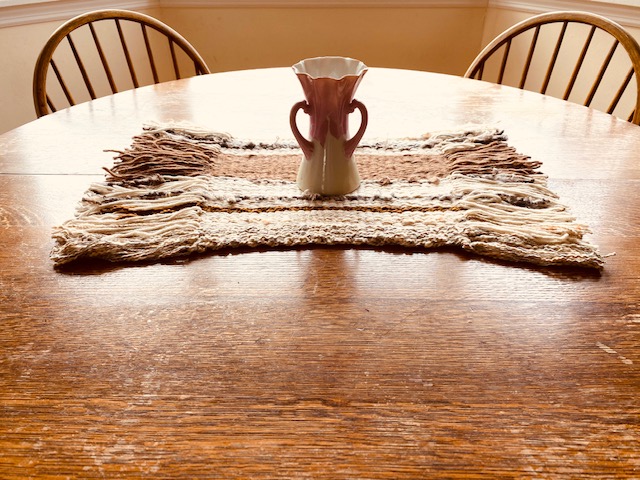
Here you see my piece with the wild fringe and sewn in warp threads. This thing definitely needs a little fringe-cut.
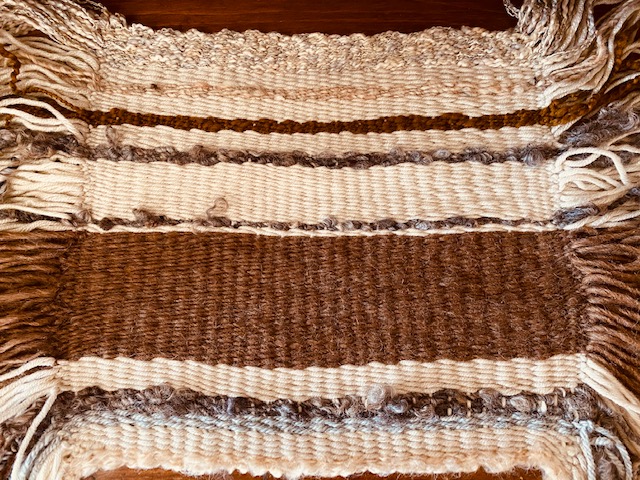
And there we have it! Who knew I needed a new woven table decor piece?!
Stay tuned for some more fiber art ideas. These will always be great for kids to do, but for sure, these are also fun for folks of all ages. It’s the truth that handcrafting is good for us. It quiets the mind, especially once we get into a good flow. It helps ground us when things feel wild or unpredictable. And, it can give us the chance to see that we can make some really beautiful things.








 Healing Handcrafting