Healing Handcrafting


Leave a comment

Thoughts On Grief

I spend a lot of time thinking about and talking about grief. It’s part of my job as a therapist. I co-wrote a book about it. And I incorporate working through grief into certain of my weaving classes, both with groups and individuals. It’s a subject that is always relevant because all of us, at some point in our lives, barring few exceptions, lose loved ones or experience losses of other kinds, like endings of relationships, job loss, or significant life changes due to chronic illness, bankruptcy, natural disaster, war. The list is long. The news of late has been devastating and heart crushing when viewing what is happening in the Palestinian Territories and Israel. So many of us are grieving locally as well as globally. So many of us have been doing this for a long time.

There’s nothing to say about it that can take away the reality of the pain, anguish, trauma, and truth of the matter, which is that human beings can be so utterly monstrous to each other. It’s shocking, and then we must think on the reality that we have choices to make every day about how we are going to be in the world. And sometimes even the most peaceful of us disappoint ourselves. I guess that’s where the truth is, too. It’s always a choice, and always it is true that how we are to others impacts our experience of our lives and our relationships.

I’ve noticed a few things lately that might seem obvious, but that have been moving me and making me look above and beyond the chatter. These observations help me connect with my choices in a way that mitigates feelings of helplessness and despair. I’ll share them with you here.

~ There’s a lot of dialogue about how much our culture gets grief wrong and how there is this pressure on people to “get over” grief quickly. I don’t disagree with that, but I have been noticing how many individuals and organizations are out there, all over the world, talking about how grief really is, and how much it changes a person and a life. As I’ve looked more deeply into remembrance and awareness days to do with grief, I’ve seen a lot of realistic information about what grief is really like as well as how we can support others when they are struggling. I’ll write soon about an upcoming awareness day to do with grieving children. I wonder what is getting in the way of the honest messages to do with grief from landing and changing the experiences people have when they are suffering. How can we release the pressure we put on ourselves to stay the same, no matter what?

~ Giving people the space and respect they deserve and are entitled to when processing life events and grief is a wonderful thing to do. When we can get out of the mindset of having to make someone “feel better” and instead hold space for them to simply be where they are, a sort of alchemy takes place. A bridge of trust grows, and often it looks like recognition. Almost like a version of namaste, it is as though the spirit says, the grief in me sees the grief in you.

~ As I talk with and listen to people, something is becoming crystal clear: long-term grief is not always solely about the loved one lost, but sometimes is a result of the anguish of trying to get back to normal too fast, whether this is a self-imposed pressure or felt as pressure from others. As a result of that anguish, there are multiple layers of complexity piled on and on and on. As people try to find their balance and figure out a new normal after any kind of grief, part of that often entails facing the pain of how their grief was received and responded to. This is tough stuff, but it seems important to me.

~ There is something incredible that happens when people let themselves process life events through the practice of making. We do so much thinking about so many things. And I’m a fan of thinking! Thinking helps us make choices that are less reactive, more informed, and ideally lead to better outcomes than when we fly by the seat of our emotions. But… sometimes we get lost in the weeds of words and self-analyzing. Creating spaces where people can translate lived experience into artistic form works, and what we get from that is insight and healing from angles that might not have been approached if the senses weren’t involved.
~ Listening… the most wonderful kind of listening… is medicine. The kind where you’re not waiting to say the next thing, or thinking about your words as the other person is still talking. Slowing down and absorbing what someone is saying and letting it affect you or work on you in some way- this is true relating. And it doesn’t require hours, or even many minutes. It just requires deciding that the person you are engaged with is worth your time and attention. Can you imagine if we all treated everyone like that? And were treated like that all the time?

What helps us meet the people around us where they are, not where we want them to be? How do we maintain compassion, patience, love, and curiosity? The first thing that comes to mind and is the only one I want to focus on at the moment is self-compassion. Sometimes it’s just the truth that our cups will not be full before we give to others, and we can sustain that for a while. Sometimes we are tired and grieving ourselves, when we are at the same time showing up for others. And sometimes, we can’t give in the ways others want us to give or we wish we could, and we need to pull back and refocus that energy. That’s okay. It helps to remember and keep remembering that it’s not anyone’s job to take grief away from others or somehow fix the pain of it. And sometimes energy needs to go back into the self for a while before it can go out again. It’s just the way it is, and there’s nothing selfish about it. It’s okay to think about how you can show up for people at any given time, and be honest about.

How do you tend to yourself and nourish yourself as you go about life and relationships? Do you have ways you tune in and respond to your heart and body? Do you take the importance of this as seriously as you do your love for and support of others? And, when you can’t be there in the way you always have and feel worried about that, or stressed or resentful, do you have ideas about alternatives? Can you imagine communicating them?

Until next time,

Bradie

Leave a comment

Five Gifts of Weaving

There is something alchemical about handweaving. It connects us with ourselves, with others, and with our ancestors, recent and distant. Weaving is part of our ancestral DNA and when we allow our fingers to interlace thread with thread, we create connection and foundation. Weaving does not have to be expensive, and weaving should be accessible to all people. If we can apply resistance to threads and create a taut warp, we can weave.

I love the long arc of weaving and the incredible potential it affords. One can sit with a simple frame loom and weave wild art pieces as well as work on a multi-harness floor loom and create wondrous and complex fabric. There are so many types of weaving and looms. Multi-shaft, tapestry, backstrap, pin, circular, inkle, Rinny Tin-Tin. Over the last decade, I’ve been teaching fiber art and craft in schools and more recently at the Shelburne Craft School, and there are some thought jewels that I’ve gathered along the way that fuel me, inspire me and make me want to keep learning and expanding. I’ve shared some of them here as a way of inviting anyone who has an inkling, to try out weaving, or any art or craft you’ve longed to try but keep putting off.

People Meet Themselves When They Weave

On many occasions, I’ve had the good pleasure of hearing people say things like, “I’m usually __________ (fill in the blank), but I’m playing with being __________ (fill in the blank) as I weave this” … or “I’ve never played with so much color before and I LOVE it!” …, or “I never realized how much tension I hold in my hands” …, or “the process of weaving while I reflect on my loved one is bringing up thoughts and feelings I’ve not held space for in so long, if ever.”

When we let ourselves just be with our hands, our eyes, and our breath as we make, our spirit has a chance to catch up and settle into the space between our lungs and in all the chambers of our heart. We can hear our own breathing again. We can let our eyes linger where they want to, and then notice where that is. We can meet our inner judge and talk it down from fear. We can usher ourselves into new territory and have woven fabric to show for the journey.

People Benefit from Having Access to Colors and Textures and the Opportunity to Experiment

This may sound so obvious it’s laughable, but hear me out. Have you ever had the experience of being invited to make something, and are given a certain set of materials that everyone else has, and a series of instructions that everyone else has, and you make something at the end that looks like a weird, kind of close but disturbingly not-close version of the thing you were supposed to make? Or is that just my life? In my experience, nothing botches up creativity more than when we are in a circumstance that doesn’t let us feel and see our way through materials we want to touch and witness. I’ve been blessed with a bunch of students who “go rogue” on the regular. It’s hilarious, and it’s shown me that people have their own ideas and their own version of learning that needs to be honored and allowed for as much as possible. Yes, sometimes technical truths need to be thrown in the mix to ensure that people can weave the thing they want to weave, but I’ve learned that creative drive is strong and shouldn’t be stamped out by rigidity.

People of All Ages Need to Play

I think we all know this intuitively, but what I’ve found is that people of all ages need access to opportunities where they can experiment, follow their noses, see what happens, try this and that, on low-stake projects. As we age, many of us become concerned with how much things cost, how much “time is worth”, how useful something is, and whether there is value to whatever it is we are doing. It puts so much pressure on the creative part of ourselves that just needs a freakin’ minute to look at things, try things out, observe what happens when certain materials interact with others, and take notice of how we feel about what we are seeing and experiencing. We need the chance to just be and drop in to our flow. When teaching elementary aged people as well as folks in their senior years, I’ve heard many exclaim, “Oh wow, I get to use this?” and, “I can’t believe I can weave with all of this! It’s so much fun!”

That makes my day.

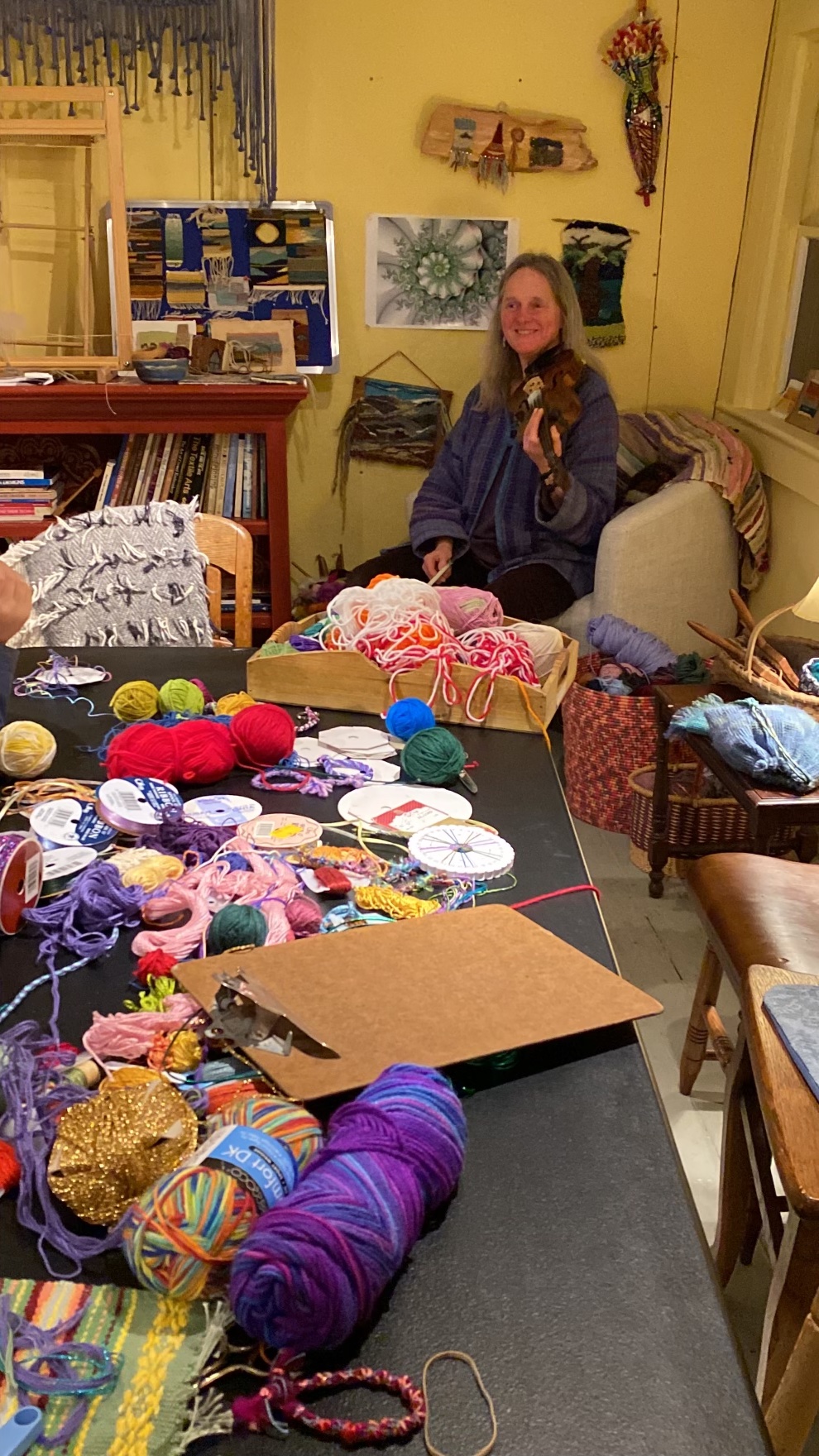
My friend and weaving teacher, Lausanne Allen, playing the fiddle while guests learned to braid using the Kumihimo method during an event at the Shelburne Craft School.

Weaving Can Be Very Simple and Very Complex

I’m hitting home runs here with obvious statements, but it’s worth saying that weaving is, at its most basic, the process of moving one material over and under and over and under another material. That’s it. Simple as that. From that foundation, we can weave the most complex and wondrous images and textiles imaginable. But it all starts with interlacing whatever it is we are weaving with. Isn’t that marvelous? Weaving is for everyone. It can be taught to people as young as nursery school age, and there is no age limit. In fact, weaving can help those dealing with the effects of stroke, dementia, and Alzheimer’s disease, as it has been shown to strengthen and encourage neuroplasticity in the brain.

When We Get to Do Things We Love, We Are Living the Universal Dream

Disclaimer: This is my view based on a whole lot of things. Feel free to take it or leave it.

If we are doing what we love at least sometimes, we can experience ourselves and share with the world our inherent gifts. There are no losers in this set-up. (Of course, I’m assuming that doing what we love doesn’t include hurting other people or living in a way that disregards others’ autonomy and integrity.) When we share what we love with others who are interested, we are giving from the place of our truest selves, because what we love is connected to who we are; the spark connected to our creativity is born from energy itself, and it interlaces with others’ creativity, like a cosmic dance. It’s amazing!

Whether it’s weaving, dancing, sculpting or singing, writing, building or baking (the list goes on and on), if we love what we are doing and sharing it with others in some way, we are putting some good energy into the world. And my friends, the world needs that big time.

Doing what we love = good medicine.

I hope whatever you are doing today includes you sharing the spark you have with the world in whatever way feels great to you. Until next time.


Leave a comment

Ways to Tap Into Your Creativity and Why It’s Important

I’ll share with you, right out of the gate, some positions I hold that are unshakeable:

  • It is my deepest belief that every person has creative energy within them.
  • Something wants to be expressed and realized in every human.
  • One does not need to go to art school to find and express their artistry.
  • We have a choice about how this creative energy is harnessed- generatively or destructively?

Where I live in the northeastern United States, summer brings a surge of energy that, whether felt by people or not, is always part of the environmental experience. We emerge out of cold winter. We make it through spring, which in Vermont is a weird conglomeration of less cold air, more moisture, thawing ground, a lot of mud, then a freeze, then another thaw, more mud, some warm days, then some cold days again. Finally, we make it to the time when it stays warm. The greens explode, flowers bloom, birds sing, farmer’s markets bustle, frogs fill the night sky with their croaky songs.

For me, this is typically when there is a powerful surge in my own creative energy, and in the last fifteen years or so, I’ve learned to harness it in an effort to create. What I didn’t really know before fifteen years ago, was that this is a distinct energy that needs tending to, not just when there is a surge of it, but throughout one’s life and throughout any given year, no matter the season. One doesn’t need to be an Artist with a capital A to do this. Many people know this already and live in accordance with their flow of expression. You might see it when you walk into someone’s home and they’ve decorated in a way that delights the senses. Or maybe you’ve known people who can prepare food that would make Julia Childs exclaim. Have you ever walked through a home garden where someone has lovingly tended to each of their plants and has bits of ornamentation here and there that makes you smile? In all of these ways, individuals express themselves and share what they love with the rest of us.

Of course there’s also painting, drawing, writing, weaving, knitting and crochet, sculpture, carving, repurposing, hand-stitching and sewing, dancing, metal work, singing, making music, playing… the list goes on and on.

Life for the majority of adults involves a whole lot of work, and these days, an astronomical amount of distraction from what’s right in front of us. Most heart crushingly, the thing that is severely neglected in this overstimulating culture is our relationship with ourselves.

We are someone we can get to know and have a relationship with.

This is incredibly important to understand. We can hang out with ourselves and get to know ourselves in ways that are very similar to how we hang out with other people and get to know them. How? We give ourselves time to follow our noses and let our creative energy lead the way for a bit. Julia Cameron talks about this at length in The Artist’s Way, and she specifically urges her readers to take themselves on dates. These can be outings that really don’t take a lot of time but that are just for you and you are just with yourself. This is crucial. Your date with yourself should not be time to catch up with phone calls or coffee dates. This is your time you give yourself in order to be with … you! The more you go on these dates with yourself, the more they become second nature and an important part of your life.

So, why is this important enough that I write a blog post about it? Here’s some reasons:

~ Creative energy is energy. When it is stuck, suppressed or unrecognized, it can shape-shift in ways that are not generative. Think abusive use of substances, depression, agitation, disconnection via distraction, sadness or grief for reasons that are hard to identify, living through other people and their creativity, and simply living life by going through the motions.

~ When we notice the creative energy in ourselves and tend to it, we allow for others to do the same, in whatever ways bring them joy and meaning. We learn about ourselves and others.

~ We slow down enough to engage in the moment that is right in front of us. For example, when I’m weaving, I’m only weaving. I’m not texting, doom scrolling, making dinner, talking on the phone… I’m doing this one thing that requires my full attention and I focus. Sometimes I can only do this for 20-minutes, but 20-minutes is better than 0 minutes, so I’ll take it.

~ We develop relationship with our selves. Sorry, as a therapist I’ll never not think this is important!

~ We allow the energy within us to flow up and out. I think about what one of my mentors said all the time when he was teaching. He talked about seeds and how a sunflower seed can only become a sunflower. It will never be something else, and when it is fully realized, it is wholly itself. It will never be a marigold, or a daisy or a tomato. This is how it is for people. Yet for us, many things get in the way of our original seed growing into what it is in its truest nature. Allowing for time to connect with our creativity is one way to clear the path for our true nature to grow up and into the light.

How Do I Tap Into My Creative Energy?

As promised in the title of this piece, I want to give you my go-to ideas for how to cultivate, reignite or tend to your creative life. This is not an exhaustive list and many books have been written on this. My favorite so far is The Artist’s Way, and if this topic is of interest to you, I highly recommend it.

But for now…

~ Accept the idea that you are a creative person with energy inside of you that is unique to you and is valuable to this world.

~ Accept that expressing your creativity is not selfish, meaningless or a waste of time. My teacher Susan Barrett Merrill said to me once that in fact, we do good for the world when we allow the gifts that we have to flow through us and out, and that when we take time to be with ourselves and create and make, we add that energy to our environment. She said that to me because I struggled with this one myself.

~ Make things easier for yourself. Here’s an example: If you like to paint or want to paint but think that the only way to paint is to buy all the expensive tools and materials you’ll need, and create a space in your home that is only for painting, and that you have to take a class before you start painting, and that you have to carve out a few hours every day to paint or it’s not worth it… guess what? You won’t paint. If you’re a busy person with a bustling life and lots of responsibilities that might be hard to stretch at first, start small. Twenty-five years ago, an artist friend of mine gave me these kinds of paints and this kind of paper so that I could delve into making things. He told me back then, “you are an artist”. I said, “no, I’m not at all an artist. You are an artist and I’ll leave that to you talented people out there.” Well, guess what? I still use those paints (a different set now because I used the set up!) and while I’ll not be exhibiting my watercolor paintings in any galleries, I love them and they inspire me to make other things.

~ Minimize distractions, but be realistic. One of the things that really gets in the way is the idea that “If I can’t dedicate hours to what what I want to do, then it’s not worth it.” This is a lie. There are ways to build in moments to connect with self via the creative path. Maybe there’s a day in a busy person’s life where settling in for some extended sewing isn’t possible, but a smaller handwork project is if you have a little basket with your bag of notions and some fabric. So is looking at books or magazines that inspire or teach. So is sitting on a front stoop or by a window and looking out at the world and gathering inspiration for a future project.

I wove this piece in 15 to 20 minute increments over the course of a month. It’s random and was an attempt to learn and play with color, as well as to make sure I wove “every *%$@ day”, to quote Tommye McClure Scanlin

~ Have at the ready small ways you can do the things you love. I’m taking this tapestry class right now with Rebecca Mezoff, and it’s wonderful. I now have a little bag with all the essentials to easily bust out a drawing, a note, or even a small weaving if I find myself in a place where I can create.

~ Make dates with yourself to do the larger things. And honor them. These are as important as anything else. (I think this is incredibly hard for many people.)

~ Avoid “killing time”. I wrote about this here.

~ Don’t compare yourself to others. This is top-shelf creativity energy kryptonite. Don’t do this. If you do find yourself struggling with these crushing thoughts, let your inner judge know, “It’s okay. I won’t (you fill in the blank with whatever your judge is saying). We are just playing and we are safe.” Sometimes our inner judge thinks it’s helping to protect us from something, so it needs to know that you are going to try to enjoy your creativity more and nothing bad will happen.

~ Visit local antique stores, art galleries, museums, flea markets, book stores, parks, outdoor art installations, open studio days, farmer’s markets… most of these are free and give you the opportunity to look around see what you’re drawn to.

Hopefully, if you’re still reading, I’ve made my case that it’s worth it and important to engage with your creative energy, and it doesn’t have to be expensive or unrealistically time consuming. You are a unique expression of life and within you are ways to engage with this expression so you and others can know it better. Why not go for it? Time passes whether we engage with ourselves or not, so in my view, we may as well make the most of it and see what we can create.

Until next time


2 Comments

The Long Grief Journey

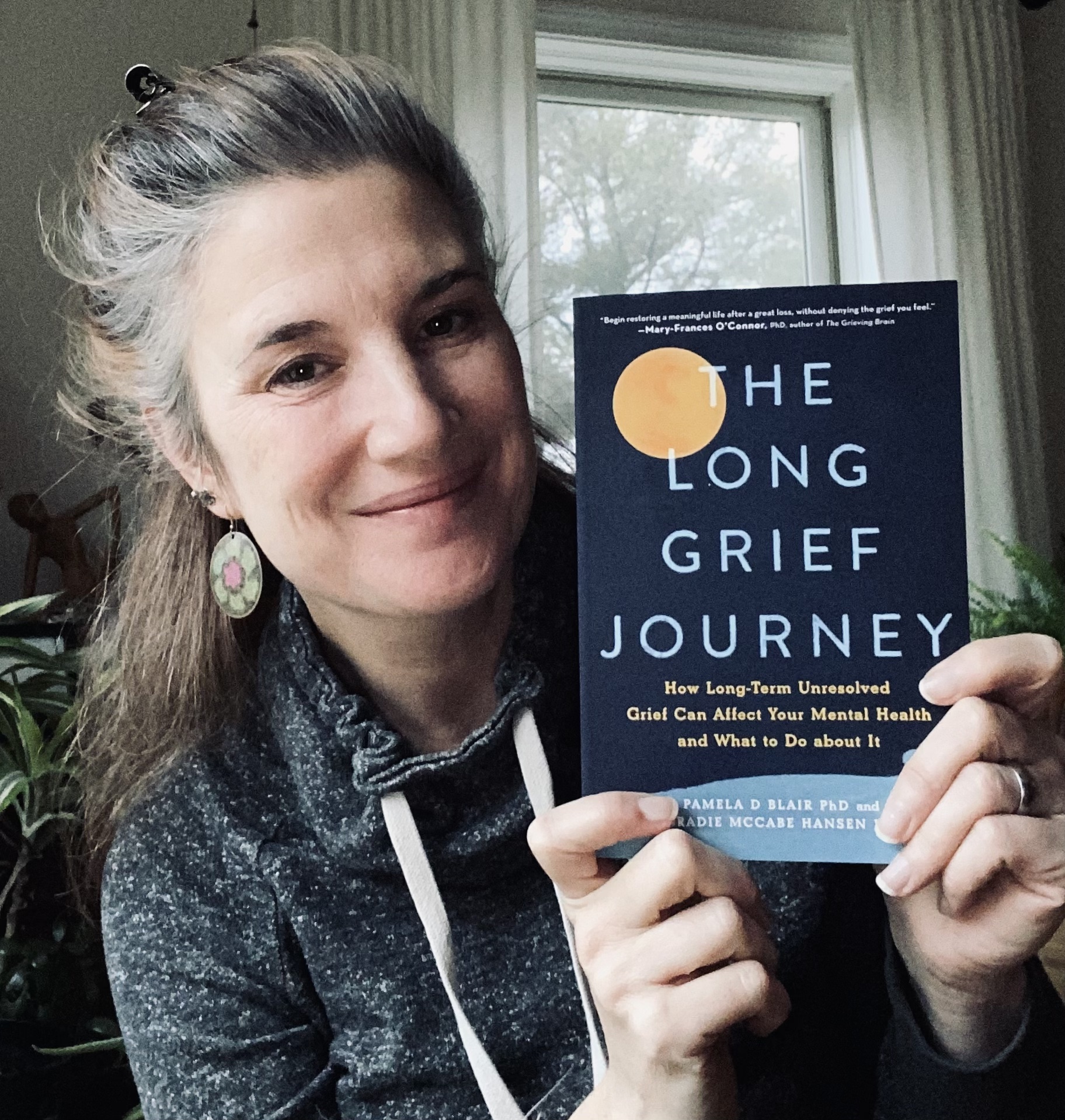
I can’t believe it’s finally happened, but this week I received a box of books, all of them The Long Grief Journey: How Long-Term Unresolved Grief Can Affect Your Mental Health and What You Can Do About It. In spring of 2020, my friend Pamela Blair who co-wrote I Wasn’t Ready to Say Goodbye and is the author of several other titles, asked if I’d be interested in writing a book about long-term grief. I wrote about that moment here. And now, a month before its release (on February 14, 2023), I get to hold it and read it and show it to people. Wow. What a trip!

It’s been a long time since The Long Grief Journey was picked up by Sourcebooks and I owe a debt of gratitude to the wonderful editor who saw the value in making our work available to people and helping us to shape it and edit it well- thank you Erin! In the last year, the waiting for the book to come to print was starting to make it all feel a little bit unreal, and a little scary and then a little disorienting- wait, we’re almost at the release date?! I need to get a new outfit or something! But now, holding the book in my hands, I remember it all: the first invitation to join Pam in the project, the jumping into researching and brainstorming and writing, rewriting and collaborating, submitting and waiting and hoping and praying and now… here it is. And I am proud. Grateful and maybe even a little bewildered, too. To be able to use my own grief experience while being honored by so many people sharing their stories with us has in many ways brought an intimacy and more open heart to my day to day than ever existed before. Maybe the word is humbled? My heart feels tenderized.

If you end up reading the book, I hope you find it useful. We really are all walking this road together.


Leave a comment

Steadily Weaving and Learning Through Time

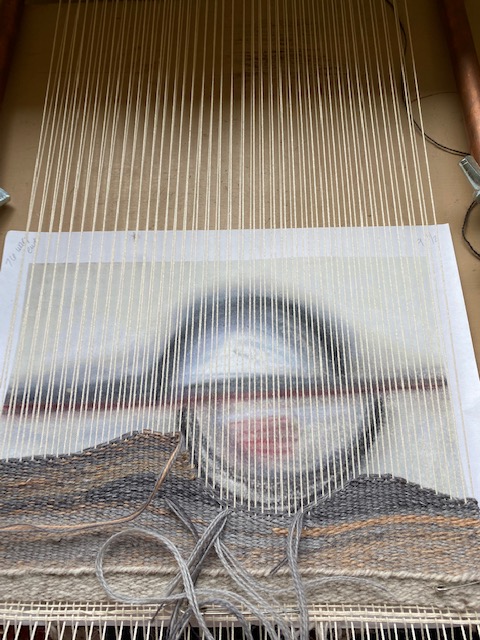
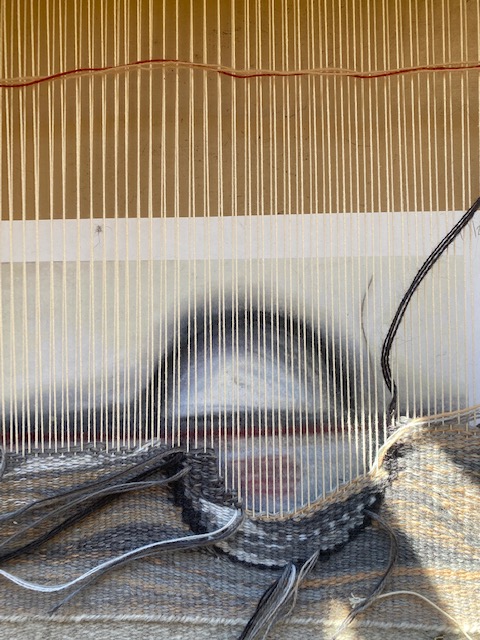
It’s been a minute. And not for lack of lots and lots of activity and making. Sometimes it’s hard to link together in a whole picture little bits of weaving here, some experiments there, and some growth elsewhere. One of the things I love about small format tapestry weaving, as well as weaving on unconventional looms, is that you can move them around, carry them with you, and finish them as you are able. That is the reality of my life these days. If not for moveable weaving, there’d be no weaving at all for me.

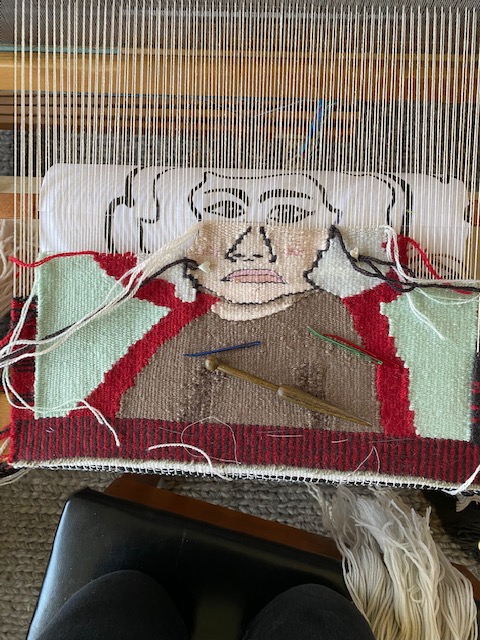
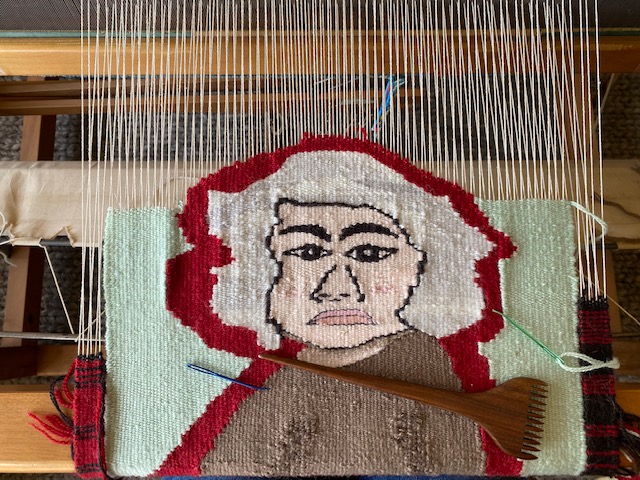
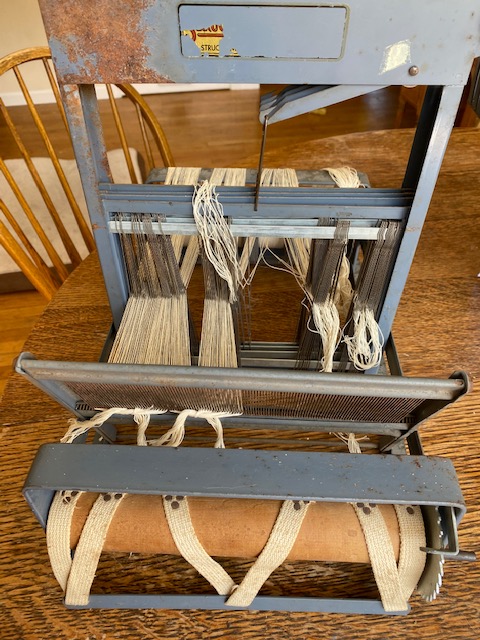
I wove this little tapestry on a Handywoman small tapestry loom that I love so much. I take it with me most places and love it when I pull out that little number instead of my phone. It helps, to weave. Seriously.

I’ve had this piece going for a while. It’s part of what I hope to be a series of tapestries flowing from drawings I’ve done when sitting with the idea of moments that distinctly create a before and after. More on that at some point.

I was on a drive recently with my daughter, soaking up beautiful Vermont autumn colors. I loved how not at all straight these grain rows are- I mean, isn’t that so reassuring? So beautiful and true?

inspiration

We always have a moment, even if it’s brief, to decide.

Decide on a sentence said or not said.

Decide on gesture extended or withheld.

Decide on a color, texture, or tension.

There’s always something to show for it.


2 Comments

Weaving Air

Having several different projects going at a time is a habit I’ve gotten accustomed to over the years. I don’t have a schedule that allows me go to weave at my loom for entire days. Instead, I have bits of time here and there that I try to make good use of when I can. I used to judge this part of my nature, the part that flits from this to that. I wondered if I had a discipline problem, or some issue with commitment. Always the therapist, I’m often unpacking who I am and how I operate, and examining how my traits and tendencies impact my day-to-day life.

Well, in this case, I’ve learned that I really enjoy making things, at home, at work, on my loom, with kids, with adults, and by myself. I feel frustrated when the only thing I’m working on is not with me, leaving my hands idle and my mind clanking a bit. When I allow myself to indulge in the many-projects-at-once rhythm, I get to eventually enjoy what I refer to now as my creative crescendo; so often many things are finished around the same time and I have this wonderful experience of seeing multiple ideas and efforts come to fruition at once.

Right now, I’ve got this vibe going in full-force. There’s a curtain (hopefully) on my counterbalance loom, towels on my rigid heddle, a tapestry on my copper pipe loom, another tapestry on a small frame loom, and oh… that second mitten I’ve been wanting to finish knitting for months.

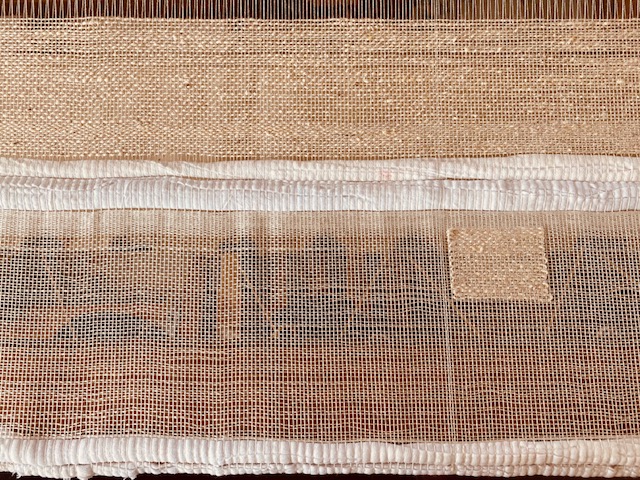
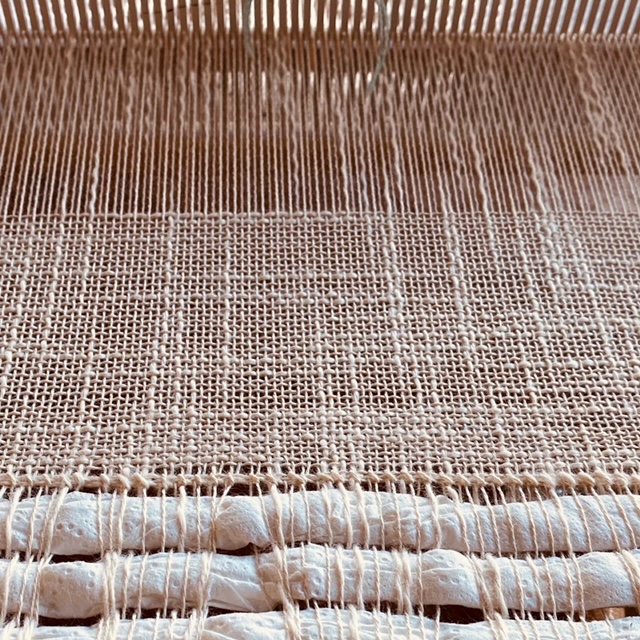
What I’m noticing about a few of my projects is that they are going after a feeling or sense experience that I can best describe as airy. I want my curtain to be as flowing and loose as I can manage weaving it, with bits of structure and form throughout. This is an experiment as I try my hand at weaving with 20/2 cotton as the warp and using inlay throughout. I’m not using a pattern or following any directions. I’ve already learned something. I have my 20/2 warp sett at 12 epi, and I originally hoped to use the same yarn for the plain weave weft; the inlay was going to be a thicker cotton slub yarn that has a yummy texture. Well, what I learned was that the fabric was just too loose. I was beating it lightly to maintain an openness and transparency. I basically wanted a curtain that blended in with air. But what I found was that if I even looked at the fabric funny, the weave drooped and flopped, making it look injured and offended. When I started considering finding a spray adhesive and shellacking the whole thing once it was done, I realized I’d maybe made a mistake, chalked it up to my steep learning curve, and switched gears. I am going to try to use the experiment to cover some beautiful handmade paper I have, so all is not lost.

Now, I’m weaving the curtain with the same warp, but with the thicker cotton slub yarn as weft, beat loosely (still finding the right beat and trying to keep it consistently). I can’t do the same inlay design I was doing because I’m using that yarn for the plain weave. I decided instead on this twine, jute-like string/rope/yarn I have and opted to just lay it in, leaving both ends exposed. This is a departure from the inlay techniques I was planning on practicing with this curtain, but that’s okay. I’ll get to them. I love the twine because you can unravel it and it becomes this wild grass-like stuff. It smells good, too. I’m hoping my curtain will still feel airy, but I suspect it will hang with a little more purpose and won’t be so vulnerable to the passing breeze or occasional handling as my original design would have been.

On my rigid heddle, I’ve got an actual pattern that I’m following. It’s another slub cotton project, this time towels. I love weaving with this yarn! It’s soft, gentle, light. Clasped weft is the main weaving technique utilized in this pattern, and it’s very satisfying to watch it build up. Getting the beat right on this project takes some doing. You can see on the bottom right that I’m beating too hard in the clasped weft section that is newly begun, but I’m working that out. I’m definitely turning into a person that uses a tape measure as a necklace! Ha! I’ll share pics of these towels when they’re done.

I’ll get to the tapestry work in another post, but for now, I hope that whatever you’re doing, there’s some room for creativity and texture, even if it’s just here and there. All those moments add up and make something, eventually.


Leave a comment

New Project on the Loom- Trying My Hand at Making a Slitrya Blanket

Finally… a project is on my floor loom. Well, not entirely. Threading is still in the queue, but with the help of Lausanne, I got the close to four and half yard warp wound on without too much trouble. There was one moment when it seemed the whole thing might become a bit more cumbersome when the rod attached to the back beam was found to be uneven, but with some tinkering, it was straightened out. I also think I finally came to understand the relationship between the pattern width, the width of the raddle sections, and the numbers of threads in each bout of the warp. For some reason, the relationship between these things has never fully clicked. I was making my warp bout size more about the total number of ends and the way to split it up as evenly as possible without the bouts being too big. I never even considered the raddle. I remember when I had to take statistics in college… I was in the second semester of it, which meant that presumably, I understood all the stuff I learned in the first class. This one day, I just could not at all, in any way, grasp what the professor was saying. To this day, I remember more his glorious, curly hair that the Florida humidity had fun with, rather than the stats itself. Doing some homework after class, I slammed into a wall of confusion and had to get some space from the claustrophobia of my own limits. I sat on a bench outside of the library, that building in which I spent most of my time, other than my own apartment. I just let my mind drift and then the concept I was struggling with came to me, like a fresh breeze on a stifling hot day. I got it! I remember I jumped a little and wanted to yell to someone… anyone, “Did you see what just happened in my head!” I didn’t. I just went upstairs and completed my homework with ease, enjoying my newfound insight. I feel like that’s what happened yesterday, thanks to Lausanne (again!).

The pattern is called Lillebror Slitrya and is from the Handwoven Nov/Dec 2020 issue. I’m very excited about it. I’ll keep you posted on progress as I make my way towards actual weaving. With the extra warp, I’ll play, play and see what happens!


2 Comments

Weaving and Fiber Arts are Coming Back to the Shelburne Craft School!

Something very exciting is happening here in Shelburne, VT, of the fibery, weavy, yarny brand. On this rainy Memorial Day Monday, I’d love to share the news with you.

A couple of months ago, I received an email from the director of the Shelburne Craft School, a wonderful woman named Claire, letting me know that they were bringing weaving back to their programming. Oh my… she had me right there. It was an incredibly welcome email to receive for reasons big and small. In it, Claire explained some of what she was hoping to accomplish and asked if I would I like to talk. Truth be known, I would have jogged my pandemic-fatigued self to her right then and there, but I tempered that urge and like any mature grown up, set a date to meet in my studio nearby on a later date.

When we met, it was difficult for me to contain my enthusiasm. I listened to what Claire’s vision was and marveled at the fact that soon, Weaving and Fiber Art would be offerings at the Shelburne Craft School again. The school had a strong weaving program decades ago. I’m unclear as to why it was stopped. I’ve only heard whisperings about “the day the looms left”, or something like that. At any rate, as we spoke, I realized quickly that while I want to be a part of this most assuredly, I don’t have the weaving expertise to spearhead the vision coming to life. But, I thought of my weaving teacher, Lausanne Allen, who has more expertise in her pinky nail than I’ll ever hope to achieve in my lifetime. I let Claire know I’d be in touch with Lausanne we’d see what unfolds.

Well… receiving Lausanne’s response to my inquiry as to whether she could imagine taking on developing a weaving program at the craft school was probably the closest I’ve come to that feeling you get when you hurriedly open a letter from a someone you’ve missed terribly, or the results of some test… I sped read it and laughed out loud and read it again more slowly… not only was she interested, but she was thrilled out it, too! I’d forgotten this, but Lausanne reminded me that she learned how to weave at the Shelburne Craft School in the 80s and right out of the gate, she had so many ideas and questions and wonderings…

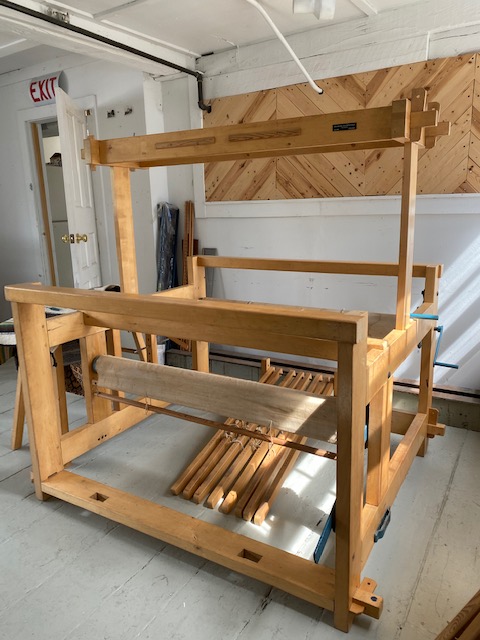
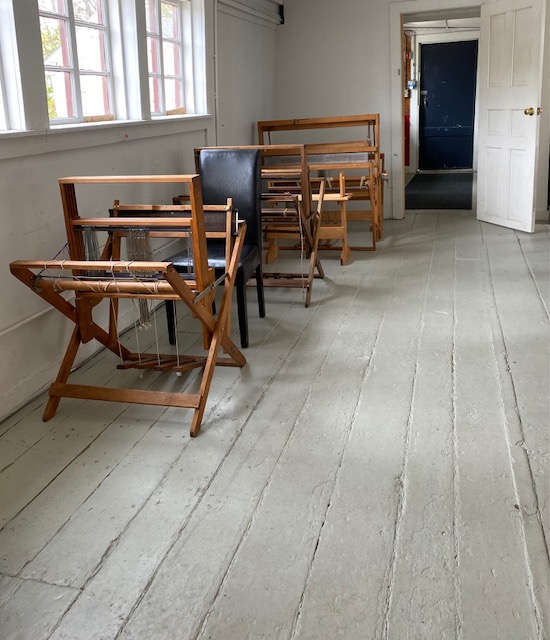
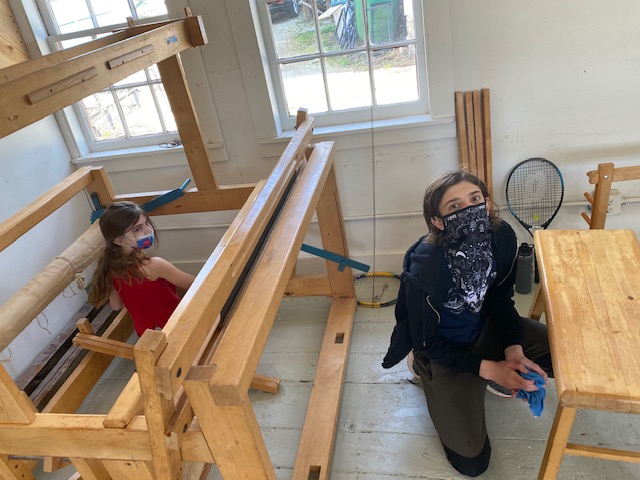
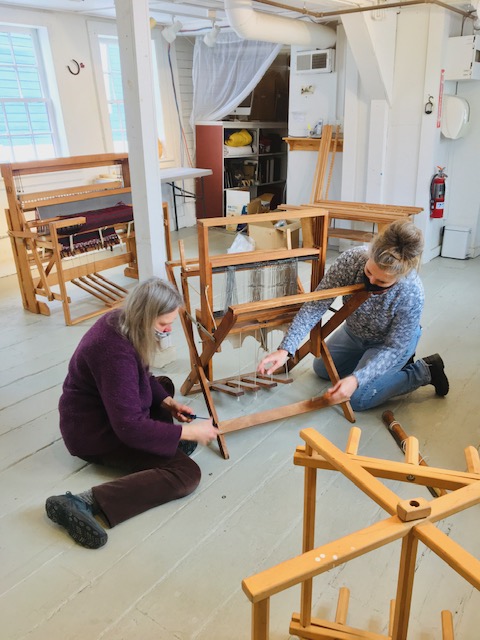
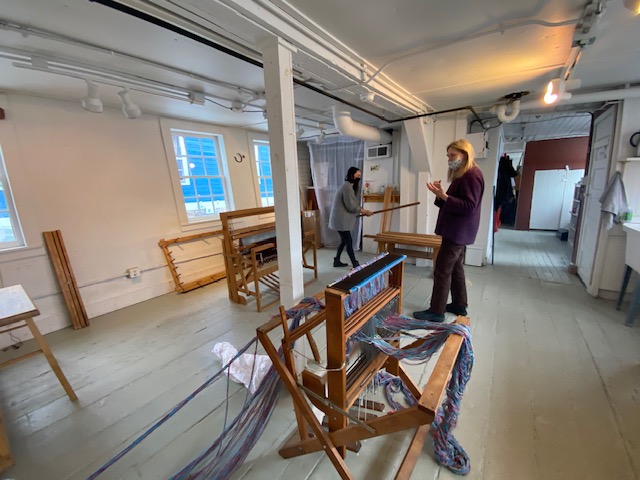
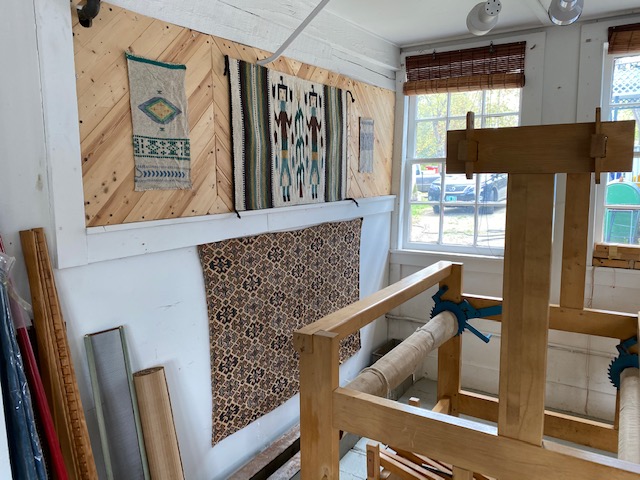
A lot has happened since Lausanne and Claire met. Spaces have been cleared, looms that the school still had from the fateful time the weaving program shut down have been resurrected and Lausanne and I have brought in a couple of our own. The walls have been adorned with Lausanne’s incredible work and other weavings we’ve collected over the years. There’s been cleaning, oiling, de-rusting and untangling. Lausanne has done many hours of research and learning and acquiring of needed items for the school. And me? I get to be Lausanne’s… I don’t know what to call myself… helper? Assistant? Grateful-To-Be-There-Apprentice? I can tell you this: I feel pinch-myself lucky to be a part of this new development in my town, and am thrilled that Claire has the vision she does to bring back such an important part of not just our town’s history, but in my view, an integral part of the story of human making.

If you are reading this with a particular interest in weaving and wonder when might things be lifting off ground at the school, I will be regularly updating you here. And of course, check out the Shelburne Craft School’s website to see all of their offerings. It’s a wonderful place to be, and soon the sounds of beaters beating, shuttles flying, bobbins spinning, and voices whispering to cloth will be filling the air and saturating the old wood of the historic building.


Leave a comment

What Color is a Temper Tantrum?

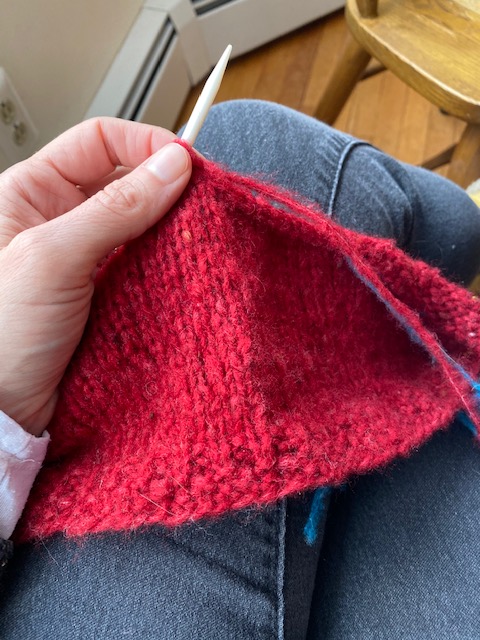
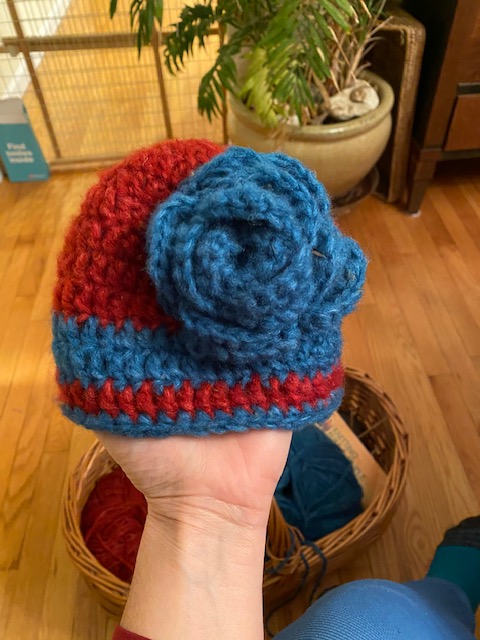
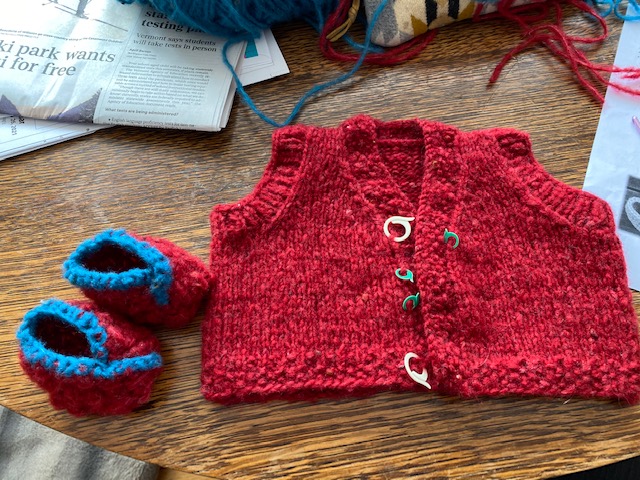
Well, hello… it’s been a while. How do we catch up after so much time? My last post was in July of 2020. Since then, I’ve become a homeschooling mom, I’ve started co-writing a book about grief that lingers beyond the time our culture demands is appropriate, I’ve barely knit or woven a thing except for a sweater, hat and booties for a soon-to-arrive little baby niece (oh, I cannot wait to meet her), and I’ve been riding the wave of pandemic life that is really pretty goddamned grueling.

Today at the store, I was double-masking it because I <heart> Anthony Fauci and he says it’s a good idea in some instances. But the second mask I had on was too big and every time I looked down into the bag I was filling, it would scooch up into my eyes and I couldn’t see a freaking thing. This was after I couldn’t help my son with his math because maybe I skipped that class? And, it was after I took a good look at what’s happened to my hair since my last real haircut & color about a year and a half ago, maybe two. So… the mask thing almost, almost made me have a temper tantrum right then and there in the middle of my neighborhood grocery. Why? Not because that’s been the most stressful thing to happen of late. Not even close. Like any good old-fashioned tantrum, they are born from buildup. An accumulation of things that exceed the nervous system’s capacity to metabolize stress. Finally there is the last straw. Usually that poor straw is puny, so to the casual observer, it just looks like someone is losing it over the “dumbest thing”. But it’s never like that. It’s just a dumbest thing that tips the scale too far into Freakoutsville. Today, my last straw was having a mask on my mouth and on my forehead at the same time. Thankfully, I did have enough self-control left in my un-Buddhalike-self to realize I could not handle an embarrassing scene over the decision I myself made about my own mask attire. Maybe it was the dude giving me side-eye as I kept adjusting and readjusting the civic duty gone wrong on my face. “What? Didn’t you see this is how we’re supposed to do it now, bro?”, I imagined challenging him while he slowly and cautiously unloaded his groceries onto the conveyor belt. As much as I wanted to blame some concrete thing, or even Side-Eye Guy for my situation, I knew there was no one but me who could pull it together. After I fumbled through the credit card machine process and then remembered to be grateful for what I have, I gathered my bag of frozen corn and peas and package of chicken, and made my way home.

I miss my people. It hurts something fierce. And my heart is breaking for the millions who are grieving those they lost in this last year. Whether loved ones died from COVID-19 or from something else, no doubt about it, the rituals and rhythms that are built into the fabric of who we are, and which hold survivors in their grief, were experienced very differently because of the pandemic. No matter where we live, what we believe, and who we wish to when we ask for anything in our quiet moments, all who have lost someone are part of a new group. This group has its own stories, memories, symbols, anguish and wisdom that are making up history as we live it. I guess it’s easier to get wicked mad at a mask poking me in the eyes than reckoning with global pain sometimes.

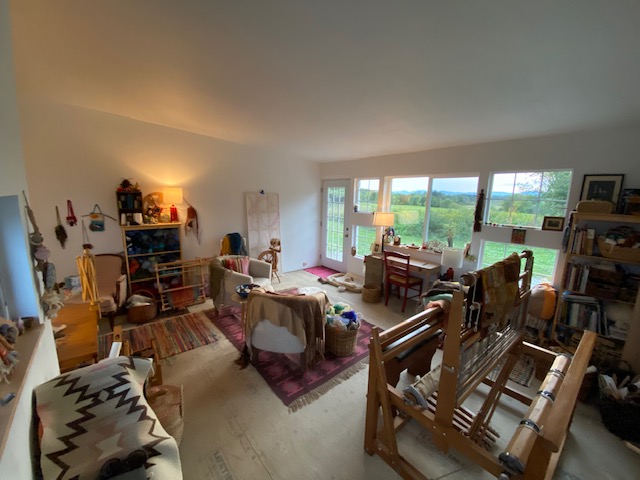
Anyway! Sorry to be a downer, but this is why I haven’t written! Who needs more people talking about how much things have sucked? I do want to share some things though, to cross the bridge back to my love of all things yarny, wooly and textured. I have a new studio space where my looms and most of my yarn reside. This development came to be after I had to close my tiny office in Burlington in the spring. I realized pretty quickly into the pandemic that it’d be a good long time before anyone would be wanting to meet in person again, at least in the space I had, and serendipitously, an opportunity arose at the Shelburne Pond Studios that was basically completely perfect for my varied needs as a therapist, fiber artist/crafter, writer and now momentary homeschooler. It has also allowed for me to unclog parts of my home that housed all of what I’ve collected for my fibrous passions over the years. Blessings on many fronts with us home all the time. I am starting to imagine spring, summer and fall there, and all the sorts of things I might be able to do inside and out with other “masked” people who want to create and play with yarn. I can feel the energy coming back and that is exciting. There’s going to be a lot to weave out of our bodies and our nervous systems as we try to make sense of all that has happened and continues to unfold.

I wonder what a woven temper tantrum looks like?


Leave a comment

Learn to Make Your Own Circular Loom and Lovely Bowl

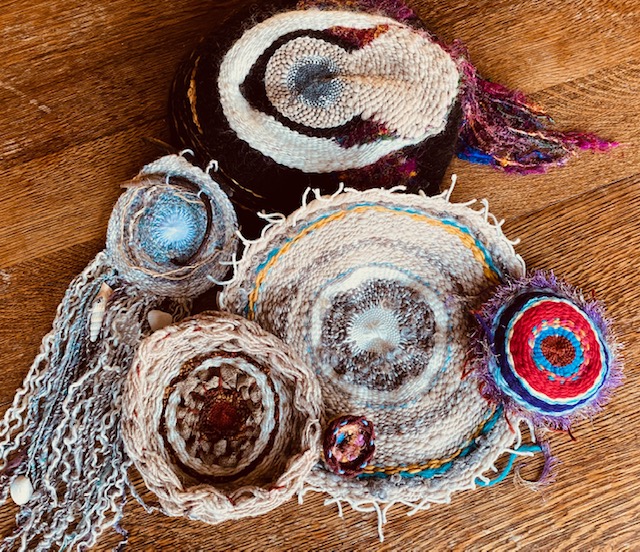
Greetings, fellow crafters. In my Fiber Saturday class yesterday, I demo’d how to make a circular loom out of cardboard. Here, I am offering more detailed instructions and a project idea. Many of the kids I have gotten to craft with LOVE circular weaving. In a way, it’s easier than weaving on a rectangular loom because you just go around and around, rather than back and forth (coming back the other way on a loom can be super perplexing to some. What do you do with that end warp thread!) Getting into the flow is easy and you end up with something beautiful at the end.

IMG_3459

Quick Disclaimer: I’ve woven many things on circular looms at this point. I’ve often had the experience where I wanted my circular weaving to lay flat, but it curls up instead, or I’ve wanted the piece to be a bowl, but it’s lays more flat than I wished. So much affects the way this project turns out. The yarn or fabric variability really changes things, how tightly the yarn is pulled as it is taken around the loom certainly affects how taut it becomes… Things I always stress with this project are: have fun, the goal is not to adhere to a rigid idea of what you want but rather to play with colors and textures and see what you get! No matter what, it will be beautiful. For elementary kids, the book Beautiful Oops, by Barney Saltzberg, is a great companion to this project. I also love the book Ish, by Peter H. Reynolds.

To make a bowl on these looms, you do want to pull a little firmly on the yarn, especially as you reach the edges of the loom.

One more thing! This is a great project for kids, but elementary age kids will likely need adult or older kid help with the construction of the loom and the step-up.

Materials:

  • cardboard- the flaps of cardboard boxes are plenty strong enough
  • yarn for warp
  • yarn, fabric, ribbon, string, jute… whatever you want… for the weaving
  • marker
  • strong scissors
  • tape
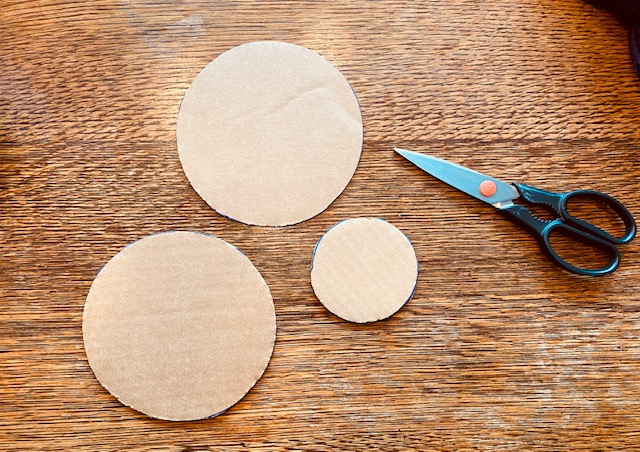
  • round things that can be used for tracing a good circle- must fit on the cardboard
  • tapestry needle (or a sewing needle with the very large eye, or, you can even use a paperclip- just find the smallest one you have and tie the end of the yarn to end of it)


IMG_3415

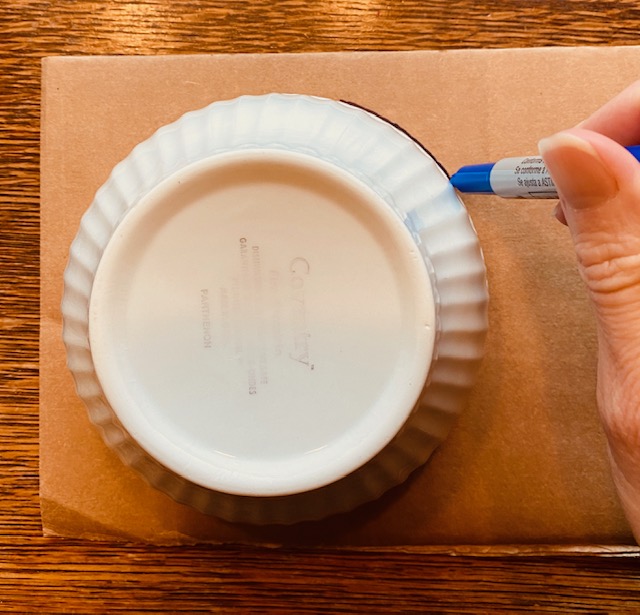
Step 1: Trace your circle. This will be the approximate size of your circular loom.

IMG_3416


IMG_3418

Step 2: Cut out the circles as neatly as you can.

IMG_3419

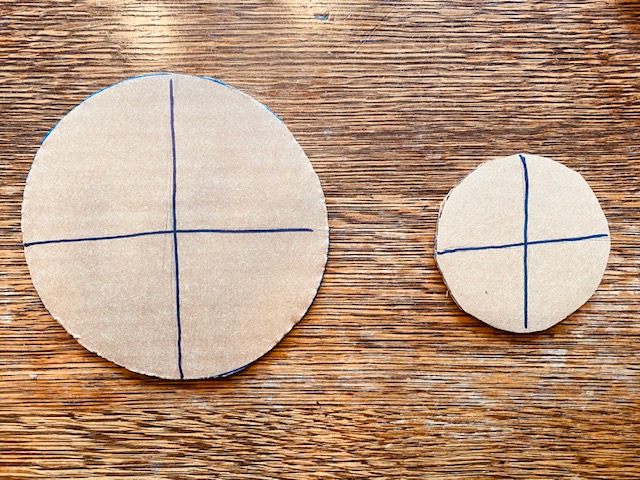
Step 3: Some folks who are really good at being precise might balk at my lack of straight or perfectly measured grid-work here. I get that. BUT, the point is to demonstrate that this does not have to be incredibly perfect. In fact, I think it’s a relief to many to not have to stress about that. You generally want to split your circle into four kinda even sections.

IMG_3420

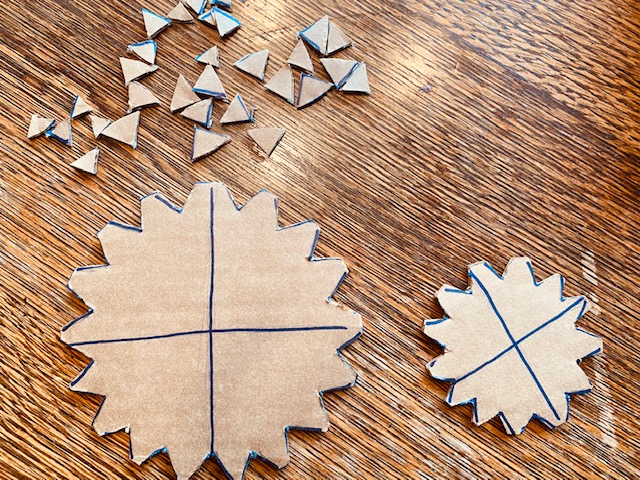
Step 4: Around the edge of each section, you will start to make triangles. These will be cut out and serve as notches for your warp thread to hold on to (the warp is what you weave around). You want the same number of triangles in each section EXCEPT ONE! You can see that in each of my looms below, I added one that straddles a segment line. This is because you need an odd number of notches so that you have an odd number of warp threads. Otherwise, each time you go around the loom, you’ll have the yarn always going under the same warp thread and over the same warp thread. You don’t want that.

IMG_3422IMG_3423

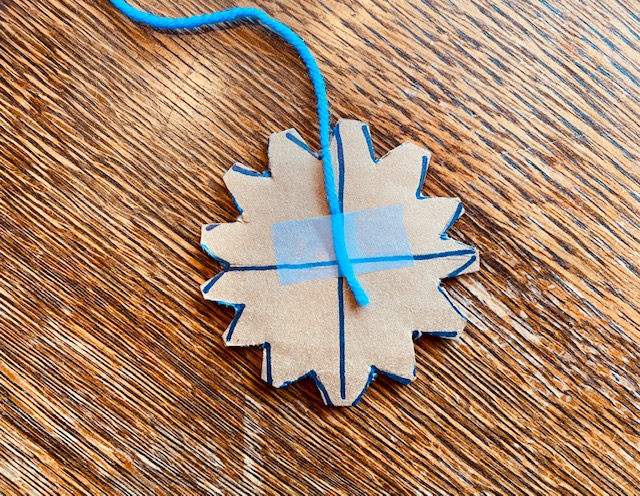
Step 5: tape one side of a piece of yarn to the back of your loom.

IMG_3424

Step 6 (warping the loom):

  • turn the loom over so you are looking at the front (the front for me is the side with no marker.
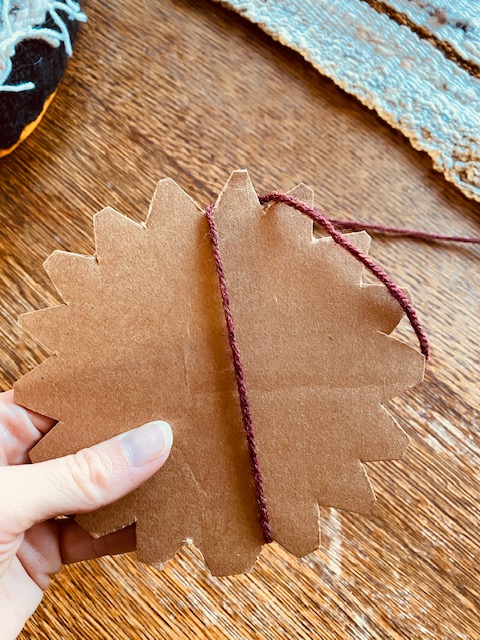
  • pull the yarn over, crossing the loom to the other side. you have an odd number of notches in your loom… so when you pull your yarn across, it won’t land right in the center, right? So you want an even number of notches on one side and an odd on the other, of the yarn just pulled across, having one more notch on one side.


IMG_3460

  • hold yarn snuggly and wrap it around the notch, moving from right to left and then turn the loom so it is “up” again, with the notch you just wrapped on the upside


IMG_3461

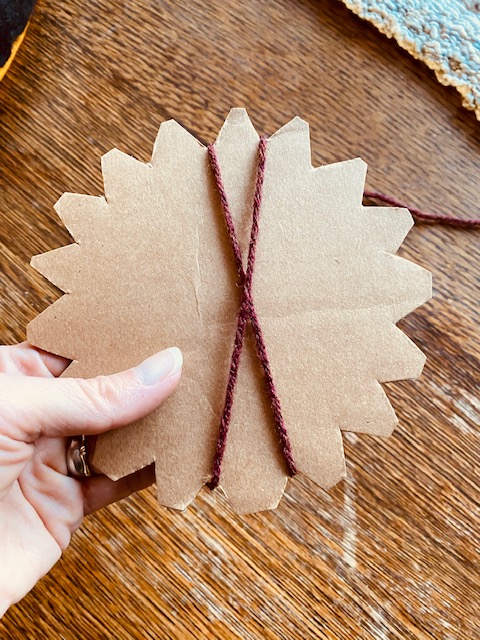
  •  bring yarn down, crossing in the middle, going to the left of the notch with the yarn in it.


IMG_3463

  • wrap the yarn around that next notch, again, moving from right to left
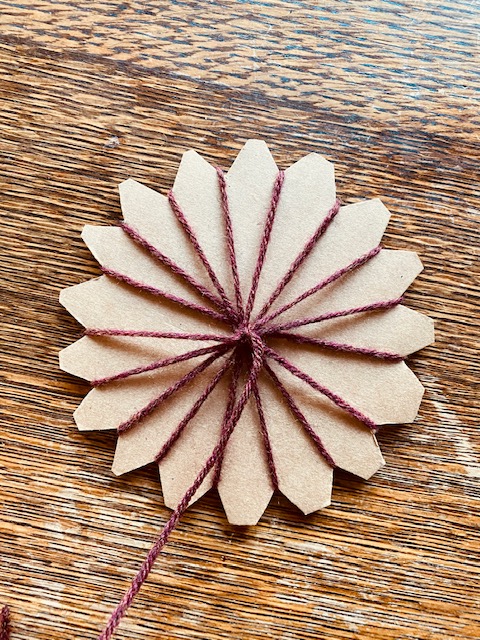
  • repeat this step until you’ve brought the yarn around every notch
  • IMG_3468

Warping the loom:


Tying the center of the warp:


Step 8: Then start weaving! I generally weave from right to left, but it doesn’t matter which way you go as long as that is the only way you go as you weave. No doubling back! The same weaving principles apply with circular looms as do with other looms. Bring the yarn over one warp thread, under the next, over the next, under the next, and so on… The first few rounds might not look right, but as you go around, it will become more and more organized and clear whether you are to go over or under.

Step 9: Optional- You can add new colors and textures whenever you want. I usually just tie on the the thread and begin weaving. When the loose ends come up against the weaving as the new yarn starts getting woven with, I gently tuck them under the already woven part. DON’T SNIP THEM! You want them longer so you can sew them in once you are finished and the piece is off the loom.

As I make my way towards the upper part of the loom, I like to use a tapestry needle to weave. It keeps one from pulling on the warp too much and allows for weaving right up to the top.


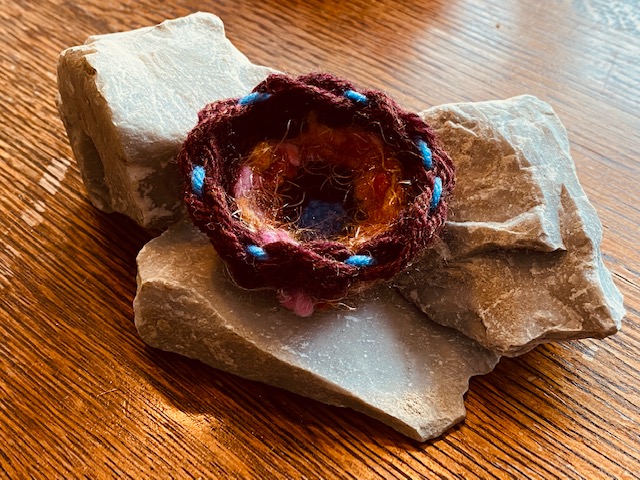
Step 10: Once you feel you cannot weave anymore, it’s time to take your piece off the loom! Gently pull off the tape, and the warp that is wrapped around the notches. You will notice how it is naturally shaped- will it be a bowl, or a coaster/placemat/wallhanging? Does it curl up or lay flat? Assess and gently shape it as you wish.

Step 11: Time to sew in those loose ends with the tapestry needle. I usually sew them into the bottom/underside of the piece. Just gently bring the loose end down through the column of weaving right below and it and carefully snip the remaining bit. It will be completely hidden in your piece.

Step 12: Admire your handiwork! I love my little bowl! I can imagine making several of these and having nesting bowls all over. Or sewing them together in a way to make something that looks like coral, or finding a little stuffed bunny or chick and making this a little nest…

IMG_3449


Have fun with this. I’ve done circular weaving with kids as young as 6. And I intend on weaving this way for as long as my fingers let me. It is so relaxing and so satisfying, and you likely have all you need already in your home.

Take care,

Bradie