Last weekend, I was able to be a part of a wonderful Open Studio day at Shelburne Pond Studios. I don’t have my own place there, but as part of their weekend, they invited local artists to show their wares. It was a good chance for me to finish up projects that had been drifting about, waiting for some attention amidst all of the things that can make a life so full. I was delighted to see how much I actually did make over the winter months. More than I realized! I think my obsession with circular weaving helped. It never felt like work, to pick up a little loom and let my gut tell me what color needed to come next, what texture, what material…
Below are some pictures of some things I had on hand.
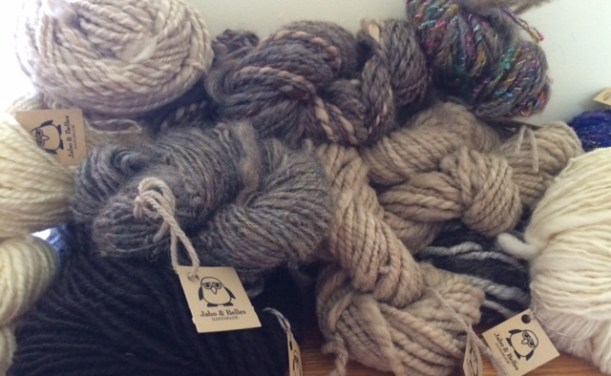
Skeins of yummy handspun yarn, all from locally sourced wool.
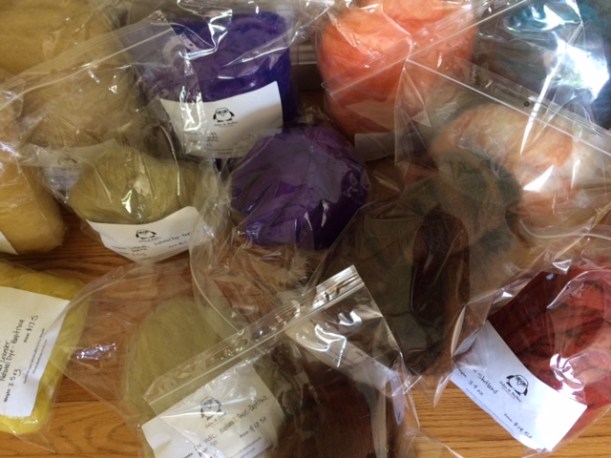
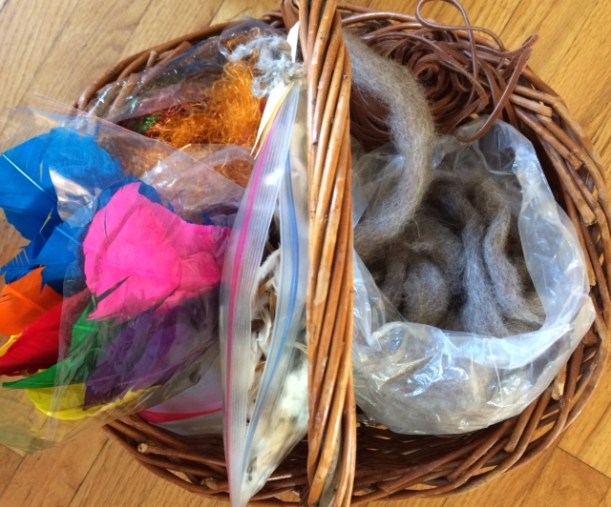
Loads and loads of batts ready for spinning or felting!
This little circular weaving piece was made using a loom from this Etsy shop. I love the sizes of looms this shop owner offers. They are affordable and very, very fun.
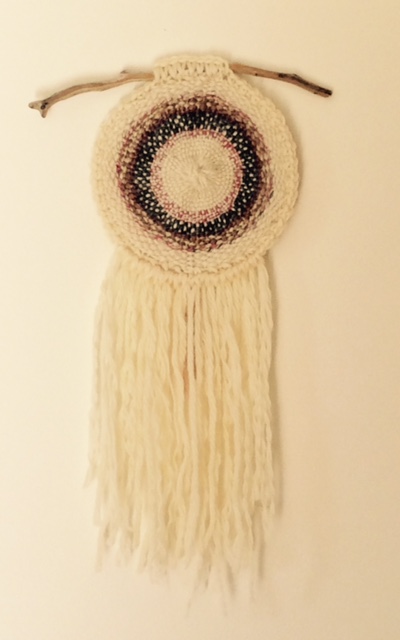
Circular weave wall hanging.
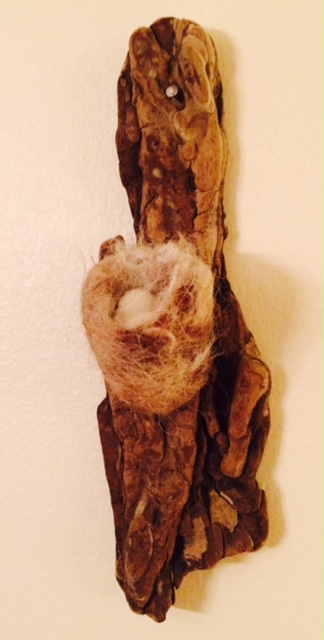
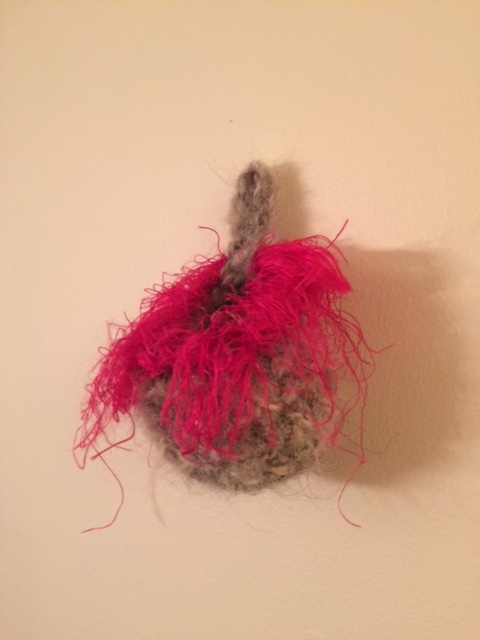
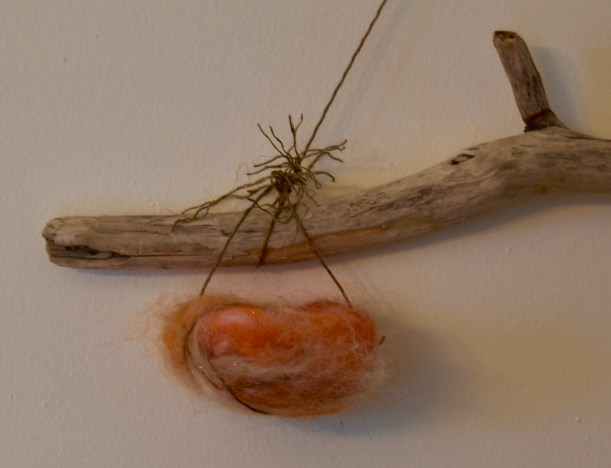
A little tiny nest with a little tiny egg on a little tiny piece of wood from our big beautiful lake.
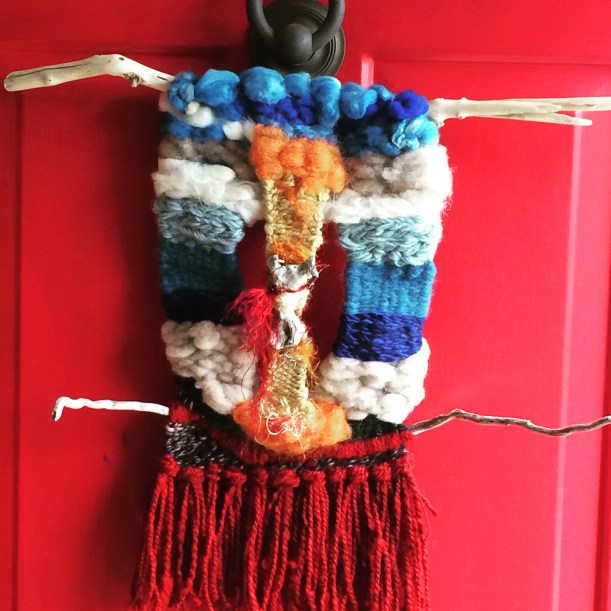
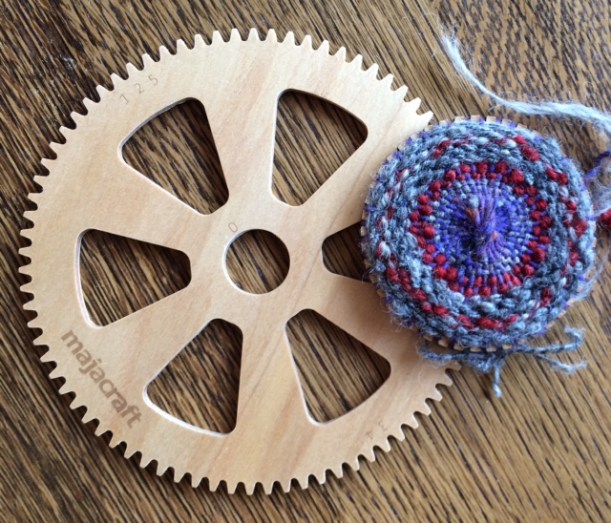
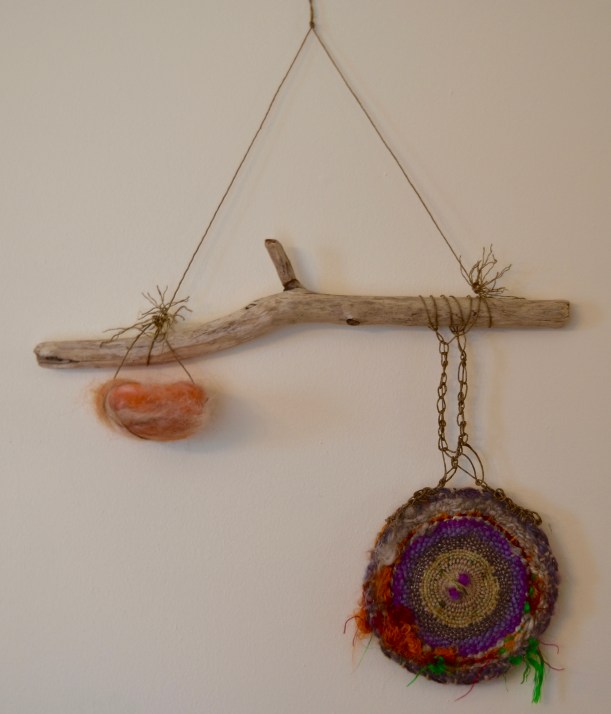
The wall hanging below was made in part with a Majacraft Circular Loom. I got mine here.
Another Wall Hanging.
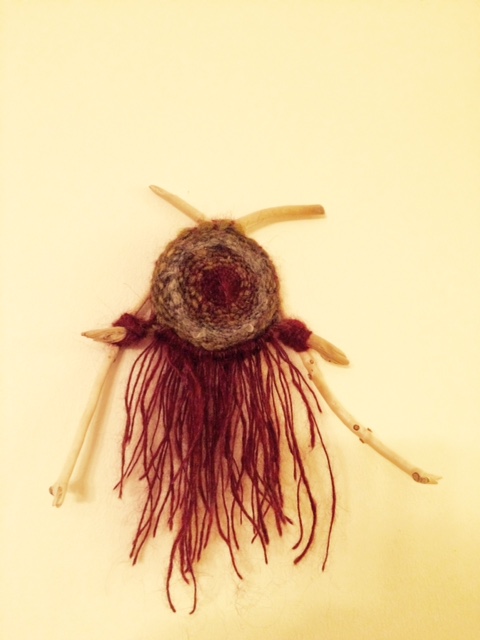
This “doll” sort of appeared. I love her but she also gives me the willies.
Wild hanging basket.
Woven piece highlighting a lovely bit of driftwood that looks to me like a lady dancing.
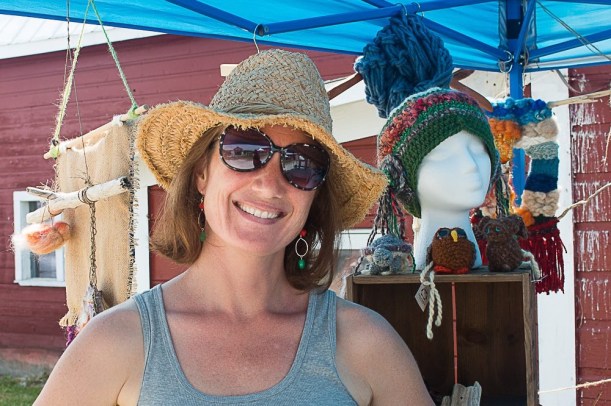
Hello from me.
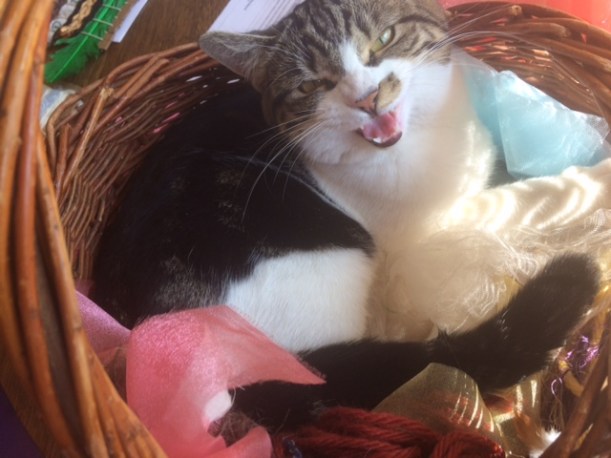
Mittens letting me know that for that moment, the fabric scrap basket was indeed HERS!
This is the time of year that marks the beginning of my favorite season. In summer, when it is hot, humid, froggy smelling and quiet, I am a better version of myself. It is easier for me to gain perspective and to slow down. Heat requires a different pattern. I learned that from my brother when we lived in Florida. He owned a landscaping company, and he and his crew went out early in the morning, to beat the suffocating heat of summer late-afternoons.
For me, summer has become the season for washing wool and imagining all I’ll do with it. I occasionally enjoy blasts of creativity and the drive to work up an idea. Last night, I listened to the coyotes, screaming, yipping, barking. I’ve come to crave that sound on hot summer nights. It reminds me of last year about this time, when I sat up late and experimented with hat designs, almost too hot to be handling wool, but not quite. Then, like now, the coyotes did their wild thing and I felt comforted the way I did when I heard snow plows working in the middle of the night the month after we had our first baby.
I may be finally starting to get the hang of understanding and riding the waves of seasonal rhythms. Rather than charging through each day as though it’s a job, I’m longing to respect the specifics. We are not really meant to do the same things day after day, with the same timing and the same momentum. It seems to me like there’s a reason for energy surges that visit some of us in the spring and fall months~ there’s a lot of work to do to bring a garden up and put a garden to bed! There’s a reason for the home-ing in that winter calls for (and that’s so often challenged by our steadfast cultural allegiance to busyness); we need a time to go within. To rest. To regroup. To gather the insight and energy required to face the coming seasons of outward growth and physical labor. And to let go of those things that have died away.
For now, I’ll enjoy the early morning garden tending, the wool processing, the swimming and playing with my children, and the planning. And I’ll relish the moments I get to hear other life happening outside my open windows, in the pitch dark during the deepest hours of night.
It’s been a while since I’ve written. The thing that’s hard about a blog is, it’s not a diary (at least not for me), it’s not for writing about everything because really, I must honor the privacy of loved ones, and in this case, it’s somewhat specific in terms of topic. Let me just say this: if you like this blog and noticed I’ve not been keeping up, I’m sorry and it’s been a regrettable reality of my life these days. Things got a little heavy, a little stressful, a little complicated and a lot lifey, and I need to work on still writing through those times.
A recent event has reignited my fuel center, and reminded me of what the heck I’m trying to convey through this blog. I had the opportunity to bring a weaving project to my son’s second grade class, and wow, was it amazing. Let me just jump in and explain.
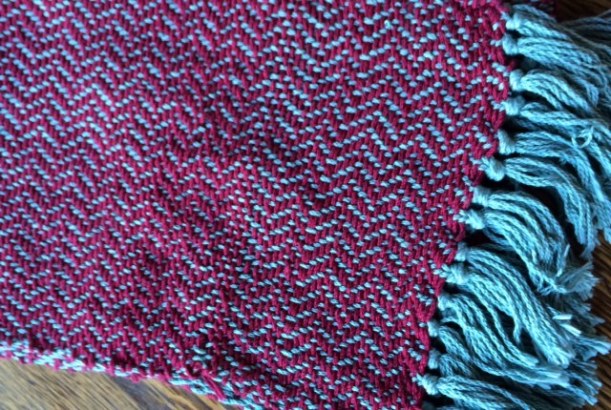
First know this: I am not an expert weaver. I took one weaving class years ago where I learned how to use a big loom, and by learn, I mean was guided every step of the way, multiple times. The apparatus that is attached to a wall that you wind yarn around to get it prepared to warp the loom (I think), almost made me lose my mind. All of it. In a burning inferno of frustration. No matter what I did, I could not keep my yarn from tangling and turning into a wild Medusa hair-like mess. Omg. I shudder to remember it. I did make this though, and I’ll always be proud of it.
I know I’ll take another class on using a big loom now that I’m more mature and have practiced a bit of mindfulness.
Anyway, I love hand weaving on simple looms, circular looms or looms made out of random things like wire, branches, busted out doors. I love how intuitive it can be, how much freedom there is to throw any such thing into a piece because it feels good, and you don’t have to worry too much about a complicated machine. I love how accessible it is, and how it’s possible to make a downright beautiful piece of art simply by understanding some basic concepts, and appreciating how different materials respond to the process of moving around warp thread. I wanted to share this with children because again, it is accessible art, and going into summer, I wanted to encourage them to use their found treasures in art projects and just experiment. I also find this medium to be extremely satisfying, grounding and soothing. I often find when I’m talking to people about it, I place my hand on my stomach when describing how it makes me feel… it’s like it makes me feel comfortable in a part of my body that holds a lot of tension, and I think sometimes a lot of grief.
Here is a little picture montage of my process:
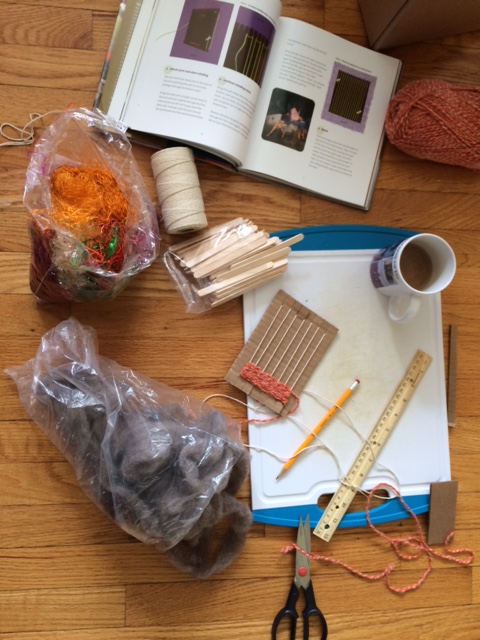
I used this book by Sarah Swett (check out her blog/website. you won’t be sorry) to gather some ideas. The loom I made was a bit different, but based on one described here. It’s a wonderful book and one I will refer to often in future projects with kids. And, my husband made me a standing loom from this book that I hope to write about soon!
Figuring out the appropriate loom size and number of warp threads took some doing.
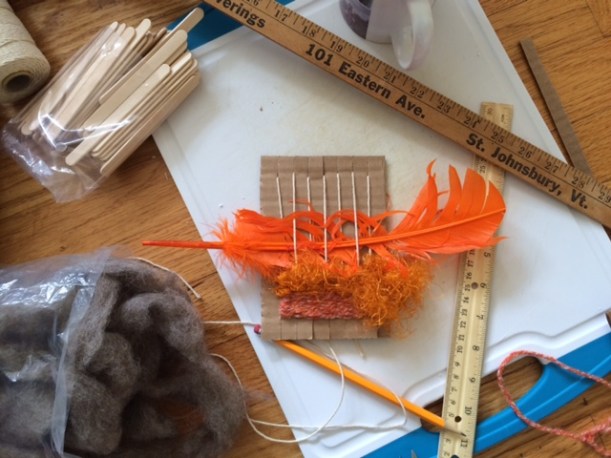
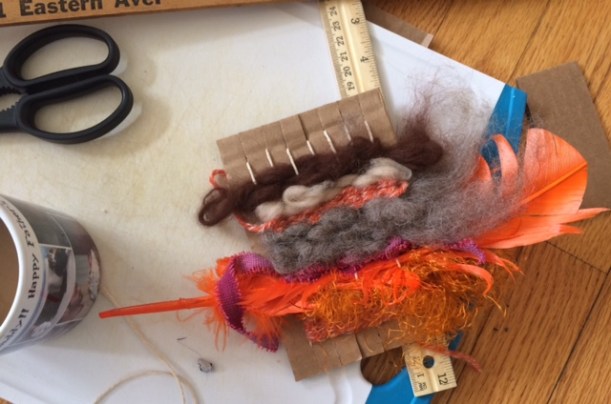
I went with the 4×6 cardboard size, but chose to use only seven warp threads. I found that the loom stayed stronger and more in tact with less threads, which I was interested in because my plan for the kids was to have all sorts of materials available to them to weave with. They also were going to only be using their fingers to weave, not needles, so I needed the loom to be able to withstand the pulling that would inevitably happen.
I wanted kids to understand that they can weave with all kinds of things.
My weave in progress…
Cardboard looms and another example piece using less wild materials.
Example of a weaving done on the simple cardboard loom.
Not gonna lie: I love my piece.
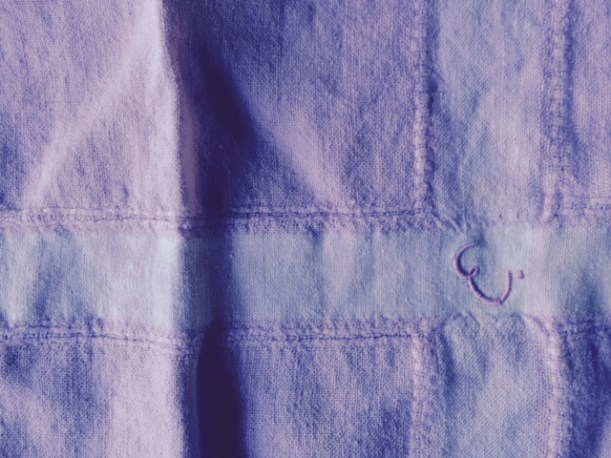
So, on the day of class, we did a little show and tell bit first. I showed the kids a napkin made from cloth that my mother-in-law’s mother, Else Jacob Eberitsch wove herself. We have a set of these napkins, and a matching table cloth. I am forever blown away by the beauty of them. My son was so proud to show it to his classmates.
I also showed them circular looms of different sorts, as well as one of those rectangular kid’s looms that can be found in most craft stores, reminding them that many might have some of these things kicking around their homes.
And then, when the wiggles got going and after answering some wonderful questions, I unveiled their materials and worked out with their teacher how to go about the rhythm of the acquisition of supplies.
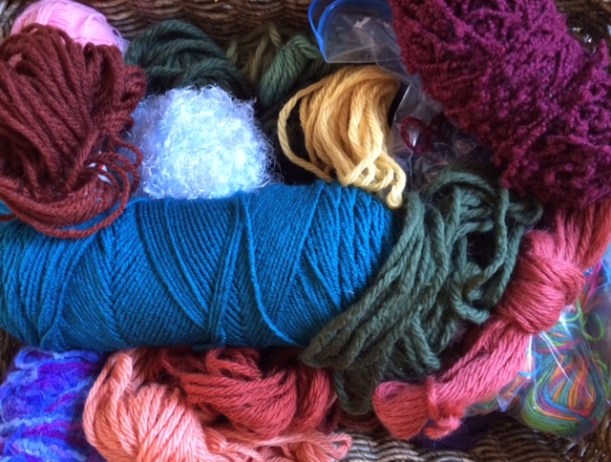
tons of yarn of all different colors, thicknesses, textures… hitting up garage sales and second hand shops is the way to go when gathering supplies for big projects like these.
And guess what happened? The kids were pumped. Truly. All of them, every single one, was into it. It was by far the most fluid and flowy project I’ve done with kids to date. Some got right into the weaving using worsted weight yarn and hit the flow. Others got into using minimal and the most wild materials~ I called theirs delicate porcelain-like pieces. I offered each child a strip of material that they could write a special message on, to be kept private or to show the world to commemorate the approaching end of their school year and some jumped on that. Some got real creative with making space between the individual woven stitches and needed some help understanding the concept behind the strength of the material they were making. Their teacher got into it, too! Her finished piece is gorgeous! Wish I had a picture of it.
Weaving is in us. It’s in our DNA somewhere. It must be. We’ve been doing it for as long as we’ve been covering ourselves, making baskets, mats, shelters (more to come on that topic, too).
If I had to do it over again, (which I will because I was invited back to do another round before school ends!!!), I would:
spend more time highlighting the importance of “beating in” or pushing the new row of woven material down against the previous row
for those whose pieces are very fragile, I would have encouraged them to keep their piece on their loom and decorate their loom to make the whole thing an art piece
I’d leave out the popsicle sticks~ those buggers are slippery
bring more ribbon
write their names on their looms BEFORE they start weaving
I actually can’t wait to go back and do it again. Seeing the children so engaged and so calm in their bodies while they worked kind of blew my mind, and I’ve spent a good deal of time in classrooms. Not to belabor the point, but I think weaving speaks to a part of our souls that is so organic, so without words and so true, that it simply must be something kids can do whenever they want. That’s why I love this. It’s inexpensive, it does not require special training, and anyone can do it. It just requires some stuff, some space, and some freedom to experiment.
It’s about time I report on how the last Farm to Frame morning went, in my daughter’s kindergarten class. Recall, this wonderful group of little ones started this project weeks before, learning how to wash wool, dye it, and then card it. They worked hard, and were so busy. With each passing class, students wanted to keep their wool, and were amazed by how it transformed in their own hands.
Finally, the day of the project arrived. I wish I could share pictures of the whole thing in the class, but privacy issues are real and I did not ask for permission to post pictures of other peoples’ children. Included here are picture from a slideshow I made to show to the class to detail what they would be doing that morning.
Each student got their own gallon ziplock bag. In it were a bunch of different colors and textures of wool. They all got colors from the batches that they dyed and carded, plus some extra that I already had on hand. Also, they had a piece of pre-felt, the “paper” for their felted painting.
Next, I showed the kids how they could layer the scene. I chose to make a sea creature scene to go along with their recent unit on sea life.
More examples… my daughter got to demo her skills.
I then explained that I’d be securing their pictures using a needle felting tool. It’s sharp! So I emphasized that I’d be the only one using that tool. I wanted to do this before the wet felting part so that it didn’t come apart in the bag.
Once the picture was completed, students could tell me or their teacher, and we’d help them slide it into their bags. Enter some warm, soapy water, and let the felting begin! I encouraged gentle, open handed pressing at first. Once felting began, they could lift their bags and really press/rub on both sides. I let them know that their picture would look different once it was felted! This was important. What goes into the bag comes out looking quite different and I encouraged them to be artistic experimenters, learning about what wool does during felting, and watching their beautiful colors take different forms. This proved to be an important reminder to some.
Above are the examples of finished products that my daughter and I made at home.
All in all the class went beautifully. What I learned was, children love working with wool. They love doing the work of preparing it and learning about about other people around the world who make things with it. They responded to the idea that people have been using wool for functional things since the Middle Stone Age. Time, of course, does not make sense to them in that way yet, but feeling connected to our ancient history is important, and it resonated.
Children allowed themselves to experiment and to create images, some abstract, and some impressionistic. Some wanted to use every last bit of wool in their bags; some only used a tiny amount and brought the rest home. All, I believe, viewed themselves as artists on that day, and allowed for imperfection and mystery.
If I were to do it again, I would work with smaller groups of not more than five children at a time. With sixteen children in class that day, I did not have the time or ability to make it to each child quickly when they had questions or needed help. For me, it felt rushed and a bit stressful. I think I would work it out with the classroom teacher for me to either work in small groups one after the other, or take a couple of mornings to do it. That way, I could calmly help and respond to questions or worries if they came up.
Other than that, I think it was a great success. I loved being with my daughter and her classmates and learning about teaching, connecting kids to natural and renewable resources in their own community, as well as to their shared history with our ancient ancestors.
Stay tuned as I prepare a new project to bring to my son’s second grade class! This time, it will be a weaving project!
We are in between seasons right now, here in Vermont. When I first moved here from Florida, I heard the term “mud season” and didn’t understand what people were talking about. Living in Burlington at that time, and not venturing much out of the city, I had little occasion to experience Mud Season head on. Now, after almost twenty years here, I get it.
The ground thaws (not too hard this year, after such a mild winter), the red wing blackbirds, robins, cardinals and cedar waxwings make an appearance in our yard. Large flocks of geese sail overhead, their calls to one another feeling like a call to my spirit, encouraging and light and commemorative of a winter gone by. The air smells clean and wet. Sugaring begins. The mud, it adds inches to my height, and a wobble to my walk when I muck around in the yard, this year imagining my cleaned up garden beds, a hoped for herb spiral, and a dyer’s patch. The need to vacuum much more frequently to prevent the brought-in-the-house mud, dirt, pebbles and sludge from making its way to the carpets is a fact. Why is taking one’s boots off in the garage so difficult?!
On a walk the other day down by Lake Champlain, the weather was the epitome of the “in like a lion” description of March. It was windy, rainy, snowy, icy… it was epic, really, and since I was dressed appropriately for such riotous weather, it was absolutely exhilarating. I laughed out loud in reaction to some especially strong bursts of wind, feeling not one ounce of embarrassment because I was alone. Down on the water, I could see Winter releasing her grip from the stoney shore.
I found large pieces of driftwood that I harvested~ a project will happen with them, I am sure. Walking all the way back to my car with these water-logged, slippery gifts, against the wind, at a speedy clip (I was due to volunteer in my son’s class in just a little bit of time) proved to be the workout I needed. Sore and tired, wind-kissed and grateful, I was able to finish a project later that day that had been waiting patiently, in all of its scattered parts, for some attention.
I love working with my Majacraft cirucular weaving loom. I’ve been making completely random things with little bits of all kinds of materials~ sari silk, banana silk threads, handspun, conventional, thick, thin, chunky, wild yarns, twine and wire. I am fully appreciative of the process of beginning a circular weaving project, releasing into the hard job of finding clarity in the first few messy rounds. I can hardly tell the order of warp threads at first. Now I can predict how much time it takes for me to begin to worry that I’ll never get it straight, and then, voila, the foundation is set for my piece and I can relax with the ups and downs of weaving. Then, adding a new element creates its own new chaos, anticipated but surprising, nonetheless. Sometimes it takes another few rounds to straighten things out again, to hit that rhythm where predictability and order are available if desired.
These projects conjure similar feelings of excitement, tension and hope as Spring does, in all of her wild glory. They promise beauty out of chaos, like spring’s pungent dirt promises baby birds, more light, new growth, froggy smells and strong storms. Order from chaos, gifts from turbulence, beauty reborn. Laughing out loud at all this natural noise is such a relief.
I’ve gotten a bit behind in documenting the wonderful work my daughter’s class did in their woolen adventures. A few weeks ago, the “job” for the day was to card their beautiful, dyed wool. I wanted to share a bit about how we did it and how these young five and six-year olds fared.
For the activity that day, I brought in my Fancy Kitty Drum Carder, which I love and adore. I was careful with it, and I had some rules: no touching it without me being right there, don’t crank it as fast as you can, no fingers on the carding cloth, and have fun! I also brought in some mini-hand carders (for this project I actually used small dog brushes (these are not the exact ones I used, but they are similar). I KNOW! CHEESY! But listen, they worked fine for this project, and they were affordable given the quantity I needed.) I brought in my regular sized Ashford Hand Carders as well.
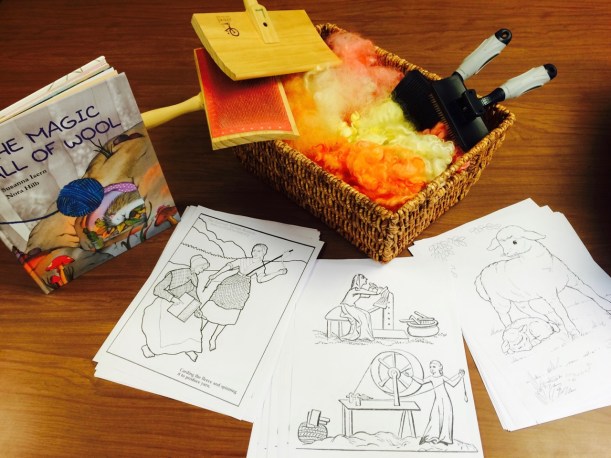
The way we organized the class that day was to show a brief slide show talking about carding and what it actually means. Then, I met with about five children at a time. Around a table, they all had locks to start fluffing out. Once enough fiber was fluffed, I taught them how to load the hand-carders. While three students used the hand carders, one fluffed more wool, and the other started the process of carding on the drum carder. They all rotated through all of the jobs. I provided coloring pages for the kids who were waiting for their turn to card.
I have to say, the drum carder stole the show. Not one of the students was unimpressed with that tool, and all wanted to use it more. I wished I could have given them more time on it! The children were in agreement that adding different colors to the drum carder batt was the way to go, so by the time we got to the very last student, we had a gorgeous tutti-fruity looking batt that I wanted to spin so bad! Oh, the self-control!
Beautiful Batt!
Rolags Galore
I think that the kids really got to appreciate the time, patience and purpose behind carding wool. They all seemed to feel like they had put in a good day’s work, including my daughter, who’s seen this all a bunch. I was so proud of them.
When I got into crochet and opened my Etsy shop, I was not part of a fiber community. I was inspired, energized and over-the-moon in love with making little funny creatures that made kids smile (and grown-ups). I would look at Etsy and marvel at the creativity and artistry of people all over the world, and often times, barely knew what I was looking at~ I had no idea what needle felting, wet felting or even fulling knitted items were! I was super green.
Until: Susi.
One day, I got an email through Etsy from someone who had an Etsy shop too, called The Felted Gnome Knows. The artist behind this great shop is Susanne Ryan, aka Susi; she introduced herself and I immediately realized that I had already been admiring her work. Her pieces are whimsical, gentle, and inspire creativity. And she lived just a couple of towns away from me! I had no idea what needle felting was at that time, but would see pictures of needle felted creations and ache to understand how they were made. I cannot remember the first time Susi and I met face-to face! Isn’t that funny? In no time at all, though, we became friends. And then we took our first trek up to Mountain Fiber Folk together, which changed my life in so many ways.
I recently sat down with Susi and asked her questions about her art, her craft, her opinions on fiber, her history, and I wanted to share our conversation with you.
The Interview:
HH: I feel like the process of working with wool inherently is soothing and centering. Obviously I’ll want to get to that, but first, can you tell the story of how you came into fiber art?
SR: Several years ago, my husband was transitioning into a new phase of his work life and consequently money was tight. We have a very large family, and that, for some reason, was the year that folks decided that we were going to get a little something for everybody. At that time, I was taking wool sweaters and fulling them down and making them into things. I was knitting and I had gotten a needle felting kit with my daughter at Kaleidoscope Yarn. It was to make little Santas. We made them, and there was something about needle felting where I thought, I could do so much with that.
Interestingly, I wasn’t interested in spinning wool at all. I started with needle felting and then went into wet felting. Initially, I found that there were not a lot of stores in the area that carried felting supplies. The area store that did had classes that were at times I couldn’t go. Also, there are some who are very ready and willing to help people learn things and some who are not, so I ended up learning a lot on my own.
Around that time, I ran into Leslie Lewis (Ewe Who Farm), an old friend from my school days, and we reconnected. Over time, she made a quilt for Maggie and told me about her sheep. So, after seeing that options were limited in terms of local stores helping with my fiber questions, or simply not having the supplies, I contacted Leslie again and asked her if she sold her fiber, and she said “Yes!” I had already been going to farmer’s markets and buying wool from farmers, but getting in touch with Leslie is really what started my seeking out of local farmers to buy fiber from.
When I was at Kaleidoscope yarn, I remember them handing me a brochure for Mountain Fiber Folk, so when I met you I said, you know, I’m going to go up there. I had gotten to the point where I wanted to buy local. I’ve always been interested in and shopped at farmer’s markets, and was involved in getting a farmer’s market in my town. I’ve always felt strongly about that. If you support a local business, they support local and your money goes back into the community.
Going up to Mountain Fiber Folk and seeing what they were doing and how they were doing it was very encouraging in terms of what I wanted to do.
I’m all self taught. I’ve only recently started taking classes this year for things that interest me like the masks and the clothes.
HH: And those classes are very specialized, right? This is a commitment to taking your craft to a whole new level.
SR: Yes, they are advanced classes. It’s interesting to meet all of these women who are so big in the fiber world. I thought Gladys Paulus and Anita Larkin, being in the upper echelons of the felting world, might not be approachable, but they were very down to earth and accessible. This is a passion for them.
HH: Oh yeah, it’s totally a passion! It grabs you and doesn’t let go! It is so inspiring to see what artists do with fiber. It seems infinite, the possibilities.
SR: It’s not going to support you… part of that is that people have no idea how much work goes into making needle felted sculpture, or hats and slippers. They take hours and hours, and sometimes many days. Especially when you take into consideration that often times, I’m getting these fleeces processed by Michael (of Hampton Fiber Mill), or processing them myself. I tend to be a very particular when it comes to skirting and cleaning a fleece, so that takes a lot of time! But you know, it’s frustrating when you pay for roving or batts and you’re picking out veggie matter!
And also, people are really getting a full-on, Vermont-made piece. Needle felting has become popular, so overseas companies are mass producing felted figures and selling them cheaply which makes it difficult for the consumer to understand why local pieces like mine are higher than other felted products.
HH: I was thinking about the social and political aspects of fiber art yesterday when I was dyeing wool with kids at school. There is so much to think about and make choices about when it comes to where we buy our supplies, how we process our fiber, and where we spend our own money. It’s a whole mind-set.
SR: I also think too, in Vermont, we are so focused on the maple producers, and the organic food movement, people forget that there are a lot of sheep and goat people out there that are struggling. They have a wonderful renewable resource that is not being tapped into or marketed appropriately. Not only can we make clothing with it, but it can be used for insulation, you can compost it…. There’s so much you can do with this product. These people are living from hand to mouth, all for the love of their sheep!
HH: What do you think it is about working with fiber that makes people so passionate? Or, what grabbed you about working with wool?
SR: There’s something very earth-bound about it. It’s very grounding. There’s something about wool that’s very… I think it’s the same as gardening… it puts you back in touch with the natural side of the world. You are woking with a natural product that is renewable. It’s warm and it evokes a sense of homeyness and tradition. There’s something magical about it. You know, you can twist it and it becomes yarn! It magically transforms! There’s a whole magic to it… like alchemy.
I also really dig the fiber community. They’re really very down to earth people. Most of them, I have to say, especially those who raise their own animals, are very warm and open and generous about their knowledge.
HH: Isn’t that what was so wonderful about Mountain Fiber Folk? I walked in there that first time knowing nothing about handspun yarn, and walked out completely moved. Next time we went, I left with a drop-spindle that Ruth so generously helped me to figure out.
SR: It sucks you in! If you talk to Michael (Hampton Fiber Mill), he’ll talk about how he learned to knit from his grandmother, and then from there, he learned to spin, and then the next thing you know, he wanted to process fiber!
For me, I can tell you all about breeds and good wools for different projects! For some reason, I can retain this information. Who knew? I make the comparison to my father; he’s really into physics and he starts talking about it and everyone glazes over, but he’s so passionate about it. My sister says I’m like our dad….”you and the sheep, man!” I get so excited about it and want to talk about it, but nobody cares! That’s why it’s so great to get together with other fiber people who get it!
HH: I have to ask this… I know for me, I get around handspun yarn, and I must smell it. I can’t help myself. It’s an automatic thing I do. Do you do that?
SR: No, I don’t smell the wool, but I love to touch it and see the luster and sheen. I want to feel the coarseness of it. I don’t mind the smell of lanolin or raw wool at all. I do have to say, I don’t like skirting at all. There’s a big thing about not using chemicals to get the veggie matter out of fleeces. Well, you don’t have to use chemicals. You just have to be really detail oriented and pick the stuff out! The fiber you and I put out, it’s clean! But you’ve seen the fiber that has a ton of vegetable matter in it!
HH: You have to front load time and effort into preparing the wool. That’s the invisible work. There’s so much dirty work. And you can’t use “chemical free” as an excuse for not being careful with your product.
SR: It was the experience of paying for roving that was filled with veggie matter that really pushed me into preparing my own wool. Now I’m selling kits and supplies and it’s kind of exploded!
HH: What’s your favorite thing to do now? If you’re looking to spend the day however you want, what would you do?
SR: Making a hat. Making whatever kind of hat I want and not worrying about it if it turns out.
HH: What’s your favorite hat you’ve made?
SR: I have two: the felted Gnome Noggin hats, and the Ratagast hats. I love those two. Those are original designs. I make my hats with wool that some would not use for that purpose, but I line them with fleece. You know, I think I’m different than a lot of felters because I think merino is overrated.
HH: What fibers do you like to work with right now?
SR: Border Leicester, Gotland, Romney and Icelandic. With Icelandic- if you take the time to separate out the outer and inner fibers, the under coat is just as soft.
HH: Did you do handwork when you were young?
SR: No. My entire family is like, who knew?! I think what it was is I was never interested in the packaged craft kits available for children when I was young. I was always into the arts, but not in a very public way. I did win a poetry slam when I lived in the Carolinas and I was always around artists and musicians. I did do a lot of theater, too. But it wasn’t until I found felting that I found my medium. I did teach myself how to sew and knit, and I had the ability to put things together, but this really was the first medium where I knew what to do with it without having any prior introduction.
HH: What’s on the horizon for you? Anything you are looking forward to tackling?
SR: I want to fool around with very freeform clothing. I took with Linda Veilleux that was incredible; she’s an amazing artist. I am not as meticulous as she is, and I am learning why it is important to take careful measurements, but I want to play around with shapes and turn them into wearable, freeform clothes. I’m not really interested in making vases. It needs to be wearable or functional. If I’m going to do a sculpture, I’m going to needle felt it. I do like the idea of marrying wet felting and needle felting. Anita Larkin is a wonderful artist~ she stitches pieces together and wet felts them. Those types of ideas are interesting, but I’m also figuring out how to support my habit.
HH: So, you’re done with the holiday fairs…
SR: Yes, but I’ll be at the Stowe Renaissance Fair in the spring. I’m going to make hats for that.
HH: I know where I’ll be seeing you in the spring! I love a good Renaissance Fair and seeing your hats, and you!
Check out Susi’s links to her Etsy shop, her Facebook page, and her website. She keeps them up to date on where she’ll be and what classes she’ll be teaching.
Thank you, Susi, for taking the time to talk with me!
I’m excited. In a nervous in my belly, hopeful, anticipatory and grateful kind of way. Tomorrow, I’m going into my daughter’s kindergarten class to do a felting project with the children. Felted Rocks, to be exact. And later in the week I’ll do the same project with two 2nd grade classes (my son is in one of them). I have come to seriously appreciate the benefits of working with, touching, experimenting and playing with fiber, and I feel utterly compelled to teach things to do with fiber-craft to kids.
The felting rocks project begins what will be a five- to six- week journey that picks up after the holiday break, and I will keep track of how it all goes here. I am calling my unit From Farm to Frame. In January, we will start with a dirty, smelly, lanolin rich fleece (or part of one), wash it, dye it, card it and in the end make a felted “painting”.
Over the last few weeks, I’ve been gathering materials for this project, thinking about why this is so important to me. One memory came to mind; the first time I skirted a fleece on my own. It was the big, smelly, creamy fleece of a Border-Leicester sheep that my friend Susi secured from a local farmer. I remember thinking, “dang, that smells”. But it didn’t offend me, and really, I got used to it very fast. I remember, after picking debris out of it and removing a lot of the gunky stuff, noticing how soft my hands had become. I was delighted to realize that it was lanolin! Lanolin had made my hands soft and shiny and smooth. I stood there in the warm May sun and it occurred to me that in the process of doing hard work and getting my hands dirty, that I had been softened, conditioned and made-over. I’d say that was a turning point for me, about two and half years ago. Since then, I’ve wanted to know more about why and how working with fiber can be so grounding and therapeutic in all of it’s stinky and at times tedious moments.
I want kids to have this. I want them to see a whole process through that involves fiber from a local farm. I want them to experience the rawness of the material and experiment with what they can turn it into. I want them to have an antidote to stress, pressure and worry. I want them to have a chance to touch nature and maybe appreciate the animals they pass on many a Vermont road.
I’m so grateful that teachers are letting me into their classrooms with these projects. Let’s just hope that the kids enjoy it. Tomorrow’s project will be a good introduction for all of us, I think.
pictured above: rocks gathered from Lake Champlain, felted rock experiments, many bags of wool and a whole lot of roving to be organized for the classes, more roving because I thought it was pretty, and some of the colors that the kids will have to choose from.
I had the great fortune to take a class at the Marshfield School of Weaving yesterday. This class was about dyeing wool with plants and other natural dyestuffs. Our teacher was Joann Darling, who is a weaver, dyer, soap-maker and plant expert (what is the word for that?). When asked what certain plants were, or what plant give which colors, Joann knew the scientific name; let’s just put it that way. Better put, our small group of five students was in very good hands. I think the best way to tell the story of yesterday would be to comment on each picture.
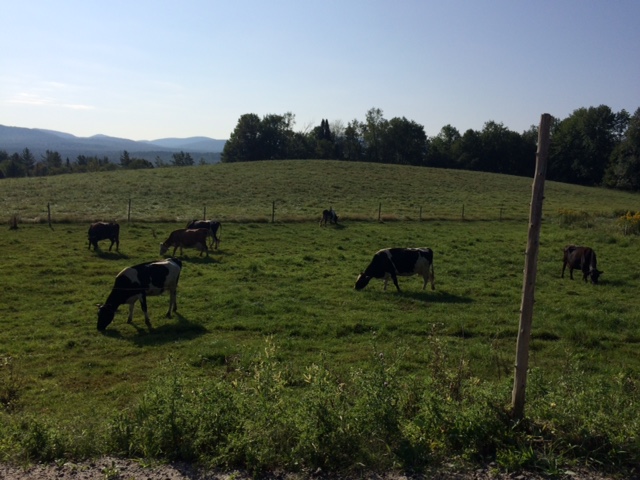
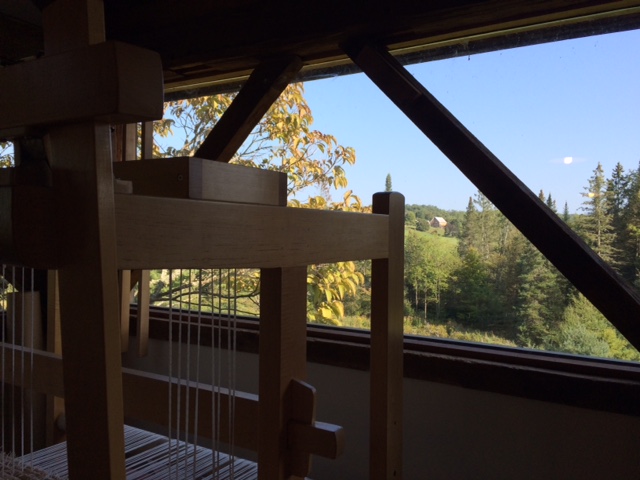
I left my home kind of early on Sunday morning to head down to the school, about an hour drive from my home. The front seat was full of food to bring for our potluck lunch, my sunhat, bags with snacks, drinks, notebooks and other essentials. It was a beautiful morning- dewey, quiet and kind of fuzzy around the edges. I felt a little nervous as I left, but more excited and curious about what was going to happen in the day. As I got closer to the school, I couldn’t help but be overwhelmed by, and grateful for, the beautiful views and the quiet. These are definitely a perks to living in Vermont. Oftentimes, where one must go to learn a traditional craft or skill is a beautiful place, set out of the way. Craggy land, full cows and swaying trees were balm to my eyes as I wove up these country roads I’d never been on before.
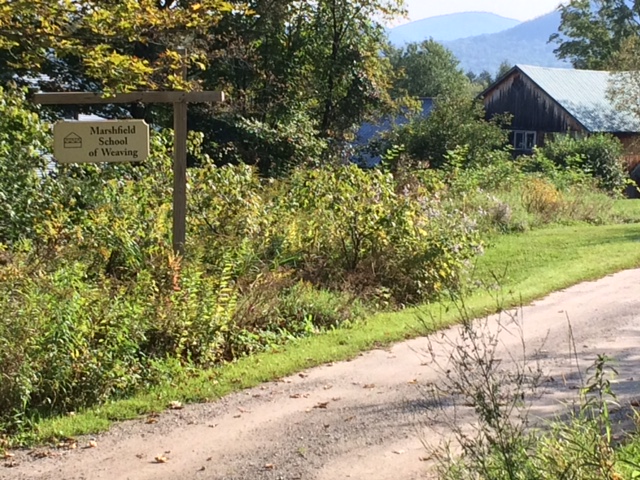
And here is the entrance to the school. I did laugh out loud with joy as I saw where I’d be spending my day.
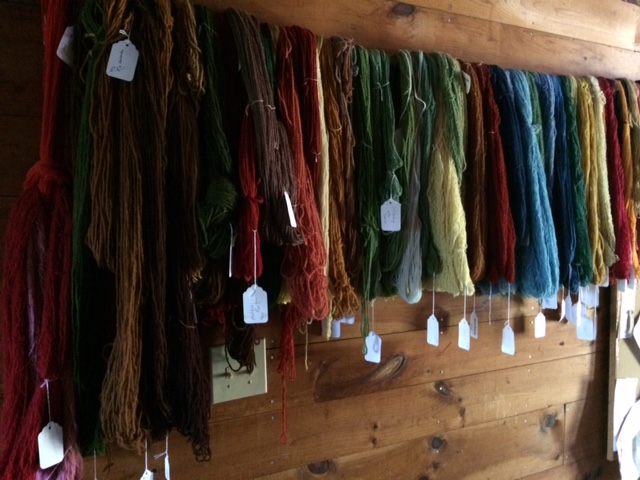
When I approached the building, our teacher Joann was busy outside getting things ready. She showed me into the studio and I felt immediately welcomed into the beautiful school. As I looked around, I was so happy to see yarn everywhere! And one whole wall was yarn dyed with natural dyestuffs. It was so beautiful. The light was soft and round, and every which way I looked, I saw things I wanted to touch, understand and look at.
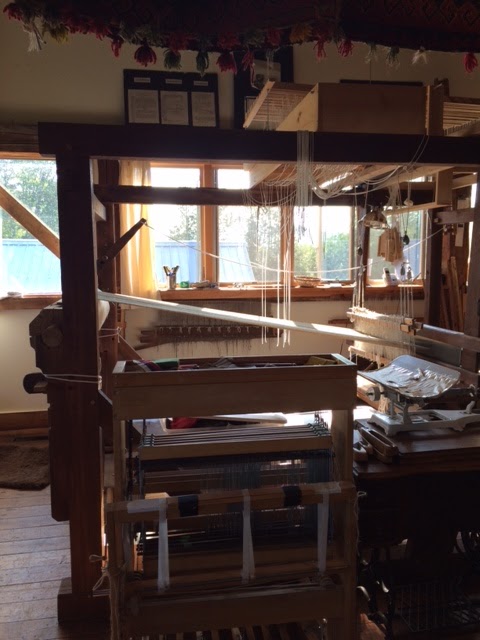
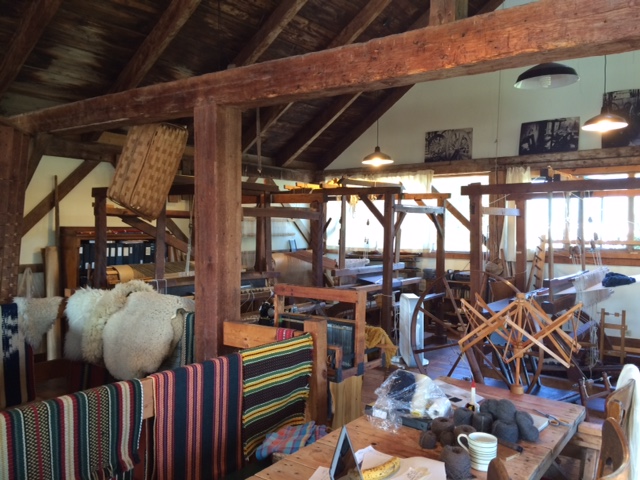
I wasn’t sure where we were meeting at first. I am so used to classroomy types of learning environments, so I made the assumption that there must be a place where we’d sit for a long time and take notes and get really official. I went upstairs assuming I’d find this. Instead, I found the studio. There were many looms of all different sizes. One gentleman was weaving at a very large loom (I don’t weave, so I don’t know what the different looms are called). And there were two women walking about, looking at things. We started talking and they were there to take the class, too. They are both weavers and were so generous with advice and knowledge about looms. I’m hoping to get a small one soon, and here already were two beautiful guides into that world.
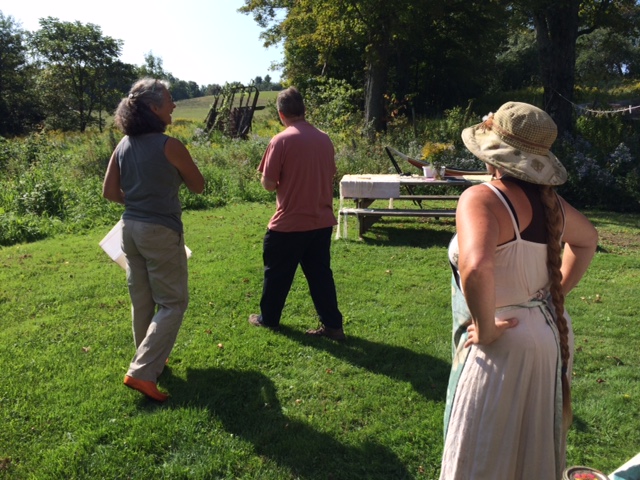
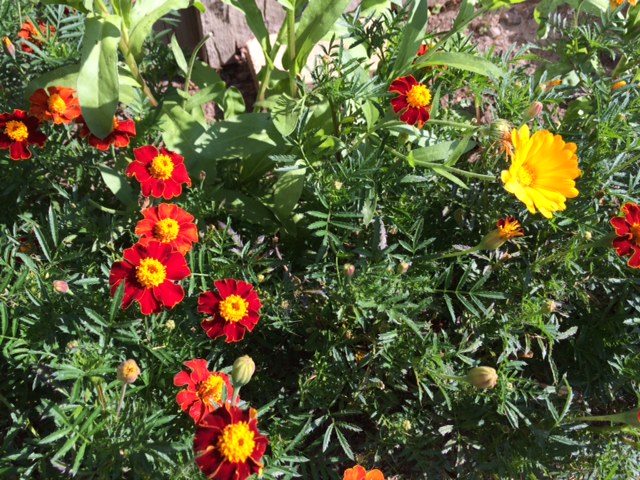
We learned soon that no, we’d not be sitting at tables taking notes. We’d be outside getting right into it with guidance from Joann. The other participants in our group were a sheep farmer and an herbalist. Within a short time, we found our rhythm and got to the work of collecting goldenrod, sorting mini-yarn skeins to be used in all the dye pots, chopping other plants, picking flowers, washing, tending to pots and listening.
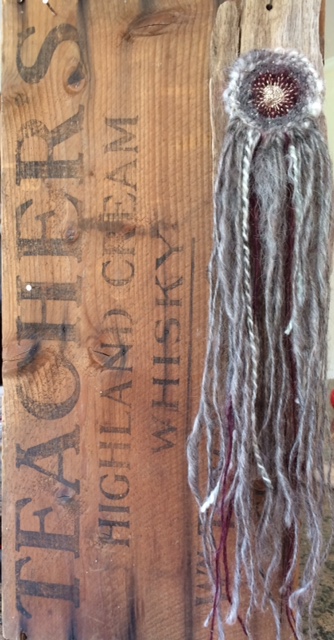
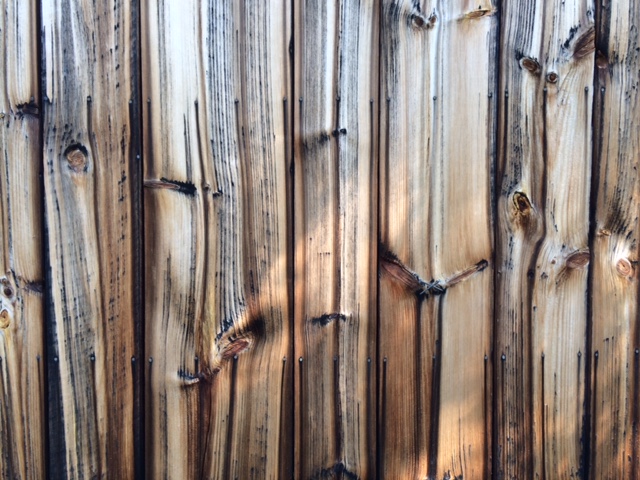
I just love this barn board. The colors and patterns are so strong.
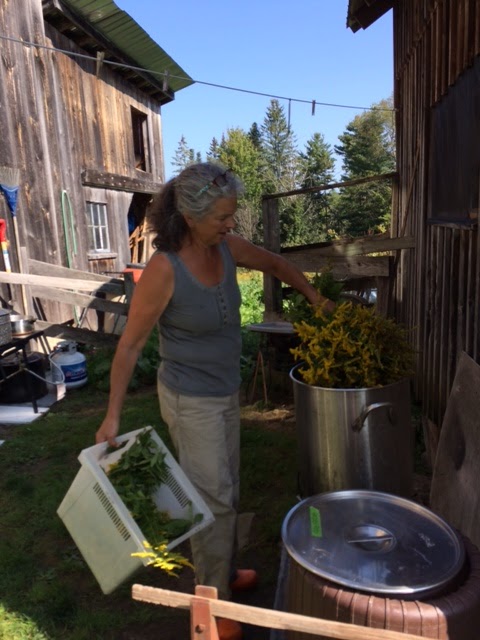
Below is a picture of goldenrod going into the pot.
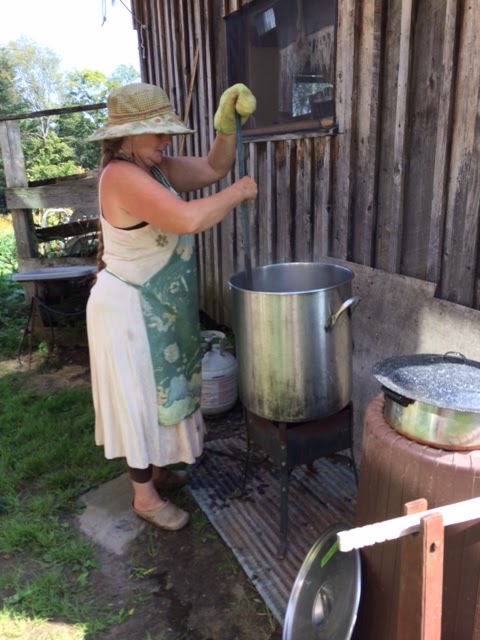
Here is a picture of Joann stirring the BIG pot~ I’m not sure what’s in there in this picture. There was a lot of boiling and a lot of rotating dye stuffs in and out. I love this picture.
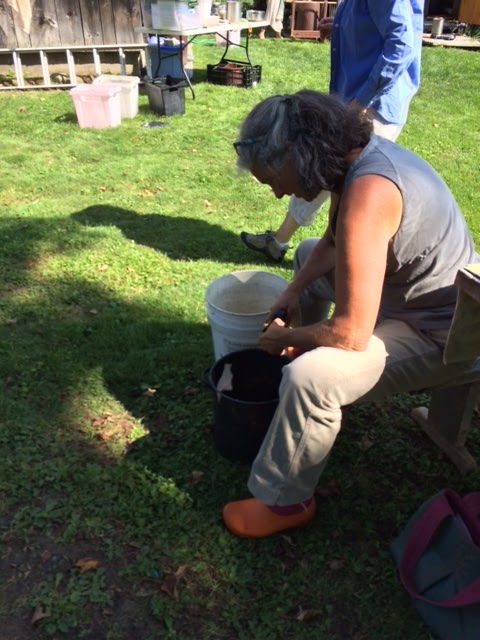
This is a student chopping up some flowers.
Once we got several dye pots going, we took a walk up quiet roads to the gardens of someone willing to share madder root and dyer’s greenwood. I haven’t gardened much this summer because of contracting the dreaded Lyme disease, so to get my hands in soil with a sweet purpose was just what the doctor ordered. The views and the quiet were also incredible treats.
Once back to the pots, we broke for lunch in the shade, and then got to making more dyestuffs and hanging our wool to dry. We also did lots of overdyeing experiments with indigo.
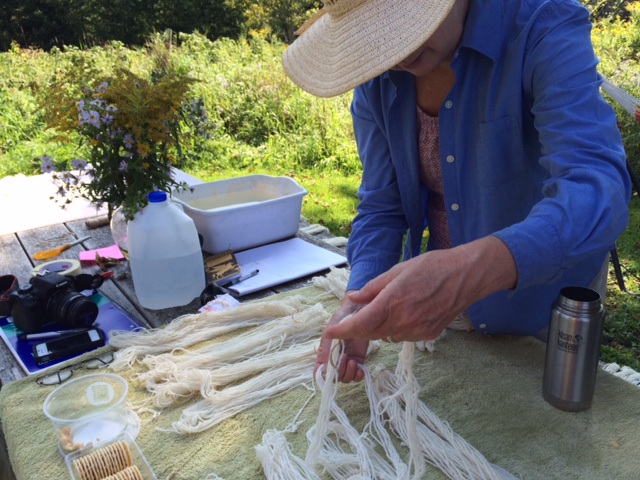
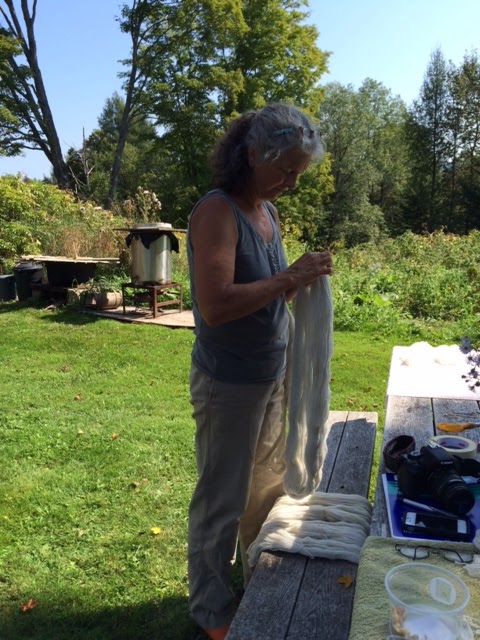
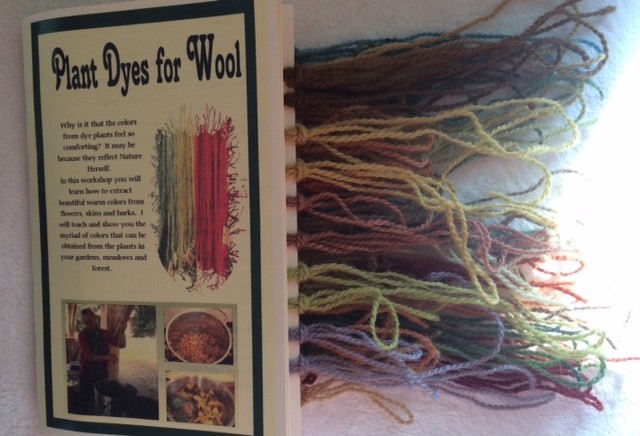
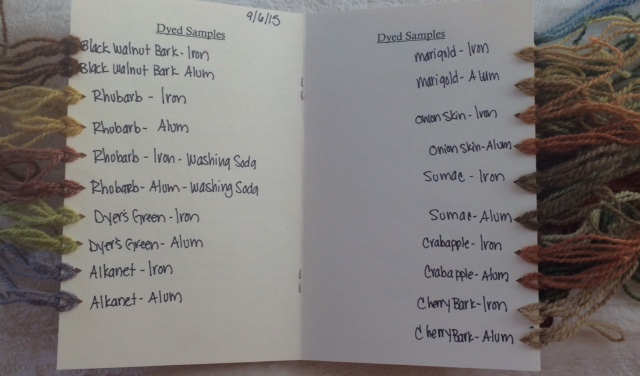
I wish I had taken better pictures of the yarn on the line, but you can see many of the colors we achieved in our efforts, and especially our teacher’s efforts, over the course of the day. Every dye pot had samples of yarn, half mordanted in alum and half in iron, so we got two color results from the same plant, plus a third if it was overdyed with indigo. As we got our books ready, Joann was available for questions and stories, and as each color was added to my book, I felt more and more proud and impressed by the outcome of our work.
It was hard to leave this beautiful place. You know, the people going there to weave, to dye, to spin… I can only assume are not in a rush. Maybe I am projecting, but I think it must be true. Towards the end of the day, when I knew it was time to hit the road to get home to my family, I felt the first twinges of urgency, but that was only to do with my own inner need to reunite with my littles. There, in this extremely beautiful and entirely functional setting, I felt as if the sun and my stomach had become my clock. When the big beautiful tree covered us in lovely shade as we ate, it marked the natural passing of time, the pots simmering away with their unique and seasonally affected color potions.
On the way home, I could only daydream about following up on things I want to learn about, and experiment with. I think a forever student I’ll be.
I cannot remember why I started the process of learning how to dye wool with plants. I did not arrive at the decision because of a strong opinion about synthetic dyes or because of an already held skill set. In fact, I hadn’t tried it until this summer because I found the whole thing to be rather intimidating. There’s a whole lot to it, especially if you’re going for a certain color. I find precision to be an anxiety-provoking requirement of any project. That is why I haven’t gone further with sewing. It really does matter if you measure correctly when you’re making pants, right? Anyway, I decided to relax into natural dyeing and just experiment and to allow myself the freedom to see what happens, which was also an exercise in patience, flexibility and managing expectations. While I’m not great at precision, the fantasy of perfection is a constant nagging companion, and reckoning with perfection’s shadow side is an important job for me.
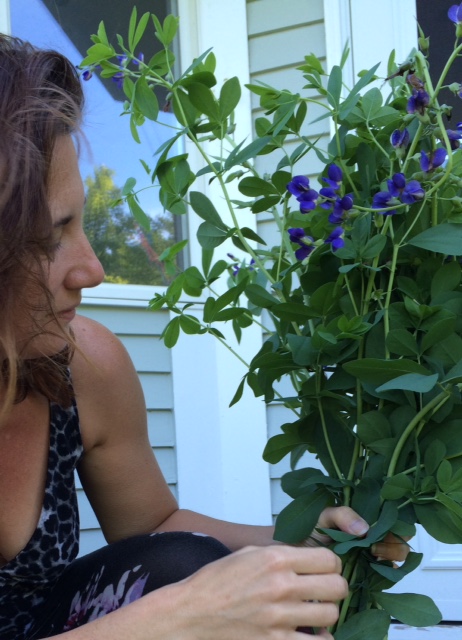
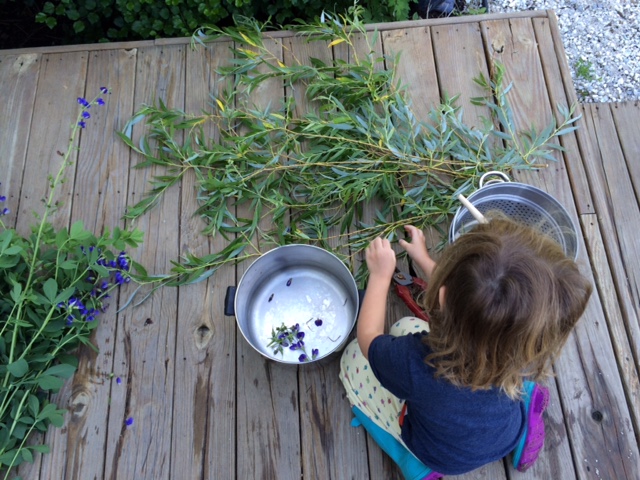
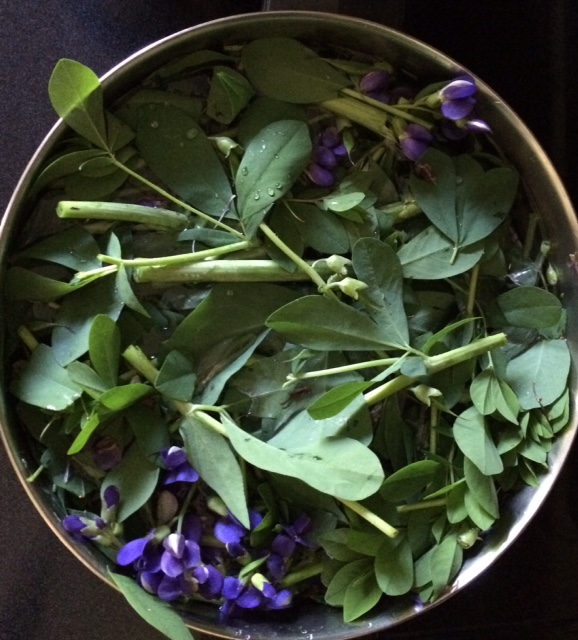
The first round of dyeing experiments started with an early morning walk with my daughter. We collected willow tree branches and leaves, and some long stems of some false indigo. We sorted and picked and plucked. It was quiet and kind of chilly. The birds were doing their early morning show and our cat was making his rounds around our home’s perimeter. Eventually, we put the plants in their own dye pots and started the slow process of simmering in water.
(Note: early this summer, I did my dyeing in the kitchen, but guess what? It’s stinks! Not to me, but to others who are not similarly obsessed and just want to eat their breakfast in peace. Now my operation is in the garage, which is fully aerated, and I have the company of a gigantic spider.)
Once the dye pots were cooling, I got my creamy wool simmering in the mordant bath (alum). For the willow and false indigo, I used some border leicester wool I have on hand. Finally, it was time to introduce the wool to the dye baths! If I had to choose one aspect of dyeing with natural dyes that is so important, and on its own a wise teacher, it would be the demand for patience and for overcoming the urge to rush a pot. Too rapidly boiling the plants can damage the flowers and alter the color; too rapidly boiling the fiber can damage the quality of the wool. Not simmering fibers in the mordant for long enough will lead to a weaker uptake of color and not letting the fibers sit in the cooling dyepot long enough will do the same, plus you can hurt yourself! And in this case, the wool I used for these dyepots I received in its raw form; it had to be skirted, picked through and washed before it could even be dyed.
Breathe.
Putter and check.
Think and wonder and hope without attachment.
Eat some snacks, drink some coffee.
Do a chore, write a note.
Don’t forget to check the pot.
Look out the window and wonder about that flower and if it too could bring color.
Open up to learning about plants and their names.
Don’t panic about not knowing.
Here is what we got:
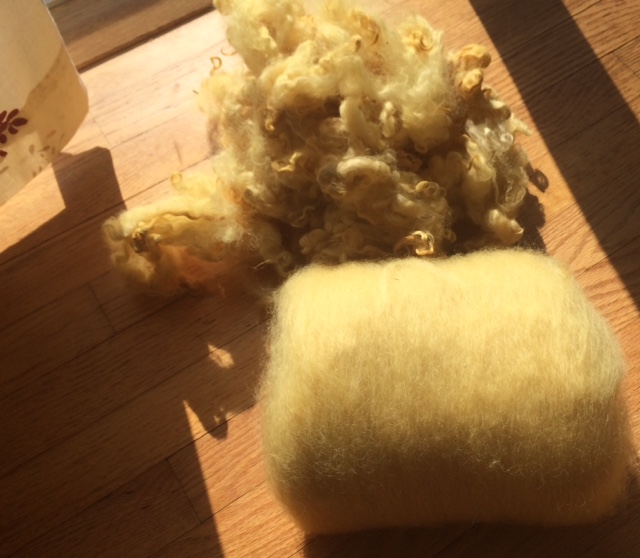
Weeping Willow Tree: leaves and twigs & border leicester wool; uncarded locks and carded batt.
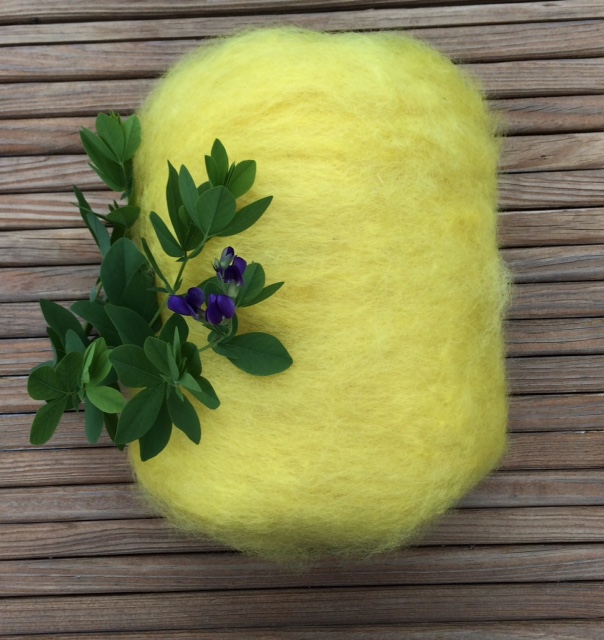
And the False Indigo leaves, stems and flowers & border leicester wool:
Remember that whole thing about precision and my aversion for it? Well, if you follow directions really well and have the time and ability to focus on what you’re doing, I understand it’s possible to get blue. That is in my future. but for now, we got:
A wonderful first go at natural dyeing for me. And a funny thing has happened on the way to the natural dye pot. My eyes have opened up a bit more, and curiosity has expanded exponentially. Walking through my yard, or through the woods or in a field, I now see bits of color everywhere, some of which I overlooked in other days. Now I look at bark on a fallen log and wonder what it would do with some attention from heat and water. And how’s about those berries? Can I share them with the animals here? The tension between wanting to dye everything with everything I see now and knowing that time and patience are necessary ingredients of any dyeing experiment is a gift in its own right.
I’ll share more of my summer experiments in posts to come. In the meantime, I want to share my go-to books right now on the natural dyeing process:
A Garden to Dye For, by Chris McLaughlin
Harvesting Color: How to Find Plants and Make Natural Dyes, by Rebecca Burgess
The Craft of Natural Dyeing: Glowing Colours From the Plant World, by Jenny Dean
What kinds of things do you do that allow you to slow down, exercise patience and enjoy curiosity?









 Healing Handcrafting