

Healing Handcrafting


Leave a comment

Supporting Grieving Children

Thursday is Children’s Grief Awareness Day. You can read about the origins of this important day here. If you have a child in your family, classroom, sports team, extracurriculars, or community that you know is grieving the loss of a loved one, you can find wonderful information on the Highmark Caring Place website about how to support them.

Definitely check out their Facts and Stats page for some insights into the breadth and depth of grieving children and the long-term flow of grief so many of them experience.

Below I’ve shared an excerpt from The Long Grief Journey in hopes of contributing to this very important conversation. There have been many times over the years where I’ve worked with children who appeared to be struggling with learning or behavioral issues who also had lost a loved one. Sometimes it was long enough before I became involved for educators and other important adults in their lives to not be aware of the child’s loss. Sometimes too, the assumption was made that so much time had passed between the child’s loss and whatever was happening at the moment that the two issues (or more) weren’t related. What we found, time and again, was that with tender care and raised awareness, support of children was more full-bodied, relevant, and empathetic when the picture of the child’s life was viewed as a whole, grief included.
I hope that if you are supporting a grieving child, you find this useful.

The Long Grief Journey, excerpt from Chapter 15:

Helping Children Cope with Long-term Grief While Tending to Yourself

It can be tough to help kids deal with grief when you’re grieving as well. It’s important to take care of yourself…

Amy Morin, LCSW, psychotherapist

A life built around a core sense of absence is its own type of grief and for many is difficult to describe in words. The journey begins early if your child lost a significant loved one at an age where they don’t hold any memories of them. If you’re helping your child grow up with the absence of a precious loved one, you already know you have a crucial role to play. It’s important to keep their deceased loved one in consciousness, by name and by image, to tell stories about them, saying their name in fluid, non-whispered ways. Consider also this truth: children will grieve and will process their grief in some way, no matter what we do. The more open we are, and the more space we can hold for them, the more fluidly their experience will go.

SPOTTING LONG-TERM GRIEF IN CHILDREN

When a child loses a parent…that child grows up feeling different and alone. A story is written in a secret place in that child’s mind—a story of loss and pain and the triumph over that pain.

Maxine Harris, PhD, author The Loss That is Forever: The Lifelong Impact of the Death of a Mother or Father

As much as we’d like to insulate ourselves from untimely loss, it’s proven to be impossible. Some people lose a loved one when they’re infants, and others after a long life lived together. There is no official roadmap detailing how loss will impact a life, but some themes emerge worth considering.

Here, we write as though you are a parent or caregiver to a child who has lost a significant loved one, but if you are reading this section with yourself in mind, hold a space for remembrance of your age and your thinking and needs from that time. So often as children go through their own grieving process, they are supported by people who are also grieving and who have varying levels of knowledge about developmental ages and stages and the needs associated with them. Those who are in the acute stage of grieving don’t generally have a lot of extra energy to spare.

Let’s begin with what unifies us all in the experience of long- term grief, regardless of the age you are at the time of loss. In the beginning, common feelings and reactions include anger, ambivalence, longing, and the persistent striving to recover the person lost. Age is what tends to dictate how these emotional reactions appear and are understood or expressed. As a rule, adults have more life experience than children and have more reference points for identifying feelings and for asking for what they need. Children are often confused about what their feelings are about and may even struggle with naming them. Anger can feel more like an urge. Persistent longing might be expressed through obsessive ritual and magical thinking. When young children lose a parent, sibling, or other precious loved one, the effects can last for years, especially if they are not supported by the important adults in their lives in a way that allows all of the feelings and fears to be expressed and processed. Michael described how his granddaughter continues to process the death of her father who passed away five years ago.

My granddaughter has hundreds of cuddly toys. So many around her bed that she can’t get in it! She fixates on keeping them all in the same order. She is ten now and she doesn’t look to be abandoning her teddy bears any time soon. We just accept it.

It’s so important for caregivers, teachers, and other adults to know that even years after a child loses a dear loved one, especially a parent or sibling, issues can arise which look like anxiety, depression, attention deficit disorder, autism, obsessive-compulsive disorder, and academic delays. In a child’s life, loss changes the shape, texture, flow, and rhythm of most everything. It doesn’t mean they can’t go on to live wonderful enriching lives, but it does mean the relevant and important adults in their lives need to keep an open ear to underlying issues as they express themselves.

Older children and adults understand time and finality, whereas infants, toddlers, and young children do not. Forever can be both an impossible concept to understand as well as terrifying when applied to the deceased loved one. It’s easy to see how immediate grief reactions can evolve and morph into long-term and unresolved grief as the child learns to have a relationship with someone who isn’t there. Even years later, people of all ages report “seeing” their loved ones in passing cars or in groups of people. Pam swears she saw her father sitting in a diner eighteen months after his death. “I saw him sitting in the window from the parking lot wearing his favorite baseball hat, and I almost approached him!” This kind of seeking behavior is found in people of all ages.

No matter the age a child is when they lose an important loved one, they are likely to regress to behaviors from a younger developmental stage, at least for a while. Children who were potty-trained may bed wet again for a time. Teenagers may want to sleep in their parent’s room or may not feel comfortable going out. Moreover, adults may wish for someone else to manage the nuts and bolts of life, responsibility feeling too burdensome and stressful. Herein lies the potential for a complicated battle of the needs. It’s easy to imagine that if an adult is feeling the pains of grief for a long time and needs a release of pressure, it might be doubly hard to care for children who suddenly are not only grieving but are also doing things that are unexpected, appear immature, or even are annoying. The way children’s caregivers respond to these regressions has a lot to do with the way grief is metabolized in the long run. That’s why getting support and gaining increased under- standing of how children express is so very important.

A LIFE REDEFINED

Ian was twelve when he lost his father. When he was twenty, he asked, “I wonder what kind of man I would have been if I’d had my father all this time.” Now he’s forty-one and told us, “I still miss him every day.”

Pam

Another thing to remember is that at every developmental stage or milestone, life is redefined. Graduations, new jobs, greater independence, a committed relationship, parenthood—all these things that come to pass in a life stand out as one more life event a parent didn’t witness, and one more moment to grieve. Over a lifetime, metabolizing this loss and incorporating it into one’s identity is the goal.

Those who lost a loved one at a young age might not feel free to talk about them. Some feel as though bringing up their name or names will make others uncomfortable. Some suffer from feelings of sadness and jealousy when they witness others having close and bonded relationships. There is a sense of difference, of otherness that marks a person’s life and can make special moments at best bittersweet, at worst, emotionally intolerable. It seems there is a value placed on the recency of loss. The further back one’s loss goes, the less room it gets to take up in conversation. Meanwhile, the person who lost someone at an early age may feel like this fact of their life is the first part of them that enters a room, the rest shaped by this loss.

Whether we’re healing our inner child, tending to our adult wounds, or helping another person on their long journey, it helps us to be oriented to where a person was in life when they sustained their profound loss. It can also help us serve ourselves from a tender and compassionate point of view.

~~~~~~~~~~~~~~~

A Book Recommendation: a dear friend of mine whose family has been impacted greatly by loss recommends the book The Invisible String, by Patrice Karst. She said this book was invaluable to her family when they were supporting her grandchild through grief. There are other books in the series that are all wonderful and deeply supportive of children and those who care for them.

Do you have books you recommend for grieving children?

Leave a comment

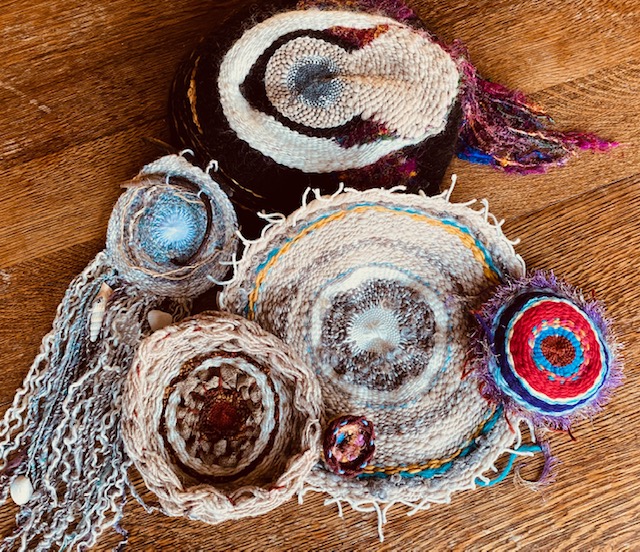
Learn to Make Your Own Circular Loom and Lovely Bowl

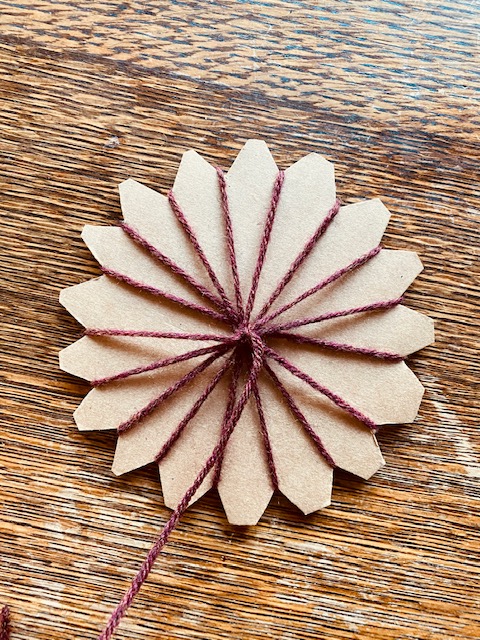
Greetings, fellow crafters. In my Fiber Saturday class yesterday, I demo’d how to make a circular loom out of cardboard. Here, I am offering more detailed instructions and a project idea. Many of the kids I have gotten to craft with LOVE circular weaving. In a way, it’s easier than weaving on a rectangular loom because you just go around and around, rather than back and forth (coming back the other way on a loom can be super perplexing to some. What do you do with that end warp thread!) Getting into the flow is easy and you end up with something beautiful at the end.

IMG_3459

Quick Disclaimer: I’ve woven many things on circular looms at this point. I’ve often had the experience where I wanted my circular weaving to lay flat, but it curls up instead, or I’ve wanted the piece to be a bowl, but it’s lays more flat than I wished. So much affects the way this project turns out. The yarn or fabric variability really changes things, how tightly the yarn is pulled as it is taken around the loom certainly affects how taut it becomes… Things I always stress with this project are: have fun, the goal is not to adhere to a rigid idea of what you want but rather to play with colors and textures and see what you get! No matter what, it will be beautiful. For elementary kids, the book Beautiful Oops, by Barney Saltzberg, is a great companion to this project. I also love the book Ish, by Peter H. Reynolds.

To make a bowl on these looms, you do want to pull a little firmly on the yarn, especially as you reach the edges of the loom.

One more thing! This is a great project for kids, but elementary age kids will likely need adult or older kid help with the construction of the loom and the step-up.

Materials:

  • cardboard- the flaps of cardboard boxes are plenty strong enough
  • yarn for warp
  • yarn, fabric, ribbon, string, jute… whatever you want… for the weaving
  • marker
  • strong scissors
  • tape
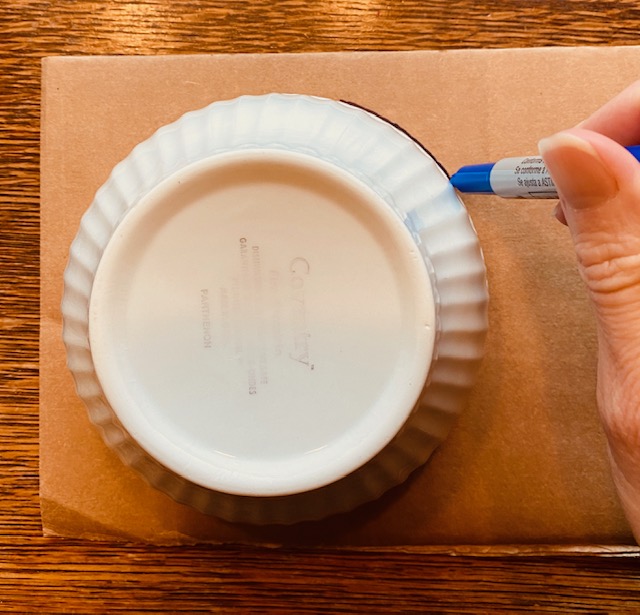
  • round things that can be used for tracing a good circle- must fit on the cardboard
  • tapestry needle (or a sewing needle with the very large eye, or, you can even use a paperclip- just find the smallest one you have and tie the end of the yarn to end of it)


IMG_3415

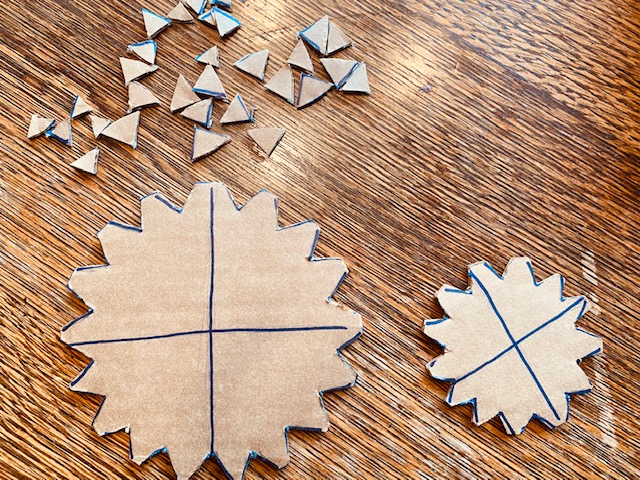
Step 1: Trace your circle. This will be the approximate size of your circular loom.

IMG_3416


IMG_3418

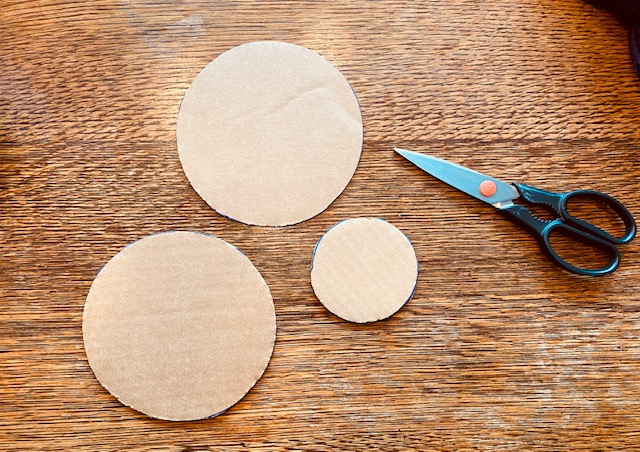
Step 2: Cut out the circles as neatly as you can.

IMG_3419

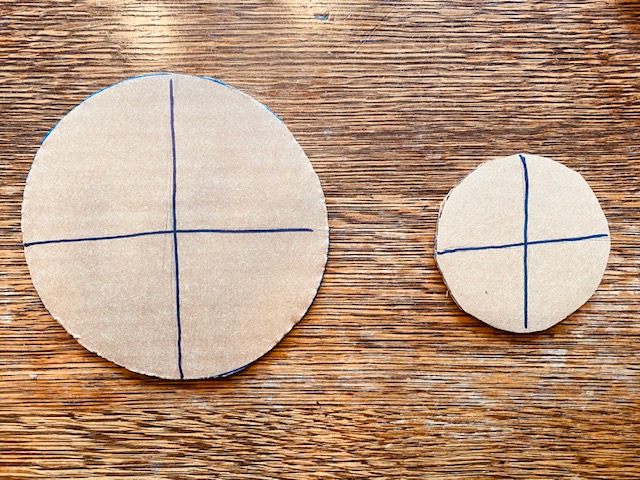
Step 3: Some folks who are really good at being precise might balk at my lack of straight or perfectly measured grid-work here. I get that. BUT, the point is to demonstrate that this does not have to be incredibly perfect. In fact, I think it’s a relief to many to not have to stress about that. You generally want to split your circle into four kinda even sections.

IMG_3420

Step 4: Around the edge of each section, you will start to make triangles. These will be cut out and serve as notches for your warp thread to hold on to (the warp is what you weave around). You want the same number of triangles in each section EXCEPT ONE! You can see that in each of my looms below, I added one that straddles a segment line. This is because you need an odd number of notches so that you have an odd number of warp threads. Otherwise, each time you go around the loom, you’ll have the yarn always going under the same warp thread and over the same warp thread. You don’t want that.

IMG_3422IMG_3423

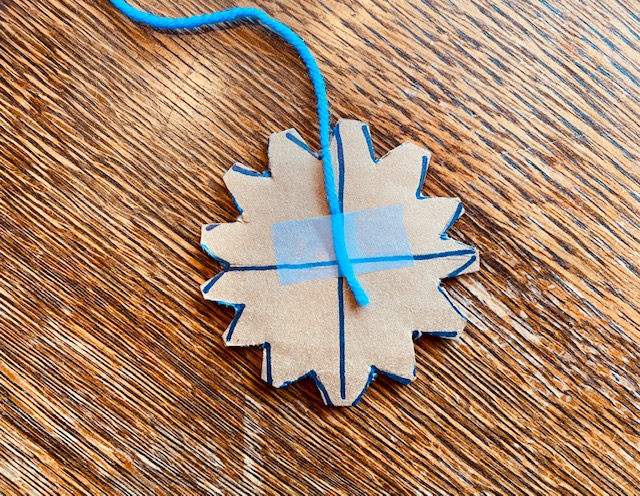
Step 5: tape one side of a piece of yarn to the back of your loom.

IMG_3424

Step 6 (warping the loom):

  • turn the loom over so you are looking at the front (the front for me is the side with no marker.
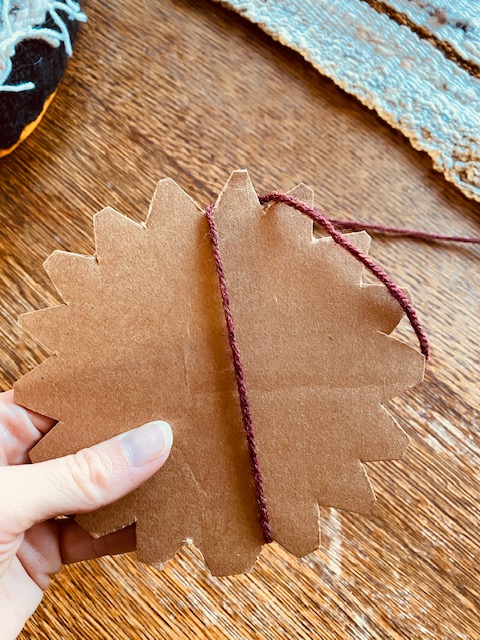
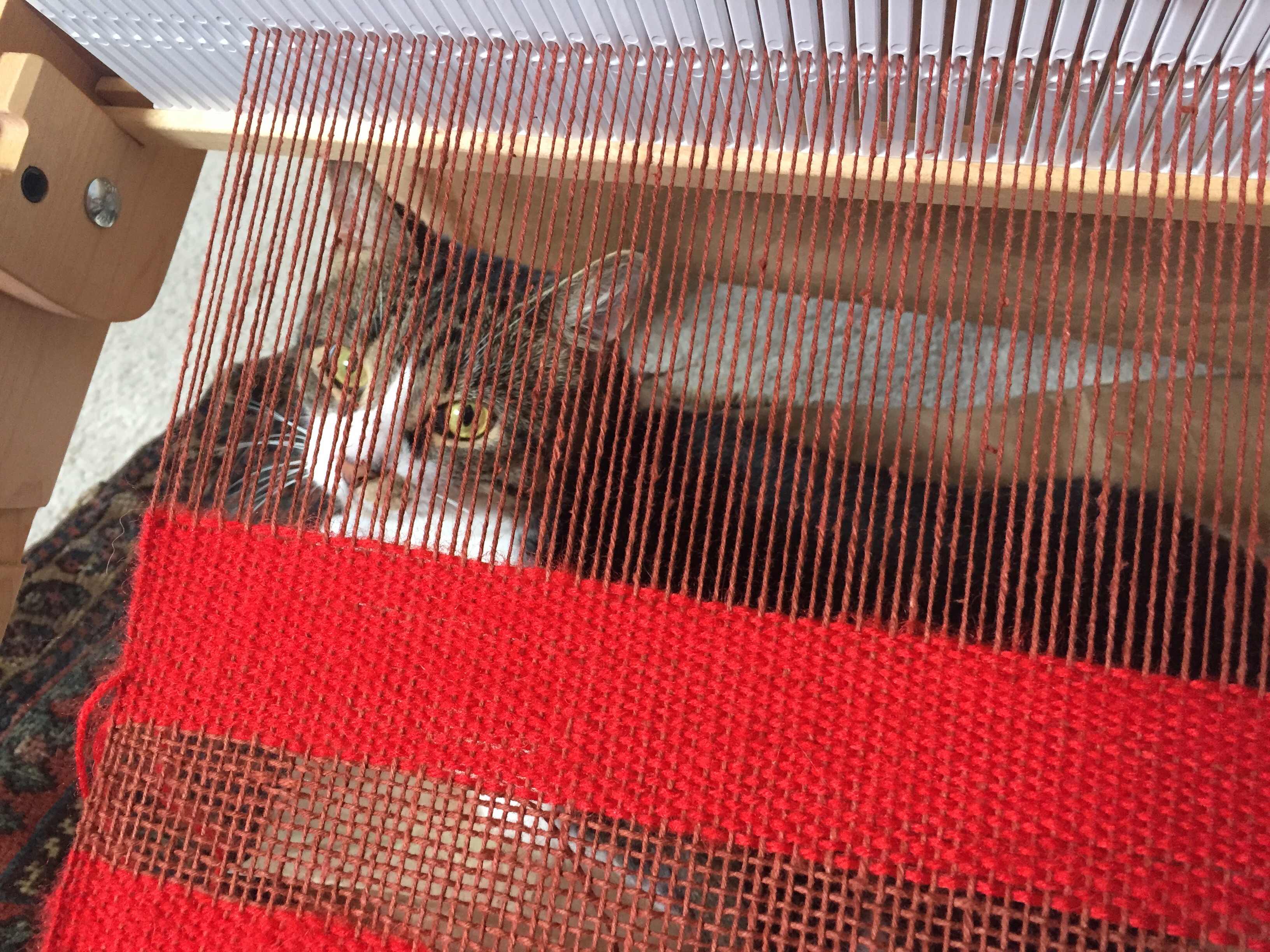
  • pull the yarn over, crossing the loom to the other side. you have an odd number of notches in your loom… so when you pull your yarn across, it won’t land right in the center, right? So you want an even number of notches on one side and an odd on the other, of the yarn just pulled across, having one more notch on one side.
 

IMG_3460

  • hold yarn snuggly and wrap it around the notch, moving from right to left and then turn the loom so it is “up” again, with the notch you just wrapped on the upside


IMG_3461

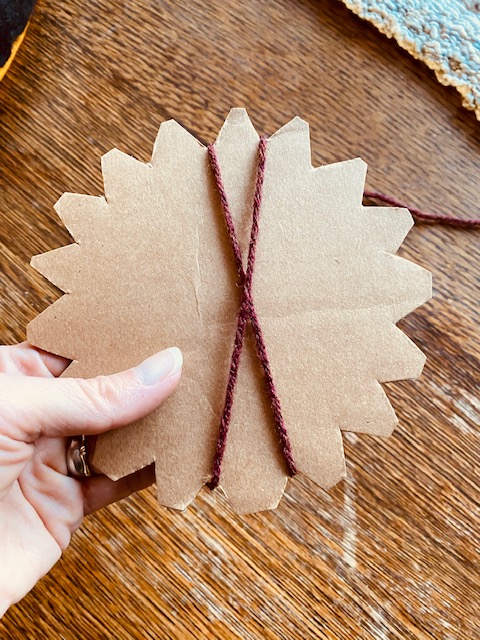
  •  bring yarn down, crossing in the middle, going to the left of the notch with the yarn in it.


IMG_3463

  • wrap the yarn around that next notch, again, moving from right to left
  • repeat this step until you’ve brought the yarn around every notch
  • IMG_3468

Warping the loom:


Tying the center of the warp:


Step 8: Then start weaving! I generally weave from right to left, but it doesn’t matter which way you go as long as that is the only way you go as you weave. No doubling back! The same weaving principles apply with circular looms as do with other looms. Bring the yarn over one warp thread, under the next, over the next, under the next, and so on… The first few rounds might not look right, but as you go around, it will become more and more organized and clear whether you are to go over or under.

Step 9: Optional- You can add new colors and textures whenever you want. I usually just tie on the the thread and begin weaving. When the loose ends come up against the weaving as the new yarn starts getting woven with, I gently tuck them under the already woven part. DON’T SNIP THEM! You want them longer so you can sew them in once you are finished and the piece is off the loom.

As I make my way towards the upper part of the loom, I like to use a tapestry needle to weave. It keeps one from pulling on the warp too much and allows for weaving right up to the top.


Step 10: Once you feel you cannot weave anymore, it’s time to take your piece off the loom! Gently pull off the tape, and the warp that is wrapped around the notches. You will notice how it is naturally shaped- will it be a bowl, or a coaster/placemat/wallhanging? Does it curl up or lay flat? Assess and gently shape it as you wish.

Step 11: Time to sew in those loose ends with the tapestry needle. I usually sew them into the bottom/underside of the piece. Just gently bring the loose end down through the column of weaving right below and it and carefully snip the remaining bit. It will be completely hidden in your piece.

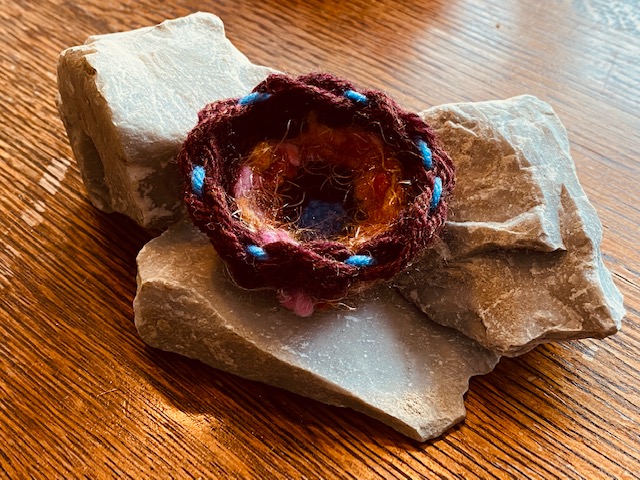
Step 12: Admire your handiwork! I love my little bowl! I can imagine making several of these and having nesting bowls all over. Or sewing them together in a way to make something that looks like coral, or finding a little stuffed bunny or chick and making this a little nest…

IMG_3449


Have fun with this. I’ve done circular weaving with kids as young as 6. And I intend on weaving this way for as long as my fingers let me. It is so relaxing and so satisfying, and you likely have all you need already in your home.

Take care,

Bradie


1 Comment

Monday’s Musings~ Writing is Like Exercise

Sheesh, it’s been a while. A raucous cold, a busy schedule, a lost cat, and maybe a few too many projects really got me off my writing groove. But, I went for a run yesterday to try to get my blood moving again, and today I’m back to writing here and on another project. Feels good. 

I’ve taken to rising early again, well before anyone else in the house is stirring. It’s so much easier to do when it stays dark longer into the morning. I love those quiet moments. And truly, coffee tastes the very best at a little past 5am. 

There are simply not enough hours in the day to do it all. So, making decisions and abiding by priorities is where it’s at. 

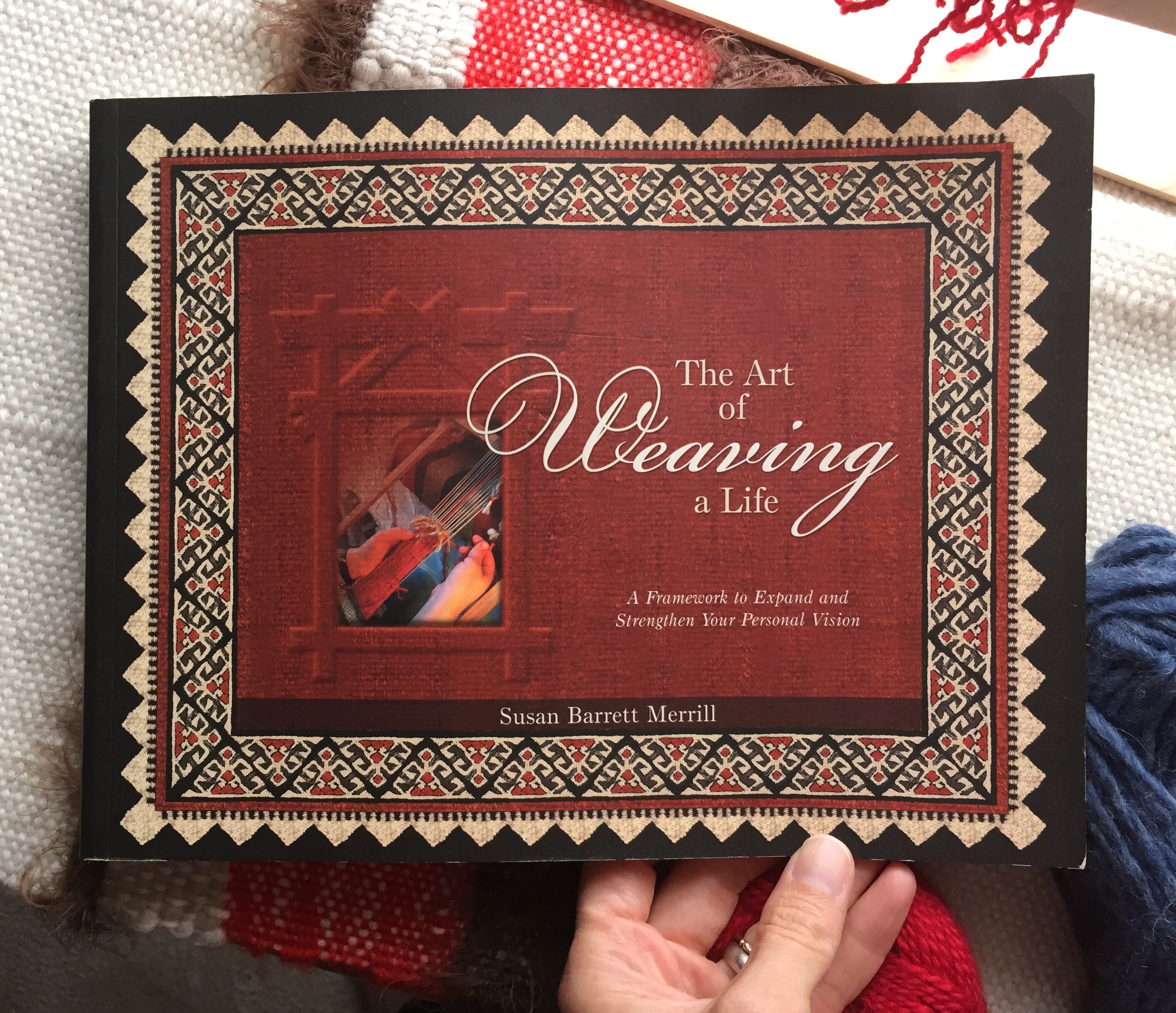
One beautiful priority for me at this time is working with Susan Merrill of Weaving A Life.


I’m going through the process of making eight projects Susan developed, with her support, guidance and wisdom along the way. Two and a half projects in and I’m already profoundly moved. I’ll write about the whole process when I’m done. For now, all that I am learning and gathering for myself is precious and intimate. When I’m through, I’ll be able to work with others in this way, which is a dream come true. 

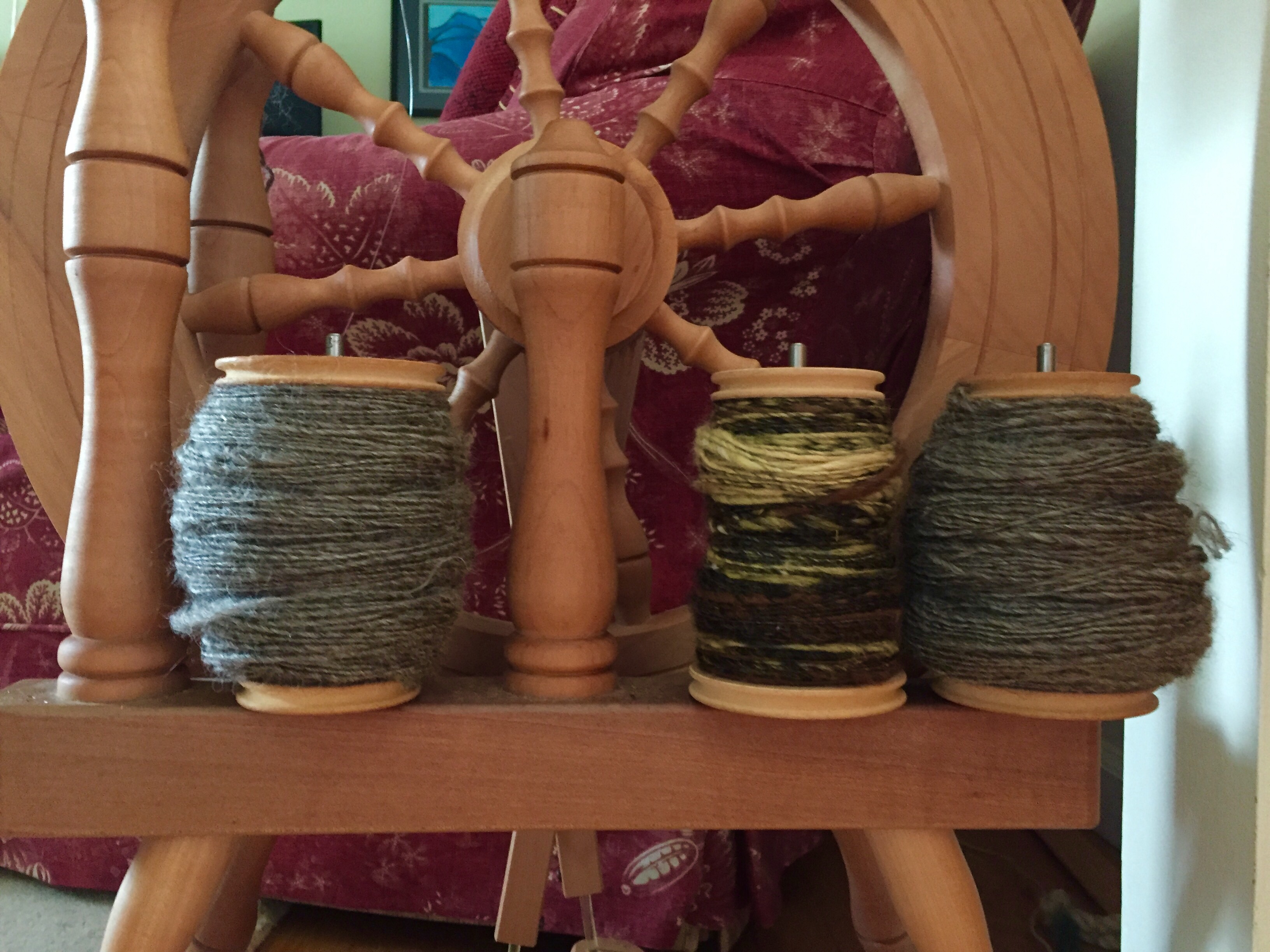
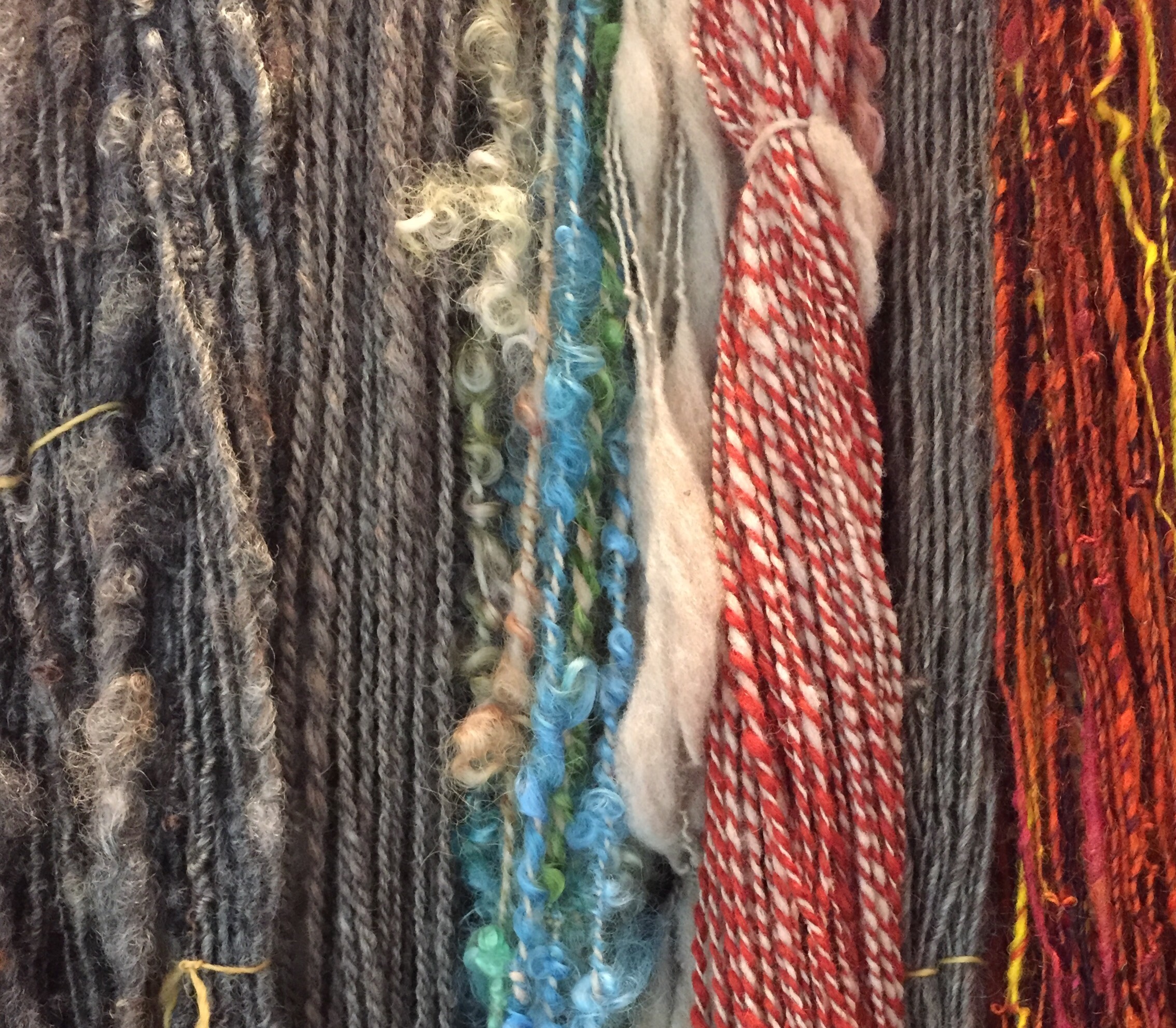
I’m spinning wool almost every night after my kids go to bed in order to have a sweet selection to sell at a craft fair in November. 


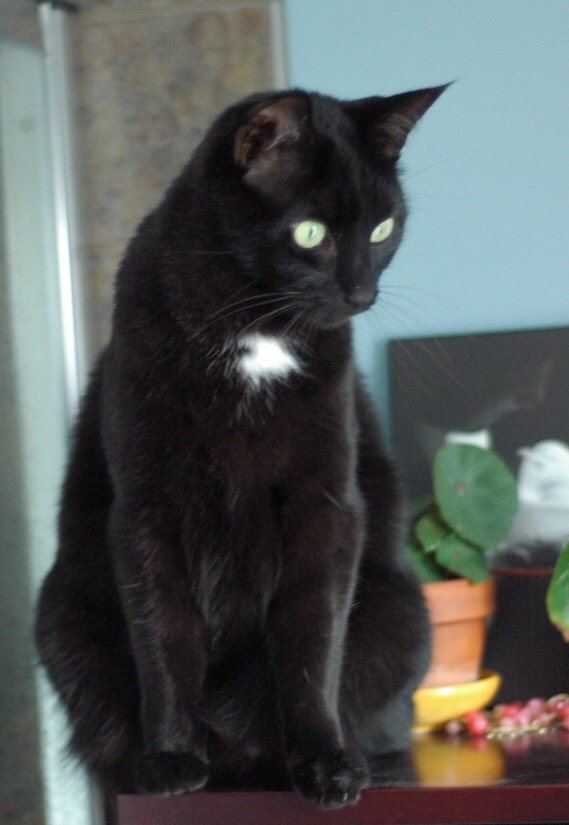
I’m tending to a sad and worried heart, of my own and my children, due to our missing cat. He’s been gone for almost a week but was sighted this morning. With the weather changing, it’s hard not to feel frantic. 


I’m working on another weaving project and struggling with warp tension due to shoddy wrapping on the beam. Frustrating! 


And tending to family, home, career, body, mind, spirit in these crazy heartbreaking times…

Not enough hours…


4 Comments

Monday Musings~ Worry Sucks

I definitely spent a lot of time worrying about people I love and places I hold in my heart these last few days as Irma coverage got scarier. I avoid the Weather Channel because damn is it dramatic, and the turbo intense music is insulting. But even reading about the hurricane in my own quiet head made for stress and ineffectual worry. My worry literally did nothing to help people. 

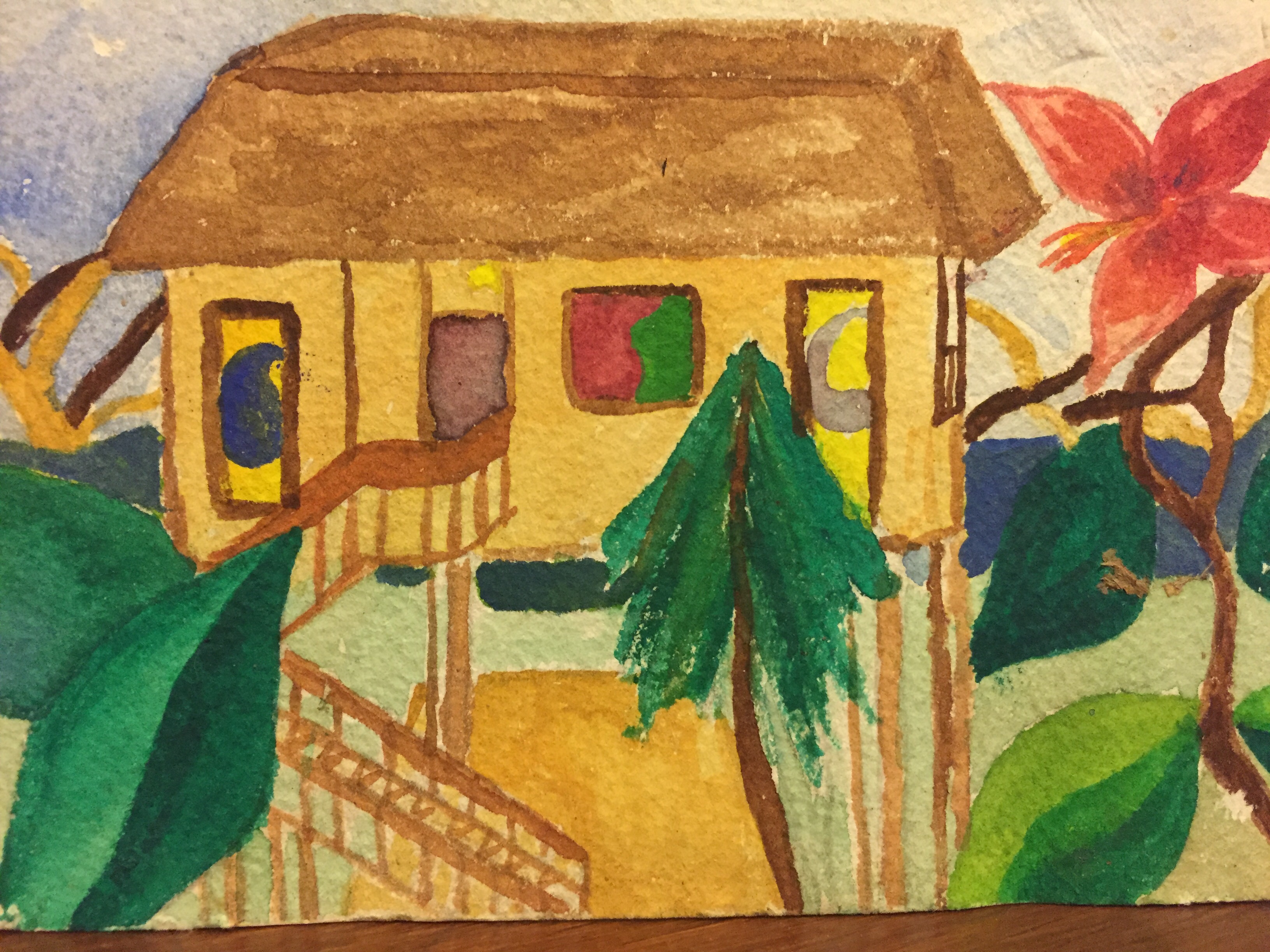
But, I cleaned the hell out of my house and found a painting I did years ago of the house grew up in on Sanibel. I’m not a skilled painter, but I love it. 


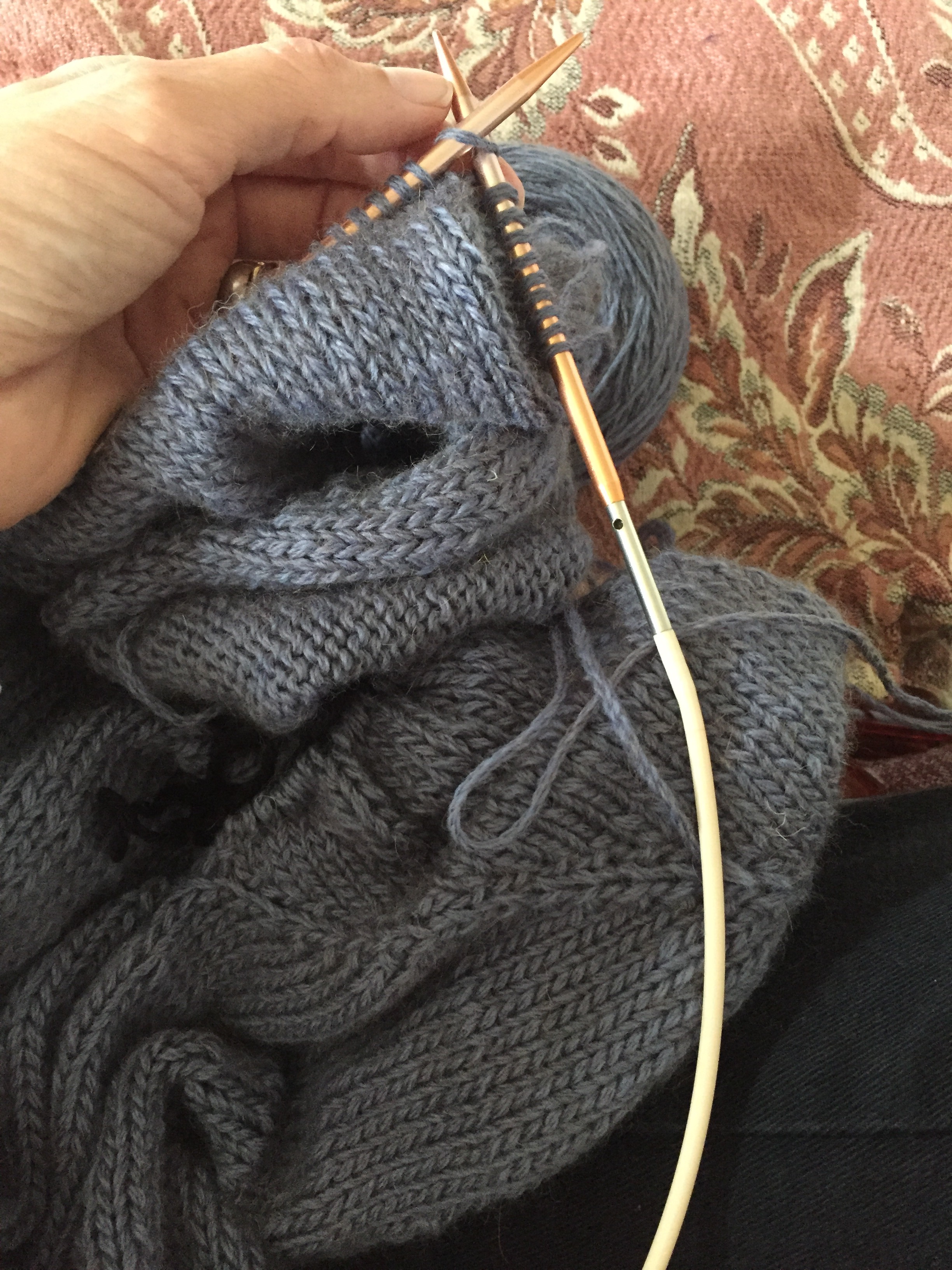
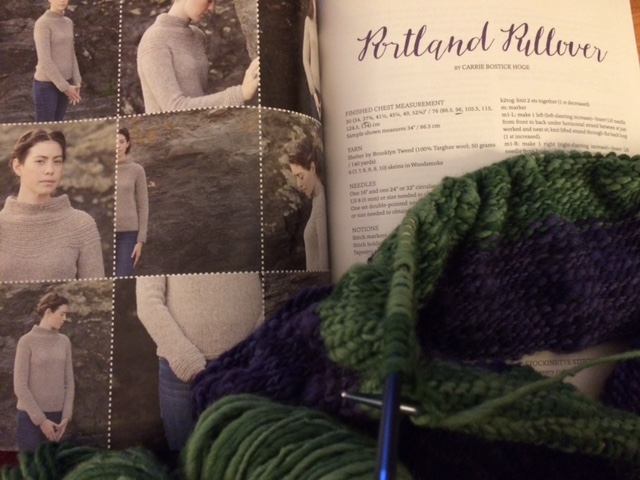
I picked up a sweater I’ve been working on for five months. I even knit a few stitches while watching a terribly stupid movie. I’ve never done that before. A success? 


I wove a little with my buddy, Mittens, who is achieving a starring role on this here blog. 


I had some sister time at the lake,


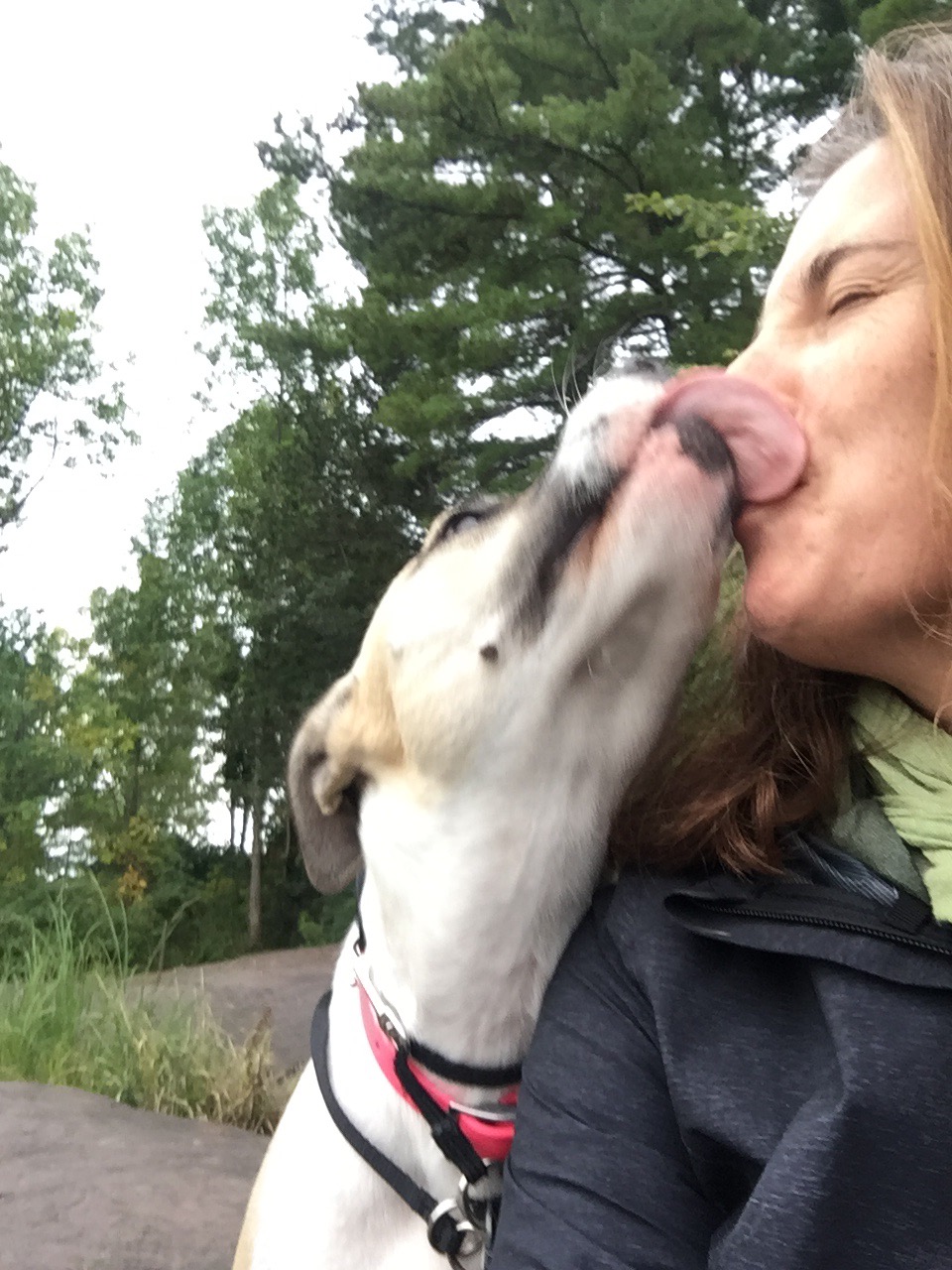
And got some crazy love from my puppy niece. 


I sent a lot of love into the air and realized I need to learn to build a fire from scratch. 

Last week’s goals are this week’s: seriously. Finish the shawl (or maybe table runner?). I’m screwing up enough to make me want to bail on the whole thing but I feel like the little bitty mess ups might not be reflective of the whole thing. Just like a bad day doesn’t mean the whole month is bad. But seriously, my selvages need work. <Palm slapping head>.

I played with my littles a lot after school and truly, sometimes playing just means sitting on the floor and letting them climb all over me so I can tickle them. This will remain a goal. Our days are infinitely better when we heart to heart connect after a long day apart. 

I never did start the hat I have stuck in my head as an idea. I was too worried. 


Leave a comment

Fun Kid Craft ~ Sock Puppets! 

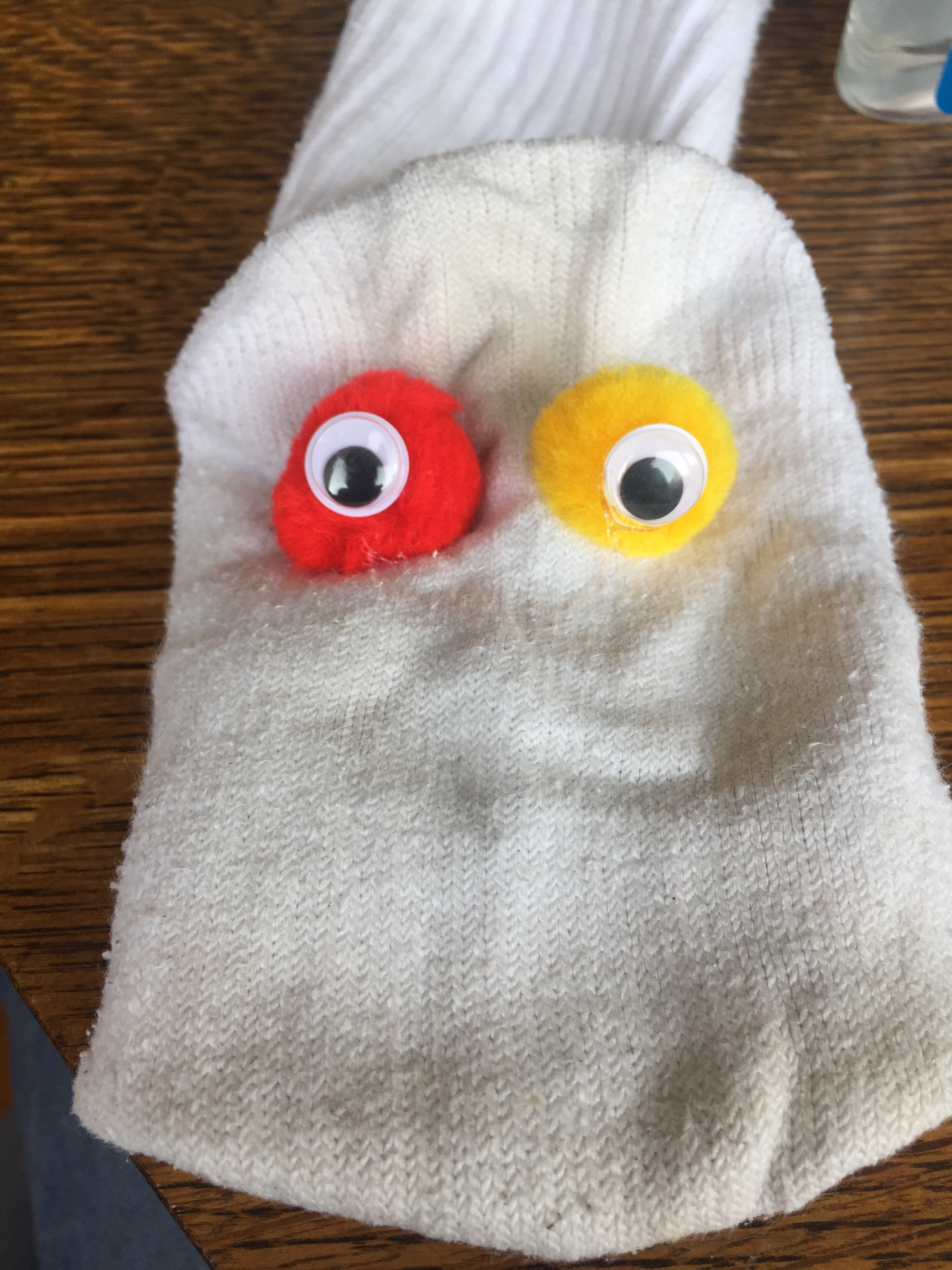
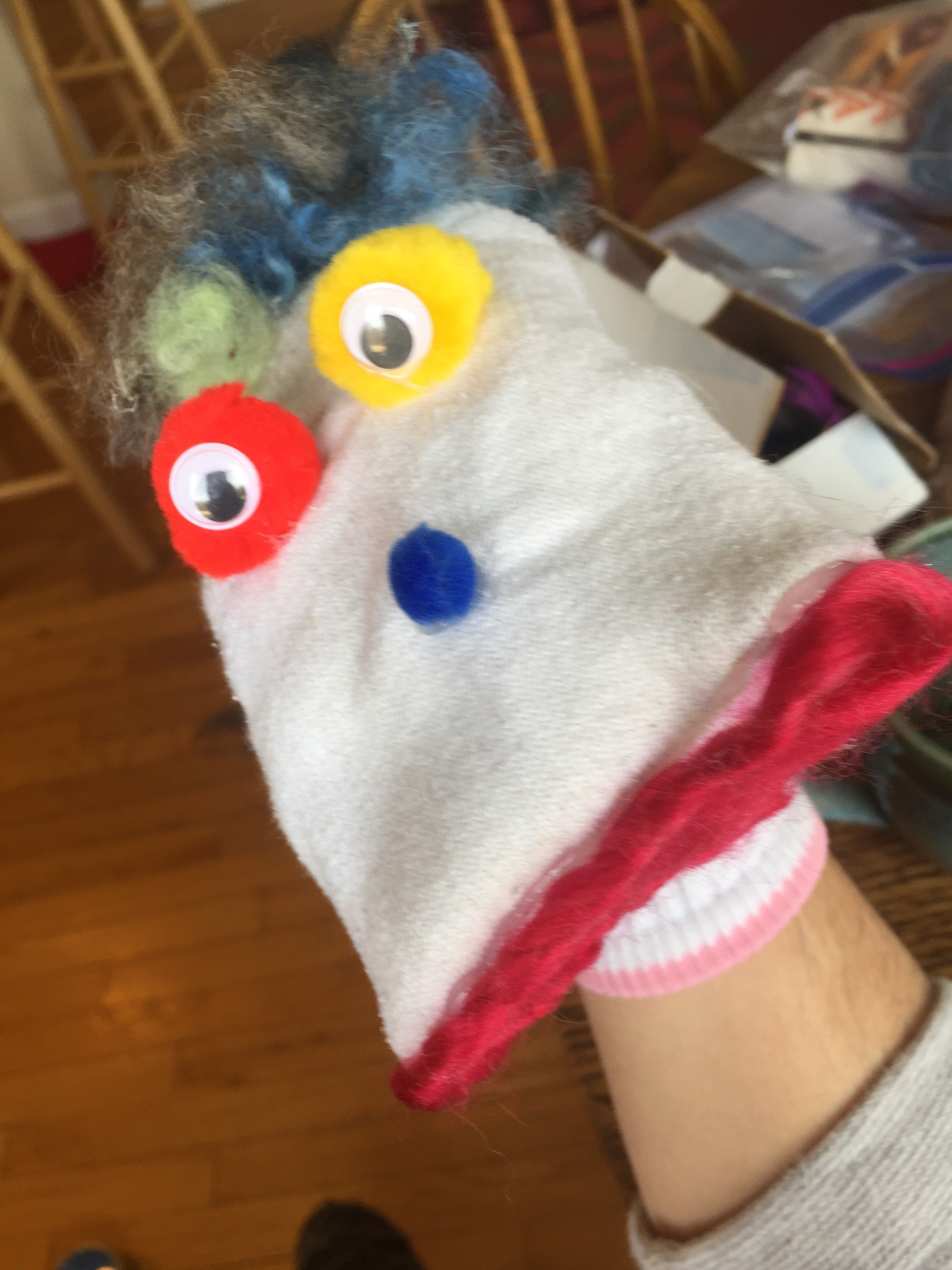
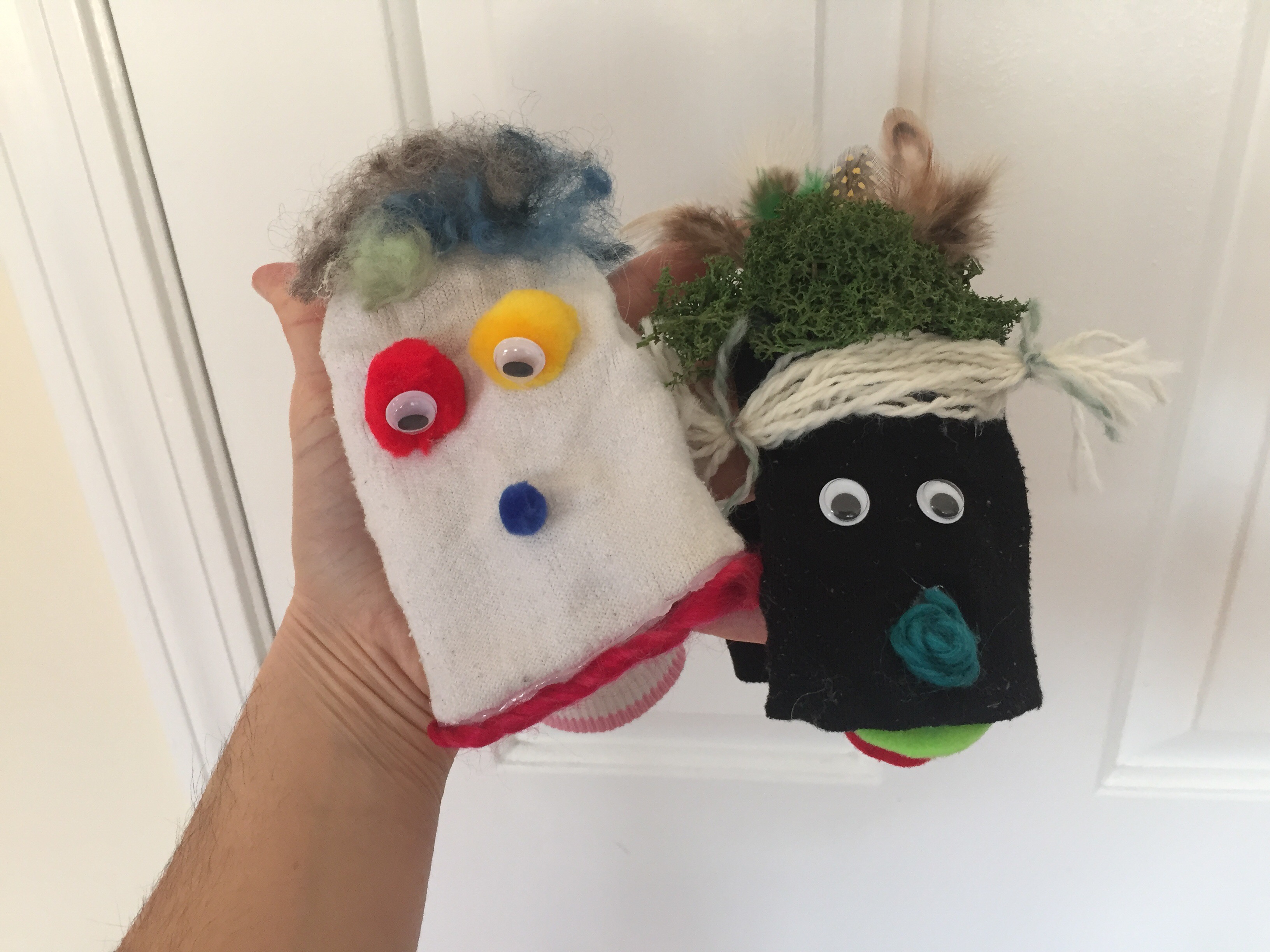
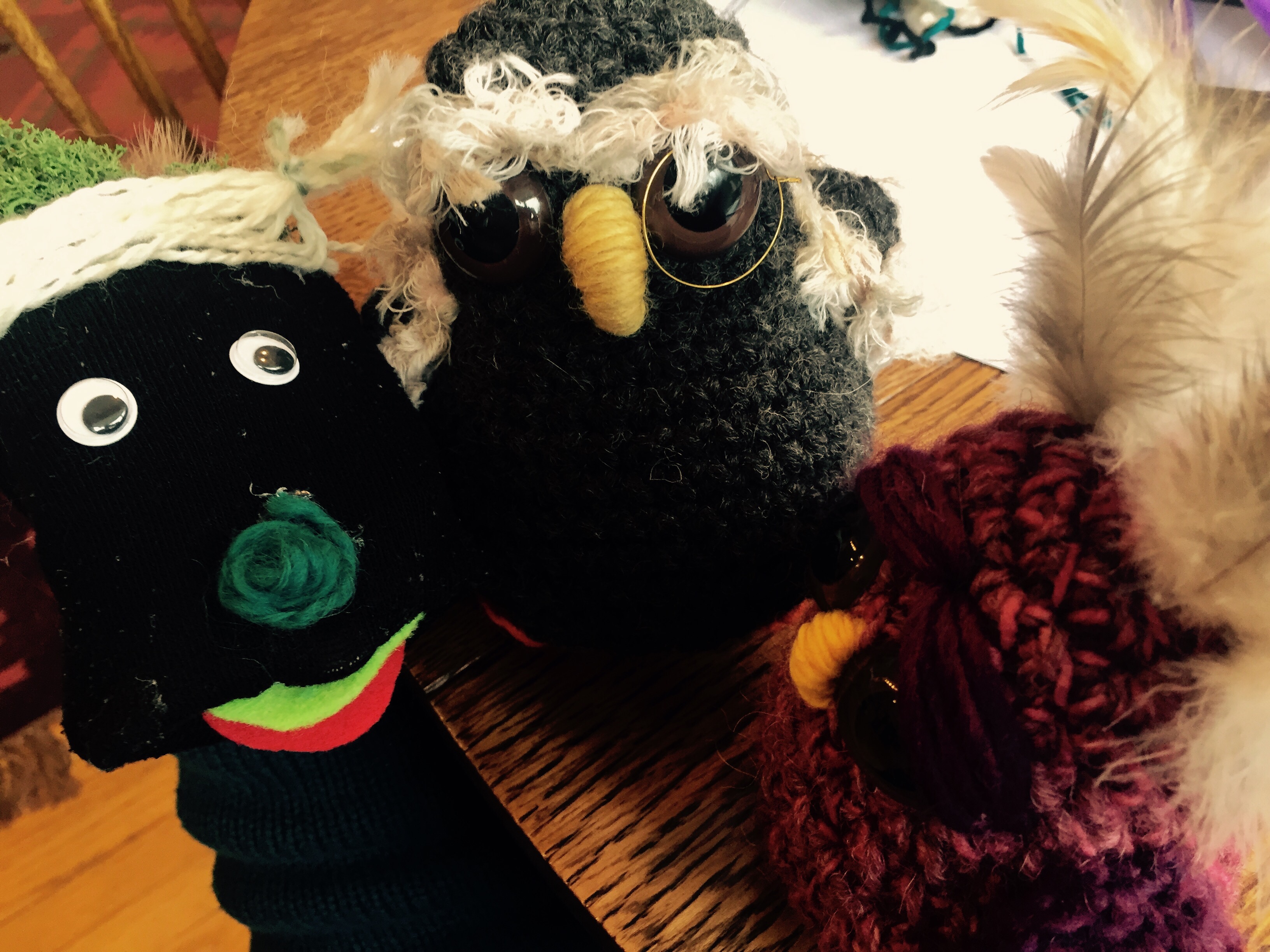
I’ve been meaning to write a post about sock puppets for months! But, you know… life. I was reminded of these hilarious characters when I read through the stupendous thank you notes I received from the kids in my son’s class for all the activities we did over the year. A large number of them said making sock puppets was one of their favorite activities. So, of course I should share what we did!

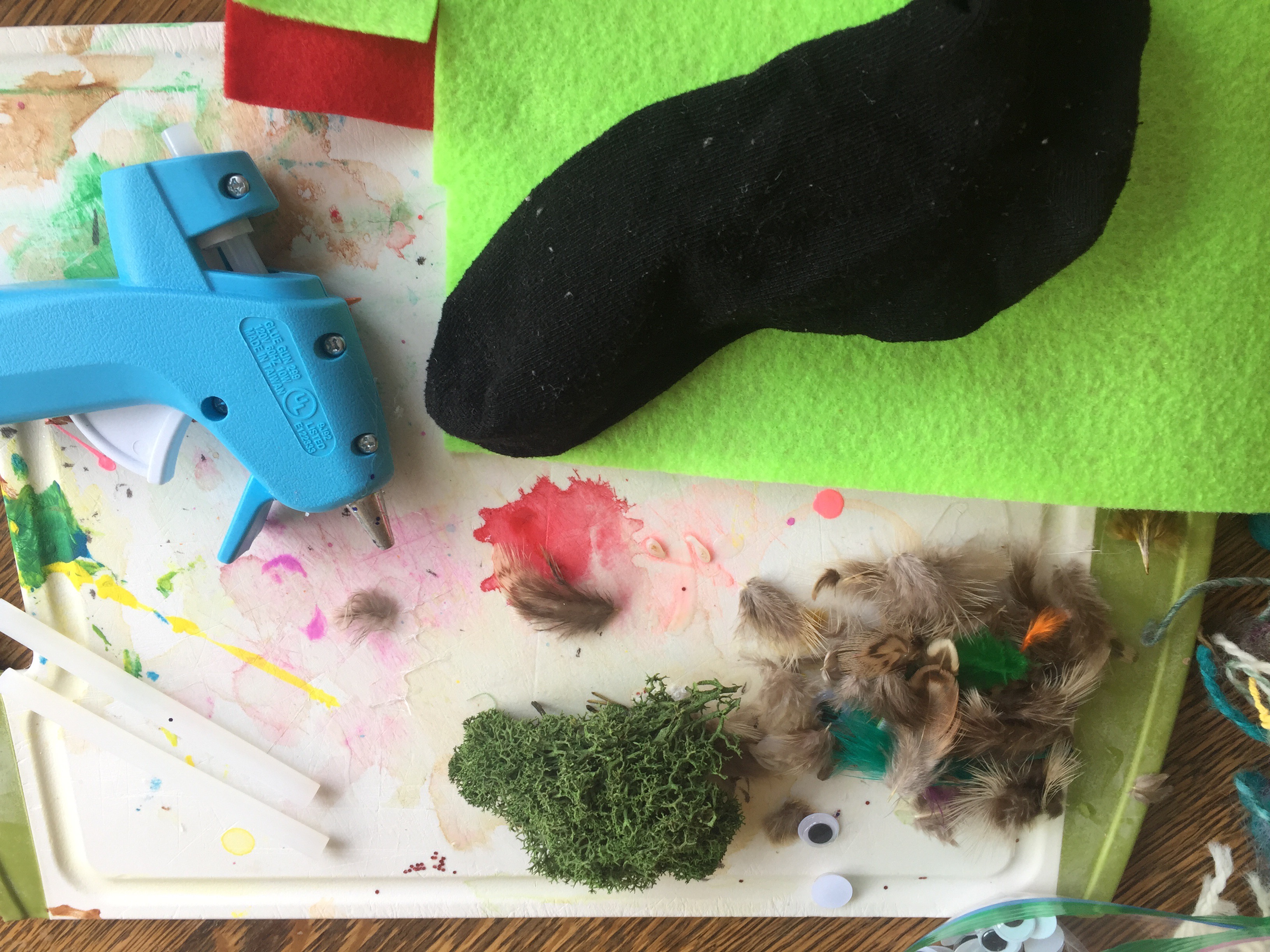
#1: Gather socks you are willing to separate from. Got any loose ones kicking around, lonesome without their mate?

#2: Collect random bits of stuff you have in the arts & crafts category. Pom-poms, beads, googly eyes, moss, old costume jewelry, felt, buttons, yarn…

#3: Get glue ready. I found my glue gun to be the most effective but standard glue works, too. Clear glue is better because you don’t see it once it dries.

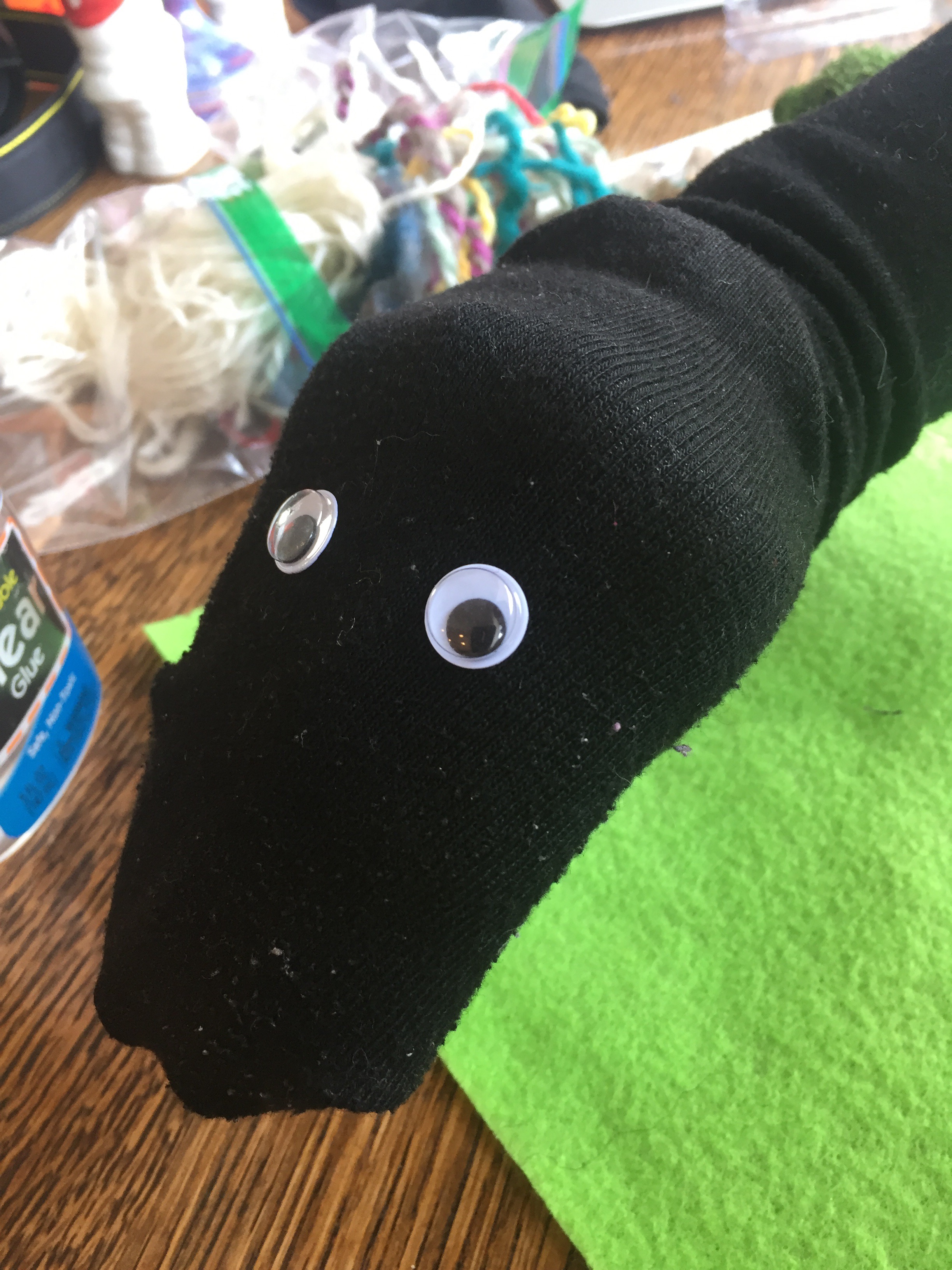
#4: Arrange sock on hand. I find that the heel of the sock fits nicely over the knuckles. When you open you hand, keeping your fingers together and away from your thumb, you can tuck the extra sock fabric that would otherwise be around your toes, into that space, creating the mouth. Close your hand, holding the mouth in place, and glue on the eyes where you want them. Then, gently remove the sock and lay it on the table.

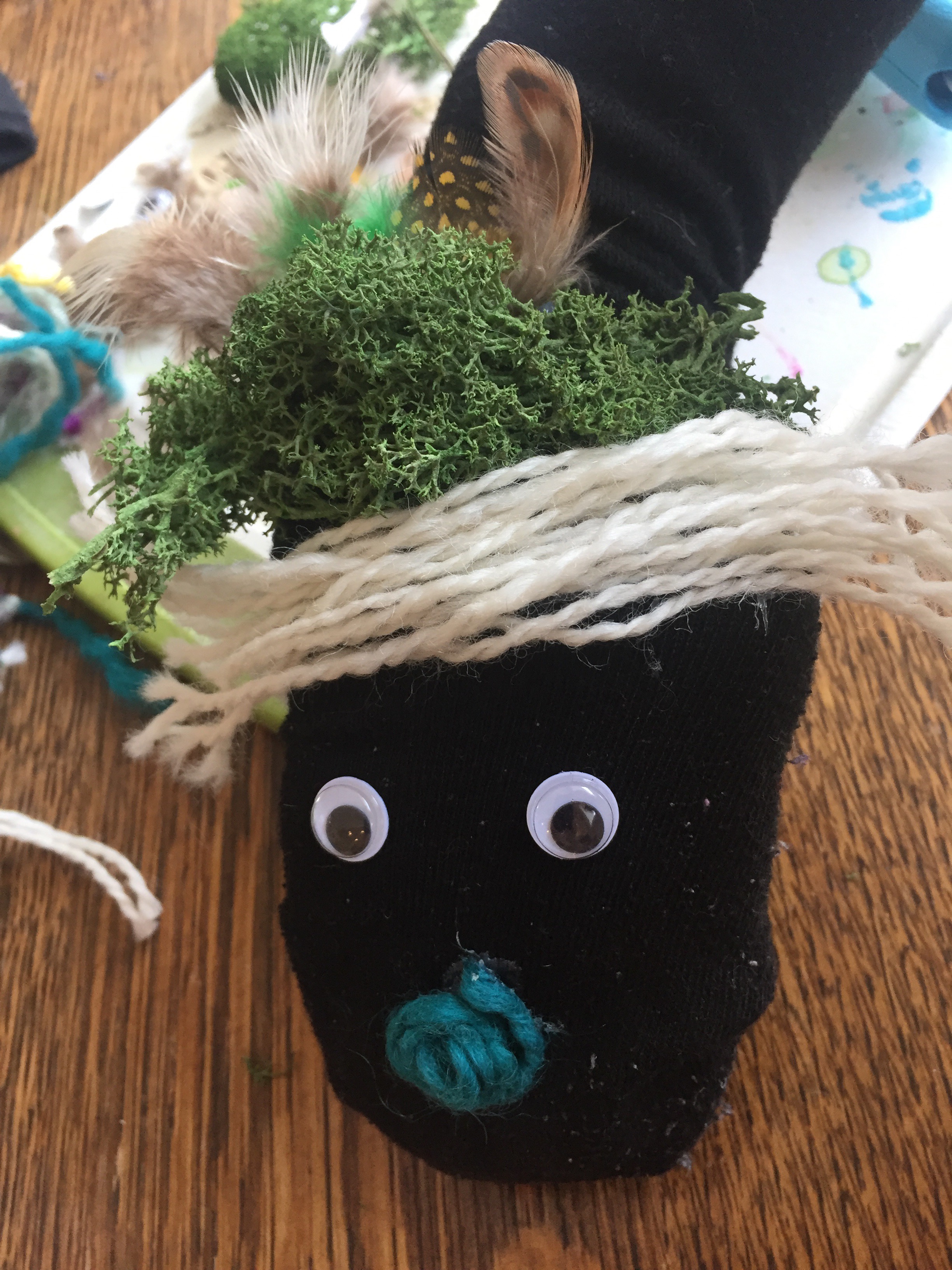
#5: Notice the personality that is already evident! Amazing, what eyes do. 👀 Start adding whatever you want to your puppet, being careful not to overglue. You don’t want the sock to stick to itself. On mine I knew mossy hair was necessary, and feathers.

And more hair… and a nose…

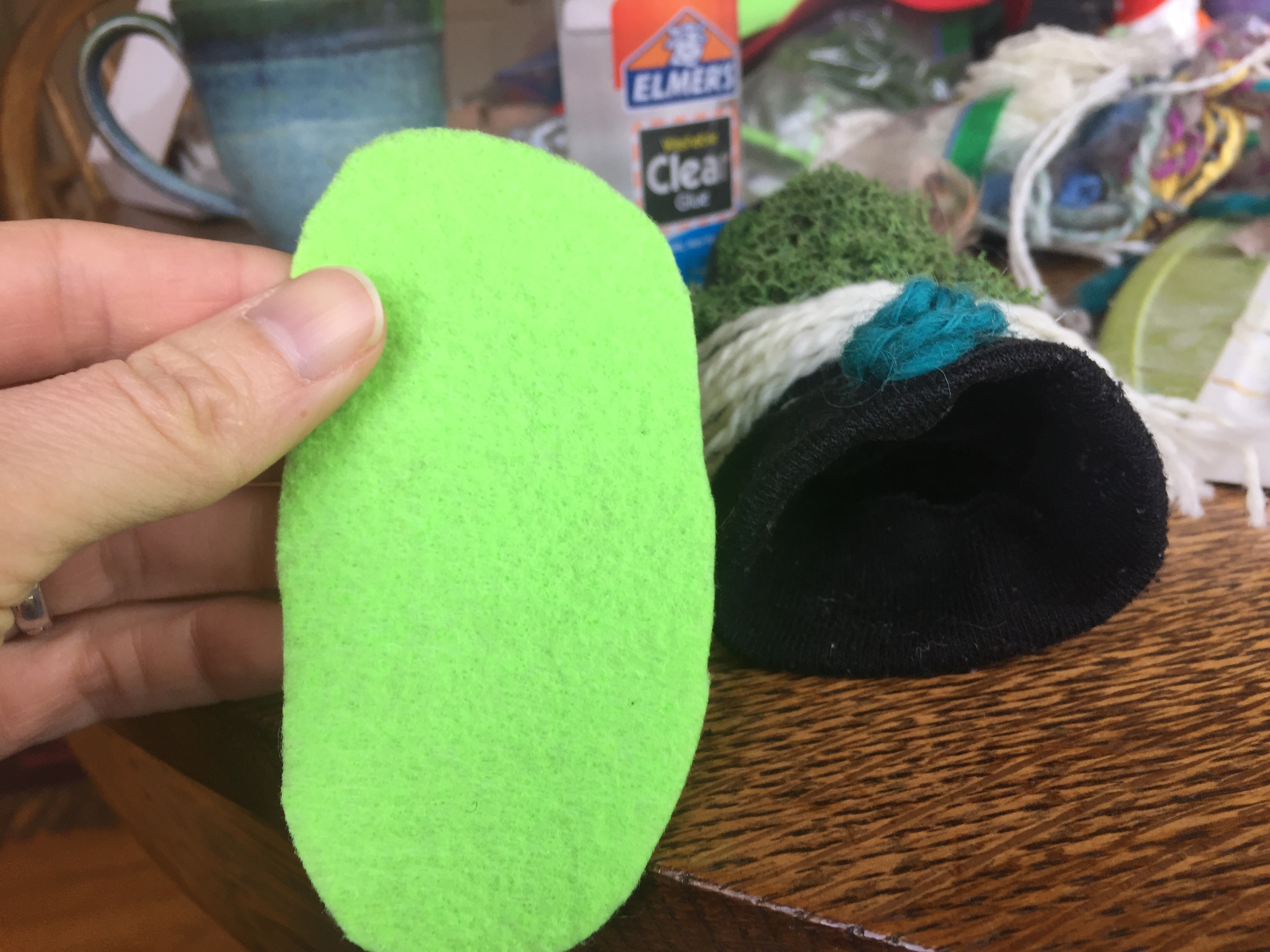
#6: after the adornments dried for a few minutes, I started on the mouth. I propped open the space designated for the mouth and eye-balled the size.

And cut out a felt oval…

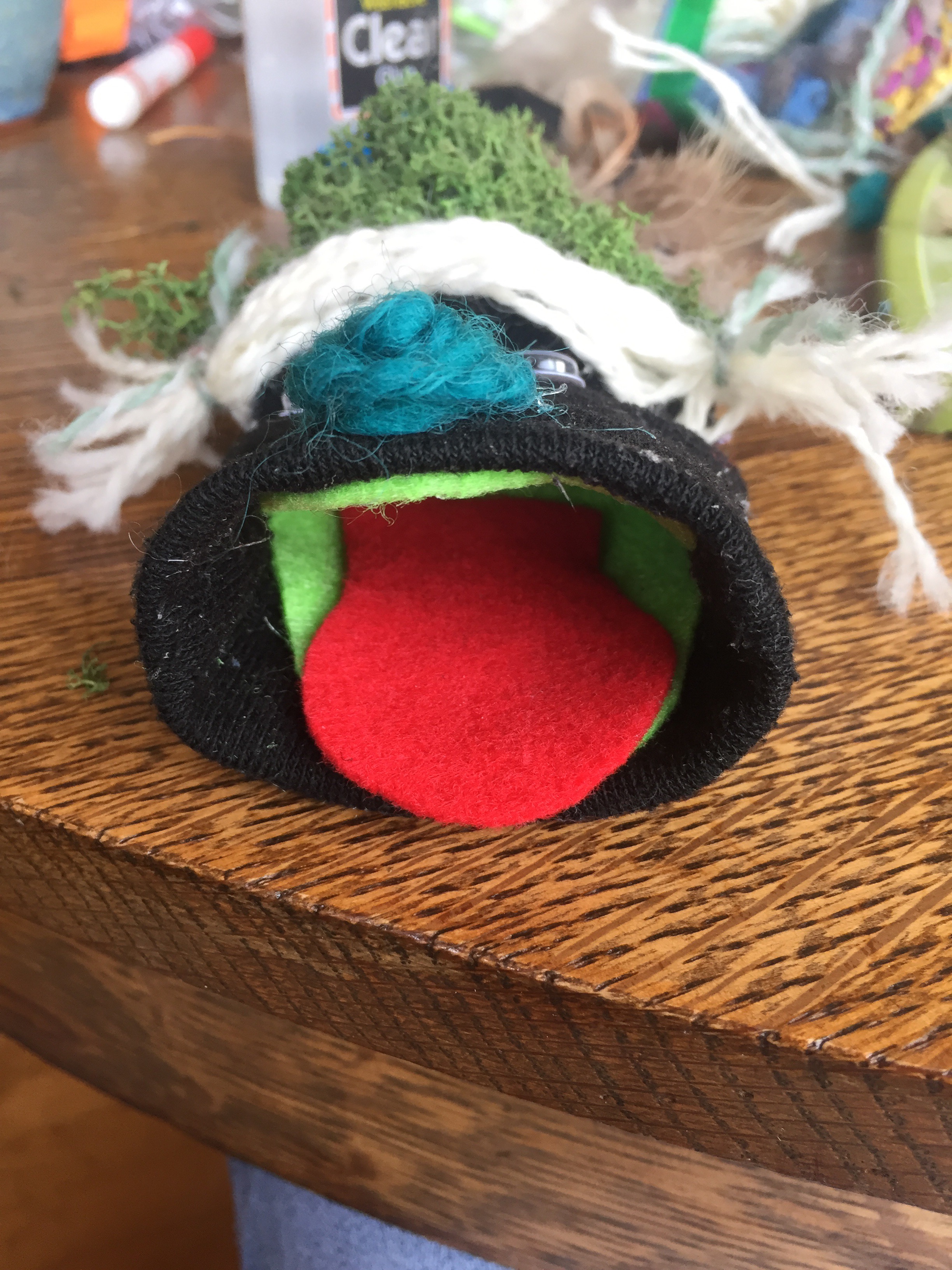
I tucked it into the sock mouth to ensure a good fit, then took it out, put glue around the edges of the felt, and tucked it back in there.

Then I added a felt tongue which was simply a smaller oval with one side cut off.

#7: And Voila! You can introduce yourself to your new friend!

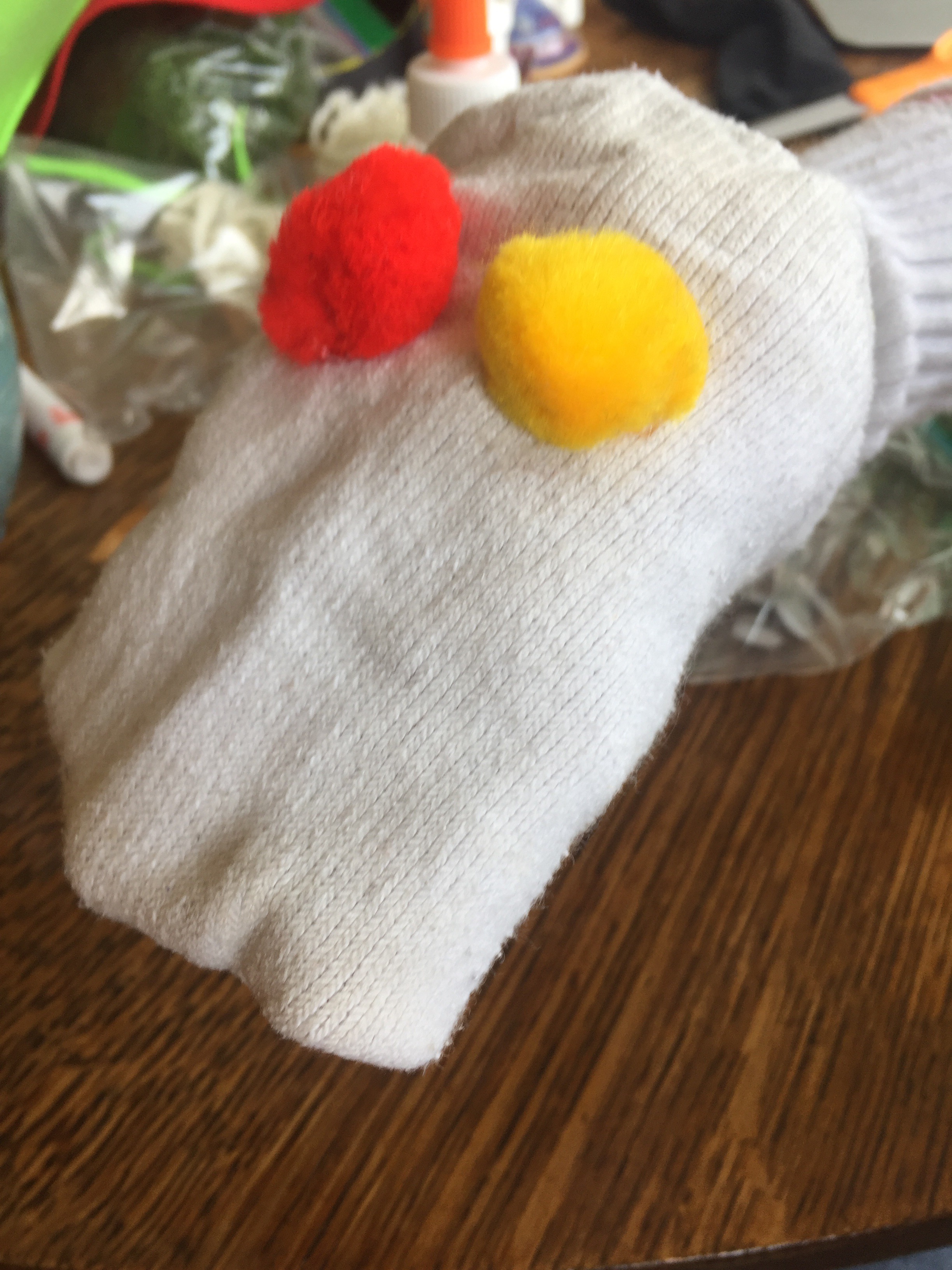
Here’s another one I made with a tube sock.

Ugh, do I need to use bleach?

Nah…

Shiny red yarn for a lovely lip expression. This took a little patience as the yarn needed ample time to dry in order to withstand this character’s rather loud voice.

I can’t share pics of other people’s kids, but I can tell you, we had so much fun that day! These characters come out of nowhere and invite story telling, play acting, and frivolity! Here’s some other perks:

👉 They are inexpensive to make.

👉 They require only as much detail as you feel like giving them. A sock with a mouth on its own is fun. Each thing you add gives it more flavor.

👉 Patience is needed, and flexibility in expectations ~ both good things to practice! Sometimes we gotta wait for glue to dry. Sometimes we don’t know how to make top hats.

👉 Puppet shows never get old.
Have fun!


Leave a comment

School and Yarn are a Perfect Pairing

My life is organized by school years. I’ve not really had much time in my life when that was not the case. I completed my own schooling when I was twenty-five. Then I worked in schools for six or seven years (I already can’t remember that detail), and then I worked for years with kids in my practice who were in school. Now my own children’s school schedules shape our family’s life. The calendar year means very little to me except for a quiet chance for me to reboot and rethink where I place my energies. The school year, on the other hand, shapes most aspects of our lives.

I spent a lot of time in my kids’ school this year. I volunteered in their classrooms teaching the kids all different kinds of things to do with wool, yarn and other fibery crafts. I also taught the same things in a more official capacity in two other classes. I loved it and I plan to share more here about some of the lessons that I taught. One thing I did in both my kids’ classes was leave a loom set up, the simple kind, for kids to work on as they pleased, with the idea that at the end of the year (or whenever it was finished), I’d turn it into something to decorate their teachers’ rooms with. Yesterday, I finished both of these woven pieces. My son’s 3rd grade classroom filled their loom. Almost every time I went in, someone was working on it.

Here’s their finished piece:

FullSizeRender-3

My daughter’s 1st grade class didn’t do many rows on theirs, but I assured their teacher I could make wall-art with it, not to worry. That class also did epically cool stuff with wool they dyed with Kool Aid, wool they felted and wool they experimented with.

Here’s their wool decor:

FullSizeRender-1

And, here’s their finished woven wall hanging:

FullSizeRender-2

I used antique wooden needles and a sanded dowel to serve as the structure from which the weaving hung. I also had a needle felted little nest hanging around that I opted to attach to the piece. I made that in their class as a demonstration one day and wanted to include it to represent that part of the work they did.

FullSizeRender

As I worked on turning the woven pieces into wall-art yesterday, I thought about all that has transpired since September, for my children, for me and my husband, for our family as a whole. It’s so much life squeezed into all of these academic months. I reflected on how much my kids learned with their fabulous teachers and with their peers this year, how much more they are doing on their own compared to September, and how much some of our growing pains have been, well, painful. I thought about how lucky I am to have been able to hang out in their classes so many times this year and be given the chance to learn how to teach better, listen better and be more flexible. And, I thought about how much I want to keep doing this. Handcrafting and fiber art are extremely effective mediums for teaching kids about art, history, creativity and themselves. I hope I do this for a long time.

Fueled by that hope, I cleaned off my work desk, and daydreamed about summer break.

FullSizeRender-4


Leave a comment

Farm to Frame Felting Fun with First Grade Friends

I am so very lucky to have standing dates on Fridays when I teach kids how to do things with wool and with yarn. These Fridays are now known as “Fiber Fridays”, and have become a part of my life I am extremely grateful for and proud of. I think about it a lot, why I want to do this stuff with kids. First of all, I have two kids of my own and I relish any chance I get to participate in things in their classrooms. I get to meet their friends, know their teachers and just be part of their school world for a small time, which is amazing. I never leave without internally bowing to teachers, para-professionals, one-on-one specialists, reading specialists, special educators. They make the world go round, in my book. Their love and dedication to the field, and the skills they have, just blows me away.

Okay, so yes, I love being in my kids’ classes. I also love going into other classes and meeting even more kids and answering questions and getting excited about new stuff. It’s just fun and a beautiful complement to my work as a psychologist. I’m not being a psychologist in any formal sense of the word when I am in with children on Fiber Fridays. However, I am sharing something that I truly believe is deeply healing to the human spirit, and is a restorative practice. Handwork/fiber craft tie humans together in a most fundamentally ancient and organic way, and exposing kids to as many ways as I know how to work with fiber has become a prized part of my career.

In one of my first grade classes (the one my daughter is in), we’ve been exploring wool. We started with real free flowing exploration. I brought in big wool batts, smaller mounds of wool in a variety of colors, some fabric, some yarn, and a needle felting tool for just me to use, just in case some quick stick-togetherness was needed. I showed the class first different ways we can play with wool. I pulled it apart, I twisted it, I formed it into shapes and wrapped them in fabric and tied yarn around it. I encouraged them to just play and sculpt and imagine, and I let them know that there were no specific things they had to make at the end. Each table got its own basket of a big assortment of wool and then, it was off to the races! I was actually amazed, and I learned so much that day of free wool play. Children made babies, cradles, nests, birds, balls, clouds, old ladies, and animals. They played and laughed and shared. For some reason I was really worried that they’d be confused or adrift without a specific goal in mind, but I was wrong! They were happy to just go for it! I was lucky to have plenty of help from the teachers and a parent volunteer with cutting fabric, wrapping, needle felting and tying. It was peaceful and joyful. I do believe working with wool is magical.

Two weeks later in the same class, I referred back to our previous experience, and said, “this time, we are going to experiment with wool mixed with soap and water!”. Our project was to make felted balls. Before we began, I first showed them balls I made at home. I also showed them my “oops” items… a disc that was supposed to be a ball… a nest that was supposed to be a ball… a weird creasy ball that was supposed to be smooth. You know, it’s kind of hard, at least for me, to get a wad of wool to felt into a perfectly smooth felted ball with just warm, soapy water and your hands. I don’t know how Martha Stewart does it!

I then quickly showed them this book:

oops

And we talked about having one idea in your head when you go to make something and how sometimes it doesn’t turn out like that. I told the kids that we are learning, experimenting, having fun and seeing what comes out of our efforts.

On the floor I had set up a drop cloth with towels covering it. On that were six plastic mixing bowls, two with soapy water and four with clear water that had to keep being replaced as kids dipped their creations into them to rinse the soap.

Water + Wool + Soap + Being Okay with Oops = Felting

Balls were made. Some were smooth. Some were crinkly and seamy. We got a mushroom, some discs and some wild looking blobby alien life form planets, or maybe coral? I saw a bunch of children totally okay with experimenting and just seeing what happened and I think that right there is a major piece of wisdom gleaned from mindful handwork.

Freedom to experiment and see what happens, within one’s own heart and spirit, is such a beautiful thing, and it’s something that I think we all should tend to as often as we can. I am often guilty of hanging on so tightly to what my plan is that I forget to see what’s actually happening right in front of me. I forget to loosen my belly and breathe and just let things be as they are. It’s so easy to forget that.

You know what else blows kids’ minds about wool and felting? With some simple ingredients and some agitation, soft and fluffy wool is transformed into felt and it is impossible to return it to its original form. I can’t explain why something so obvious is so mystical and amazing to kids, but it is, and I need to meditate on the symbol.

Stay tuned. I’ll be sharing more projects and ideas and insights from this cool gig I have.


1 Comment

Showing Up With Love and Presence, and Fiber

fullsizerender-154


Dear Readers,

Have I let too much time go by in between posts? My longing to write about the moments, the textures, the projects and the beauty around me has been dulled, stolen really, by my broken heart, fear and unyielding anger at what is this new administration in the county in which I live, the United States. I am finding it hard to write about lovely things that I get to enjoy when executive orders put out by the president-I-cannot-name and his lackeys are, in my estimation, severely screwing shit up. People, beautiful, innocent, loving people are being traumatized and retraumatized by having plans and dreams wrestled from their hands, literally, in airports. People, lovely, hardworking, courageous, resilient and prayerful people are trapped now, either within US borders or outside of them, regardless of having the right paperwork in many cases. We have here a president who is saying that all is fine, all is great, things are working well in airports… have you seen the images of people grasping at one another after being detained for many hours because of the country they flew in from? Have you seen images of the protests all over the country? All over the world? Sorry. Things are not fine. Things are not great.

The Dakota Access Pipeline…

The Wall between the US border and Mexico…

Healthcare…

Here’s what is bringing me hope, making the blood move in my veins with energy, combatting my desire to go to sleep for four years (or two~ here’s to the mid-term elections people, let’s make some shit happen): the protesters all over the world showing the powers that be that actually, not everyone shares the same ideas about huge groups of people; an overwhelming amount of people are aligned with world citizenship and have compassion and love flowing from their core; lawyers are freaking BRINGING IT to serve people, pro-bono, to help them deal with the cluster that is this Executive Order on Immigration. You guys, and the ACLU, you are amazing.

I’m just a regular person trying to keep up, trying to make sure that I’m reading accurate news and taking right action. I’m seeing in my corner of the world that all signs point to a major crossroads in this country. We’ve been tumbling in this direction for a long time. The highways, roads, rivers and tributaries leading towards the Moment of Choice, where we determine how we view ourselves in relation to the world have been covered over , polluted and at times unclear. Not any more. Not for anyone. Those who have always been fighting the fight for equality, justice and freedom have not succumbed to complacency or obtuseness the way many of us have, as I have. Not any more.

I am not a political writer. This place that I have secured to write about the healing effects of fiber art, handcraft and creativity, it will remain that and I love that, but occasionally I may have to refer to what’s going on here and around the world from my little vantage point. All I do is housed in the reality we all share, and compartmentalization has never worked very well for me.

Some Recent Things:

Ice:

My Sweet Littlest Harvesting Icicles Like It’s Her Job:

img_1849

Our Resident Owl:

fullsizerender-155

Teaching Weaving to Children Is One of My Greatest Joys:

Paper Making Attempt:

I read a cool thing the other day, maybe a friend’s Facebook post? I don’t remember, but the gist of it was that in order to handle all that our world, our spirit, our heart asks of us, we must also attend to our places of love and hope, health and strength. I wish for all of us to reside in these places, and meet with what comes our way from a place of integrity, wisdom and power. The other day, I showed a group of 6- and 7-year olds images of people weaving from all over the world. All different colors of skin, all different kinds of attire, all different kind of settings. I told them them that when weaving, we are engaging in a practice that humans have been participating for at least 10, ooo, but more likely closer to 25, 000 years. We are all bound by a need for clothing, housing, containers, and beauty. These fibers, they connect us to each other and to our ancient ancestors. It felt good to talk about that on Friday, having no idea what was about to transpire.

I’ll keep talking to kids about things like that, for as long as they’ll listen.

Be well,

Bradie


2 Comments

I Love These Two

Recently, my children and I hit a sweet, melodic flow. It’s not a coincidence that this occurred organically after I made some concrete decisions to simplify my life a bit, pare down the number of things I consider top priorities (how many top priorities can we possibly have?!), and just let myself live a little, without letting the constant internal judge that resides in my psyche like a doomsday specter screw up the sweet life I have. 

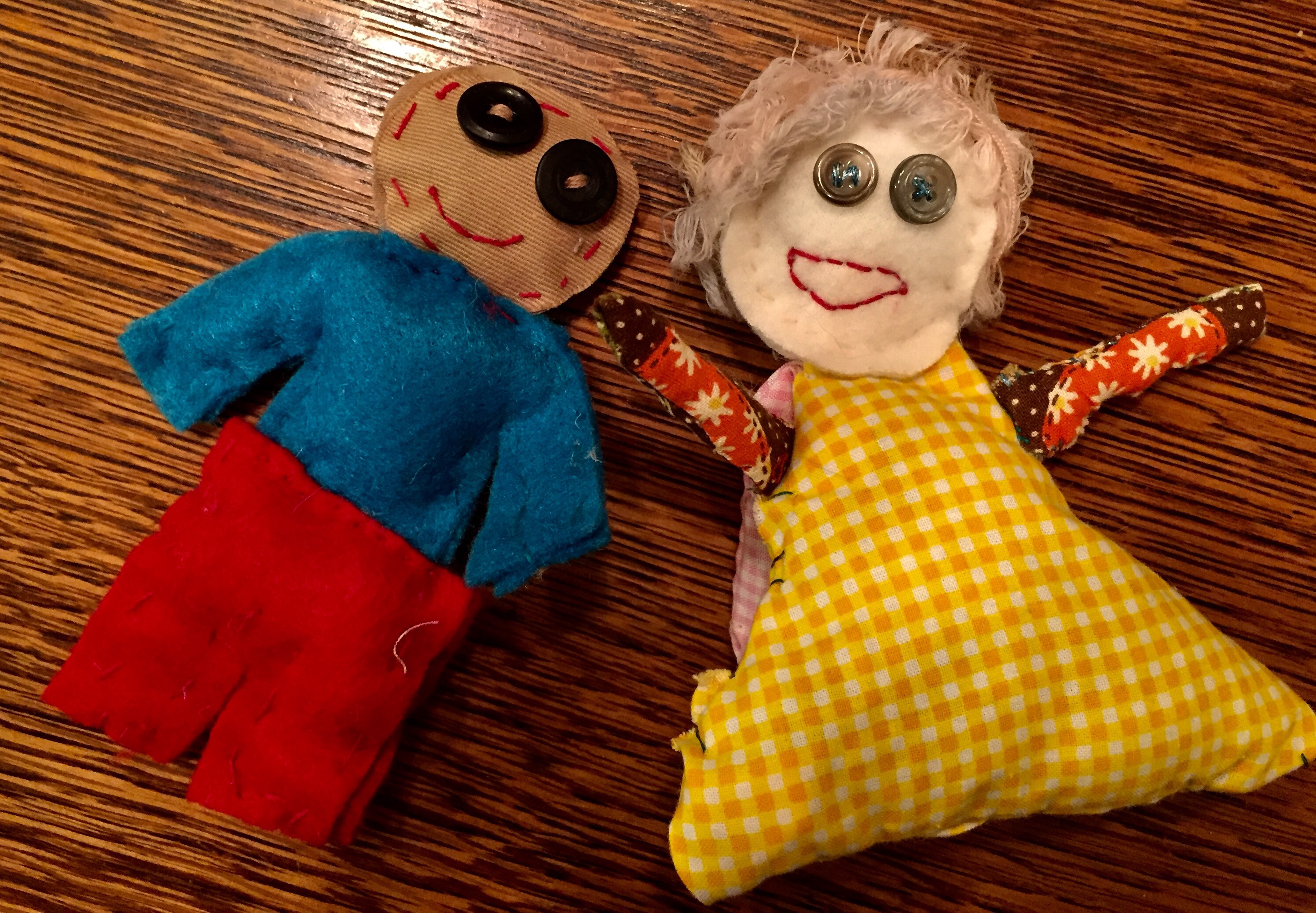
Afternoons after school, I worked on a gift for my cousin and her soon to be born Bebe, and my kids finished these wildly awesome dolls that they have played with every day since. I adore them. 


I’m learning, people. 

On the bus heading to my cousin and her full with baby belly, I just read a cool quote I thought I’d share, too. 

From, Will-Developed Intelligence: Handwork & Practical Arts in the Waldorf School, by David Mitchell and Patricia Livingston, it speaks to why making things from start to finish is so deeply satisfying and important for human beings. I’m working on curriculum ideas for my Farm to Frame series and find this quote a beautiful buttress to my efforts. I’m learning so much from this book. I did not go to a Waldorf school, nor do my children. It’s wonderful finding language, research and guideposts for teaching according to developmental stages. A true gem. 

I hope you have a lovely weekend, wherever you are in the world. 


Leave a comment

Gratitude, Grief, Love and Yarn: Holding it All

It’s been almost a month since my last post. I have missed writing here and allowing for myself the space to reflect on and share thoughts about handwork, process and life. I’ve not handled political news and world news well and needed to take some serious steps back so that I could regain some sort of balance and be the kind of mother, wife, daughter, sister and friend I want to be. As I write that, I realize that the one area I’ve neglected significantly is how I want to be in relationship with myself. It’s a well-worn complaint really, one that I’m kind of tired of, but nevertheless, tending to my relationship with myself is always, always the first priority I have to take a hit when the rumblings of pressure, grief, work and responsibility register on the Richter Scale of the nervous system. I can feel the effects now, but they are more of a tugging, a call to get back to having yarn move through my fingers as it becomes part of an image made real, practicing hand-stitching so that I might learn something new and make textured and calming designs, an urge to walk through the outside, amidst people and alone.

I do have to say, another deep and abiding feeling I have as this year wraps up and a new one is about to begin, is gratitude. Immense gratitude. I am learning how to have this feeling while allowing for grief at the same time for the immeasurable suffering that is experienced by people all over the world. It’s requiring a lot of stretching and expanding and allowing for reality. All of it. Not just the little slivers that I experience in my life with my loves.

And, there’s the word… Love. It is all I come back to and all I strive towards.

“Love is absolutely vital for a human life. For love alone can awaken what is divine within you. In love, you grow and come home to your self. When you learn to love and to let your self be loved, you come home to the hearth of your own spirit. You are warm and sheltered. You are completely at one in the house of your own longing and and belonging.” Anam Cara: A Book of Celtic Wisdom by John O’Donohue

There are so many ways to share love and cultivate it in a life. This will be a primary focus of mine in the coming year, years, life…

~And, here’s a bit of a view of the last month~

Some things I made for gifts and for a little vendor pop-up in our town…

And a little bit of our outside life!


A sweater project I’m taking on!

img_1242

My work space (a small part of it!)…

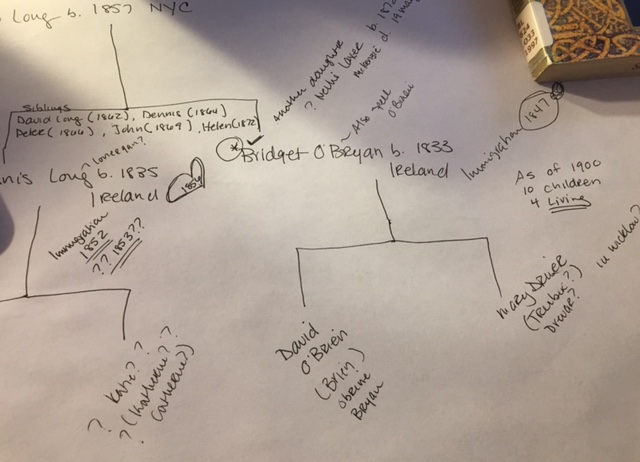
I’ve dug into working on genealogy and wow is it FUN!

familytree

Some projects that I’ve been doing with kids at our local school. Such fun! The circular weaving bird’s nest project came from this wonderful crafter. Check her out!


I hope the last few days of 2016, quite an ass-kicker of a year, prove to be gentle, filled with love and all that is precious to you.